-
Use Cases
-
Resources
-
Pricing
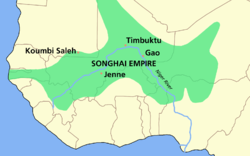
The Songhai Empire was a powerful West African state centered on the Niger River, with its capital at Gao. Flourishing from the 15th to 16th centuries under rulers like Sunni Ali and Askia Muhammad, it became one of the largest empires in African history, renowned for its wealth from trans-Saharan trade in gold and salt and its centers of Islamic learning such as Timbuktu. More Less
900
% complete
Before the 10th century, these early settlers were subjugated by more powerful, horse-riding Songhai speakers, who established control over the area.
Image source: Songhai Empire
1000
% complete
By the 10th century, the Songhai chiefs had established Gao as a small kingdom, taking control of the people living along the trade routes.
1100 - 1200
% complete
Inscriptions on a few of the tombstones in the cemetery indicate that this dynasty ruled in the late 11th and early 12th centuries and that its rulers were given the title of Malik or Malikah (Arabic for 'King' and 'Queen' respectively).
1250 - 1300
% complete
During the second half of the 13th century, Gao and the surrounding region had grown into an important trading center and attracted the interest of the expanding Mali Empire.
1290
% complete
Mali conquered Gao near the end of the 13th century, bringing the Songhai heartland under Malian command.
1300
% complete
Around 1300, Gao had become prosperous enough to attract the Mali Empire's attention due to its growing role in regional trade.
1353
% complete
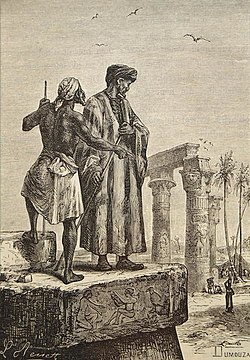
Ibn Battuta visited Gao in 1353 when the town was still a part of the Mali Empire, leaving an account of the region during his famous travels.
Image source: Ibn Battuta
1360
% complete
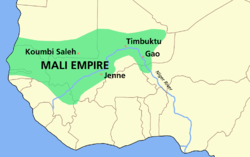
Following the death of Mansa Sulayman in 1360, disputes over who should succeed him weakened the Mali Empire, opening opportunities for Songhai's rise.
Image source: Mali Empire
1400
% complete
Gao remained under Malian command until the late 14th century, after which it broke free from Mali's control.
1464
% complete
Sonni Ali established Gao as the empire's capital, although a Songhai state had existed in and around Gao since the 11th century.
Image source: Government Accountability Office
1464 - 1492
% complete
After the death of Sulayman Dama, Sonni Ali reigned from 1464 to 1492, establishing Gao as the empire's capital and greatly expanding Songhai territory.
1466 - 1473
% complete
After a seven-year siege, he was able to starve them into surrender, incorporating Djenné into his empire in 1473.
1468 - 1593
% complete
Many Muslim accounts described Sonni Ali as a tyrant, including the Tarikh al-fattash, written by Songhai scholar Mahmud Kati (1468-1593).
Image source: Tarikh al-fattash
1468
% complete
He annexed Timbuktu in 1468 after the leaders of the town asked him to help overthrow the Tuaregs, who had taken the city following the decline of Mali.
Image source: Timbuktu
1475
% complete
Other important cities in the kingdom were Timbuktu and Djenné, where urban-centred trade flourished; they were conquered in 1468 and 1475, respectively.
Image source: Djenné
1492
% complete
Sonni Ali died in 1492 after nearly three decades of rule that transformed Songhai into the dominant power of the western Sahel.
1493 - 1591
% complete
Initially, the Songhai Empire was ruled by the Sonni dynasty (c. 1464–1493), but it was later replaced by the Askia dynasty (1493–1591).
Image source: Askia Muhammad I
1496 - 1497
% complete
Historians from Cairo said his pilgrimage consisted of 'an escort of 500 cavalry and 1000 infantry, and with him he carried 300,000 pieces of gold'.
1528
% complete
In 1528, Askia's children revolted against him, declaring his son Askia Musa king.
1531
% complete
Following Musa's overthrow in 1531, the Songhai Empire went into decline.
1549 - 1583
% complete
Emperor Askia Daoud ruled the Songhai Empire during a period of relative stability before his death triggered renewed turmoil.
1583
% complete
Following the death of Emperor Askia Daoud in 1583, a war of succession weakened the Songhai Empire and split it into two feuding factions.
1590
% complete
In 1590, Al-Mansur took advantage of the recent civil conflict in the empire and sent an army under the command of Judar Pasha to conquer the Songhai and gain control of the trans-Saharan trade routes.
1591
% complete
When Songhai forces under Askia Ishaq II (r. 1588–1591) met Judar at the 1591 Battle of Tondibi, Songhai forces, despite vastly superior numbers, were routed by a cattle stampede triggered by the Saadi's gunpowder weapons.
Image source: Battle of Tondibi
1591
% complete
The Songhai Empire collapsed after the defeat at the Battle of Tondibi in 1591, ending its dominance over the western Sahel.
1655
% complete
The Tarikh al-Sudan (History of Sudan), written in Arabic around 1655, provides an early history of the Songhai as handed down through oral tradition.
Image source: Tarikh al-Sudan
Or browse the full history timeline directory, with more than 2,000 topics.
This Songhai Empire timeline was generated with the help of AI, using information found on the internet.
We work hard to keep these timelines accurate, but mistakes do get through. If you spot one, email us at [email protected] and we'll fix it for future visitors.
Generate yours with AI or build it from scratch, for free.
Export your timeline, add your own events, edit or remove AI-generated events, and much more
No credit card required.
Cancel anytime.
Cancel anytime.
You can create an unlimited number of timelines with up to 10 events on each one, customize how they look, export them to PDF, PNG, PowerPoint, CSV, and Excel, and share them with a link. Paid plans raise the event limit and add features like spreadsheet imports and collaborators.
Yes. You can cancel your subscription from your account page at any time, and you will not be charged again. Your subscription stays active for the rest of the period you already paid for.
Yes. We will email you a reminder before the annual renewal, and we will also email you a receipt.
Yes. You can email us within 15 days of any payment, and we will issue you a full refund.
Check out our pricing docs or send us an email anytime: [email protected].