
-
Use Cases
-
Resources
-
Pricing
1598
Spanish colonists established settlements and religious schools in New Mexico, creating some of the earliest educational settings in what became the United States where Spanish and Indigenous languages were used alongside one another.
Image source: History of New Mexico
1624 - 1664
Dutch colonial New Netherland supported schools and civic life in a linguistically diverse setting. Dutch, English, Indigenous, African, and other languages circulated in the colony, illustrating the multilingual conditions of early North America.
Image source: New Netherland
1693 - 1917
German-speaking communities founded schools and maintained German-language instruction across colonial and later United States communities. These schools demonstrated that multilingual education was an established part of American educational life long before twentieth-century language debates.
1769 - 1846
Mission and community schools in Spanish and Mexican California operated primarily in Spanish, while Indigenous languages remained important to many students and communities. The transition to U.S. rule later brought stronger pressure for English-only schooling.
Feb 2, 1848
The treaty transferred large Mexican territories to the United States and promised protection for Mexican residents' civil and property rights. It did not create a national bilingual-education system, but it placed Spanish-speaking communities within U.S. institutions and shaped later language-rights conflicts.
Image source: Treaty of Guadalupe Hidalgo

1879
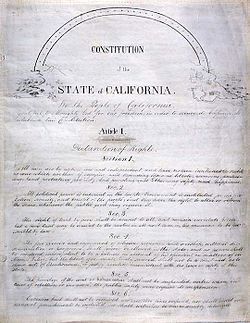
California adopted a constitutional provision requiring instruction in public schools to be conducted in English. The measure represented the growing assimilationist assumption that public education should replace heritage-language instruction with English.
Image source: Constitution of California
1923
The Supreme Court struck down a Nebraska law that severely restricted teaching modern foreign languages before the eighth grade. The decision recognized protected liberty interests for teachers and families and became an important constitutional limit on English-only restrictions.
Image source: Meyer v. Nebraska
1947
A federal court found that segregating Mexican American children into separate schools in Orange County, California, was unlawful. The case did not directly decide bilingual education, but it helped establish the civil-rights context in which Mexican American communities later sought equal language-access programs.
Image source: Mendez v. Westminster
Jun 15, 1982
The Supreme Court ruled that states could not deny undocumented children access to public elementary and secondary education. The decision ensured that immigrant English learners, regardless of legal status, remained entitled to public schooling and language-support services.
Image source: Plyler v. Doe
Nov 4, 1986
California voters approved a state constitutional amendment declaring English the official language. Although its direct educational effects were limited, it reflected the broader English-only movement that challenged bilingual instruction and influenced later ballot initiatives.
1987
The Seventh Circuit held that states and school districts could be liable under the Equal Educational Opportunities Act for failing to provide adequate services to English learners. The case emphasized that state-level policies could not excuse local failures.
Jun 2, 1998
California voters approved an initiative requiring most public-school instruction for English learners to be conducted in English through sheltered or structured immersion, generally limited to one year. It sharply curtailed traditional bilingual programs and inspired similar campaigns elsewhere.
Nov 7, 2000
Arizona voters approved an English-only education initiative modeled partly on California Proposition 227. It replaced most bilingual instruction with structured English immersion and required parents seeking alternatives to navigate a waiver process.
Nov 5, 2002
Colorado voters approved an English-only initiative requiring sheltered English immersion for English learners. The measure was later invalidated by courts after challenges argued that it conflicted with federal law and constitutional protections.
Jun 25, 2009
The Supreme Court held that Arizona officials could seek relief from an earlier injunction concerning English-learner funding and programs. The decision addressed how changed circumstances and improved educational policies affect continuing federal-court supervision.
Nov 8, 2016
California voters repealed most of Proposition 227's restrictions and authorized school districts to establish more bilingual and multilingual programs. The measure marked a major statewide shift from English-only policy toward local choice and expanded dual-language education.
Jul 2, 1964
Title VI prohibited discrimination based on race, color, or national origin in federally funded programs. Federal agencies later interpreted discrimination against students because of inadequate English access as a national-origin violation, providing a major legal foundation for bilingual education.
Image source: Civil Rights Act of 1964
Apr 11, 1965
The ESEA established broad federal involvement in public education and provided the statutory foundation from which the Bilingual Education Act emerged. Its Title I programs also became central sources of assistance for economically disadvantaged multilingual students.
1968 - 1974
Puerto Rican families and advocates challenged New York City's failure to provide adequate services for Spanish-speaking students. The resulting consent decree helped establish a citywide bilingual-education program and became a significant example of community-led language-rights litigation.
Jan 2, 1968
Title VII of the Elementary and Secondary Education Act created the first major federal aid program specifically for students with limited English proficiency. Sponsored by Senator Ralph Yarborough, the act funded experimental bilingual programs and marked a shift from assimilation toward compensatory support.
1973
The Supreme Court recognized that intentional segregation of Mexican American students could support a broader desegregation remedy in Denver. The case connected language, race, and educational segregation and influenced demands for equitable programs for Latino students.
1974
A federal court ruled that New Mexico's Portales school district had denied Spanish-speaking students equal educational opportunity by failing to provide adequate bilingual services. The decision reinforced Lau and required the district to develop a suitable program.
Image source: Vilma Socorro Martínez
1974
The 1974 reauthorization formally defined students of limited English proficiency and expanded federal support for bilingual programs. It also strengthened the program's civil-rights orientation and encouraged attention to students' cultural and linguistic backgrounds.
Jan 21, 1974
The Supreme Court held that providing identical English instruction to students who could not understand English was not equal educational opportunity under Title VI of the Civil Rights Act. The ruling required school districts to take affirmative steps to address English learners' language needs.
Aug 21, 1974
Congress declared that school districts must take appropriate action to overcome language barriers that impede students' participation in instructional programs. Section 1703(f) became a central federal statutory basis for enforcing services for English learners.
1975 - 1981
The Office for Civil Rights issued guidance known as the Lau Remedies, outlining acceptable approaches for identifying and serving students with limited English proficiency. The guidance encouraged bilingual-bicultural education where feasible, while also recognizing structured English immersion and other approaches.
1978
Congress revised Title VII to broaden program models, improve teacher preparation, and provide support for students from language-minority backgrounds. The changes reflected growing experience with transitional, developmental, and bilingual-bicultural programs.
1981
The Fifth Circuit established a three-part framework for evaluating programs for English learners: they must be based on sound educational theory, implemented with adequate resources, and shown to work in practice. The test remains influential in federal enforcement of language-access obligations.
Image source: Castañeda v. Pickard
Jun 23, 1981
The Fifth Circuit's decision supplied a practical legal standard for judging whether districts were meeting their obligations to English learners. It required educationally sound planning, faithful implementation, and evidence that the program actually helped students overcome language barriers.
Oct 20, 1994
The act reauthorized federal education programs and replaced Title VII's former emphasis on transitional bilingual education with broader initiatives supporting language instruction and academic achievement. It also promoted standards, accountability, and professional development for teachers of English learners.
Jan 8, 2002 - Dec 10, 2015
NCLB replaced Title VII with Title III, Language Instruction for Limited English Proficient and Immigrant Students. It expanded testing and accountability requirements for English learners and made annual progress in English acquisition a major federal objective.
Dec 10, 2015
ESSA replaced No Child Left Behind and retained Title III support for English learners while giving states more flexibility in accountability systems. It required states to establish goals for English-language proficiency and include English learners in academic accountability.
1990 - 2021
Two-way immersion and dual-language programs expanded across the United States, enrolling both English-dominant and language-minority students and teaching through two languages. Research and demand increasingly associated these programs with bilingualism, biliteracy, cross-cultural competence, and academic achievement.
2011
California launched the State Seal of Biliteracy, recognizing graduating students who demonstrated proficiency in English and another language. The initiative reframed multilingualism as an academic asset and spread to states and school districts nationwide.
Image source: Seal of Biliteracy
2014 - 2021
New York City increased its dual-language and bilingual program offerings in response to enrollment growth and advocacy from immigrant communities. The expansion illustrated a broader urban trend toward multilingual programs, while persistent shortages of qualified bilingual teachers remained a challenge.
Image source: New York City Department of Education
Mar 2020 - Jun 2021
School closures and remote learning disrupted language instruction, assessment, family communication, and access to technology for many English learners. Districts increasingly used federal recovery funds and hybrid strategies to address instructional and opportunity gaps.
Image source: Impact of the COVID-19 pandemic on education
Or browse the full history timeline directory, with more than 2,500 topics.
This History of Bilingual Education in the United States timeline was generated with the help of AI, using information found on the internet.
We work hard to keep these timelines accurate, but mistakes do get through. If you spot one, email us at [email protected] and we'll fix it for future visitors.
Generate yours with AI or build it from scratch, for free.
Export your timeline, add your own events, edit or remove AI-generated events, and much more
No credit card required.
Cancel anytime.
Cancel anytime.
You can create an unlimited number of timelines with up to 10 events on each one, customize how they look, export them to PDF, PNG, PowerPoint, CSV, and Excel, and share them with a link. Paid plans raise the event limit and add features like spreadsheet imports and collaborators.
Yes. You can cancel your subscription from your account page at any time, and you will not be charged again. Your subscription stays active for the rest of the period you already paid for.
Yes. We will email you a reminder before the annual renewal, and we will also email you a receipt.
Yes. You can email us within 15 days of any payment, and we will issue you a full refund.
Check out our pricing docs or send us an email anytime: [email protected].