-
Use Cases
-
Resources
-
Pricing
The Civil Rights Act of 1964 was a landmark piece of U.S. federal legislation signed into law by President Lyndon B. Johnson on July 2, 1964. It outlawed discrimination based on race, color, religion, sex, or national origin, ended segregation in public places, prohibited employment discrimination, and strengthened enforcement of voting rights. The Act was a cornerstone of the civil rights movement and reshaped American society. More Less
1883
% complete
In the landmark Civil Rights Cases, the United States Supreme Court ruled that Congress did not have the power to prohibit discrimination in the private sector, thus stripping the Civil Rights Act of 1875 of much of its ability to protect civil rights.
Image source: Civil Rights Cases
Jun 25, 1941
% complete
After the United States entered World War II, President Franklin Roosevelt issued Executive Order 8802, the first federal anti-discrimination order, and established the Fair Employment Practices Committee.
Image source: Executive Order 8802
1947 - 1948
% complete
President Harry Truman appointed the President's Committee on Civil Rights, proposed the 20th century's first comprehensive Civil Rights Act, and issued Executive Orders 9980 and 9981, providing for fair employment and desegregation throughout the federal government and the armed forces.
Image source: President's Committee on Civil Rights
May 17, 1954
% complete
The Supreme Court ruled school segregation unconstitutional in 1954 in Brown v. Board of Education, a pivotal decision that energized the civil rights movement and set the stage for further legislative action.
Sep 1957
% complete
The televised Little Rock Crisis, challenging the Brown v. Board of Education ruling that outlawed public school segregation, generated negative global attention that put major pressure on the executive branch to enact sweeping legislative reform. Global media continued to play a major influential role across both the Kennedy and Johnson administrations.
Image source: Little Rock Nine
Apr 1963 - May 1963
% complete
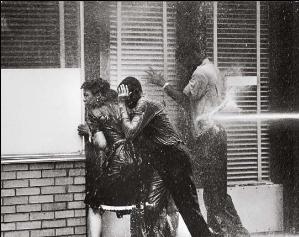
With elevated racial tensions and a wave of African-American protests in the spring of 1963, including the Birmingham campaign whose protestors were attacked on camera, Kennedy realized he had to act on civil rights. The televised attacks drew negative global attention and pressured the government toward reform.
Image source: Birmingham campaign
Jun 10, 1963
% complete
One year earlier than the Civil Rights Act of 1964, the same Congress had passed the Equal Pay Act of 1963, which prohibited wage differentials based on sex, setting a precedent for later gender-related provisions.
Image source: Equal Pay Act of 1963
Sep 9, 1957
% complete
The Civil Rights Act of 1957, signed by President Dwight D. Eisenhower on September 9, 1957, was the first federal civil rights legislation since the Civil Rights Act of 1875 to become law. It established the United States Commission on Civil Rights and the United States Department of Justice Civil Rights Division.
May 6, 1960
% complete
By 1960, black voting had increased by only 3%, despite black voter registration ranging from 0% to less than 5% in many majority-Black counties. Congress passed the Civil Rights Act of 1960, which eliminated certain loopholes left by the 1957 Act.
Nov 8, 1960
% complete
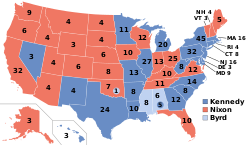
In winning the 1960 United States presidential election, John F. Kennedy took 70% of the African American vote, underscoring the political importance of civil rights issues.
Image source: 1960 United States presidential election
Jun 11, 1963
% complete
Kennedy first proposed the 1964 bill in his Report to the American People on Civil Rights on June 11, 1963. Emulating the Civil Rights Act of 1875, the bill included provisions to ban discrimination in public accommodations. That same day, Kennedy met with Republican leaders to discuss the legislation before his television address that evening.
Aug 28, 1963
% complete
After the March on Washington for Jobs and Freedom on August 28, 1963, the organizers visited President Kennedy at the White House to discuss the civil rights bill, adding momentum to its passage.
Image source: March on Washington for Jobs and Freedom
Oct 1963
% complete
Kennedy called the congressional leaders to the White House in late October 1963 to line up the necessary votes in the House for passage of the civil rights bill.
Nov 1963
% complete
The bill was reported out of the Judiciary Committee in November 1963 and referred to the Rules Committee, whose chairman, Howard W. Smith, held significant power over whether it would reach the floor.
Nov 22, 1963
% complete
Kennedy's assassination on November 22, 1963 changed the political situation. Afterward, President Lyndon B. Johnson announced his intention to carry forward the civil rights bill as a tribute to the slain president. By the time of the 1963 winter recess, 50 signatures were still needed.
Image source: Assassination of John F. Kennedy
1964
% complete
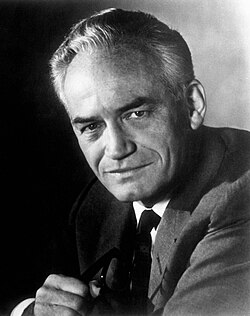
Though he opposed forced segregation, Republican 1964 presidential candidate Senator Barry Goldwater voted against the bill, remarking, "You can't legislate morality." He supported previous civil rights attempts in 1957 and 1960 and the 24th Amendment outlawing the poll tax, but opposed Title II as violating individual liberty and states' rights. Johnson went on to win the 1964 election by one of the biggest landslides in American history, and the South became a Republican stronghold by the 1990s.
Image source: Barry Goldwater
Feb 10, 1964
% complete
H.R. 7152 was brought to a floor vote in the chambers of the House of Representatives on February 10, 1964, where it was passed, moving the landmark legislation one step closer to becoming law.
Feb 26, 1964
% complete
Senate majority leader Mike Mansfield took a novel approach to prevent the Judiciary Committee from keeping the bill in limbo: after waiving a second reading following the first reading, he took the unprecedented step of giving the bill a second reading on February 26, 1964, thereby bypassing the Judiciary Committee and sending it to the Senate floor for immediate debate.
Image source: Mike Mansfield
Mar 30, 1964
% complete
When the bill came before the full Senate for debate on March 30, 1964, the "Southern Bloc" of 18 southern Democratic senators and lone Republican John Tower of Texas, led by Richard Russell (D-GA), launched a filibuster to prevent its passage.
Image source: Strom Thurmond filibuster of the Civil Rights Act of 1957
Jun 10, 1964
% complete
Senator Robert Byrd ended his filibuster in opposition to the bill on the morning of June 10, 1964, after speaking for 14 hours and 13 minutes. Never before in its entire history had the Senate been able to muster enough votes to defeat a filibuster on a civil rights bill.
Image source: Robert Byrd
Jun 19, 1964
% complete
The United States Senate passed the Civil Rights Act of 1964 on June 19, 1964, after a 72-day filibuster. The bill was then brought back to the House, which agreed to a subsequent Senate amendment.
Jul 2, 1964
% complete
After the House agreed to a subsequent Senate amendment, the Civil Rights Act of 1964 was signed into law by President Lyndon B. Johnson at the White House on July 2, 1964. The landmark law outlaws discrimination based on race, color, religion, sex, and national origin.
Dec 14, 1964
% complete
In Heart of Atlanta Motel v. United States (1964), the Supreme Court held that Congress drew its authority from the Constitution's Commerce Clause, rejecting Rolleston's claims that the act breached the Fourteenth Amendment and violated the Fifth and Thirteenth Amendments. The Court upheld the law's application to the private sector.
1965 - 1972
% complete
Between 1965 and 1972, Title VII lacked any strong enforcement provisions. In response, Congress passed the Equal Employment Opportunity Act of 1972, strengthening enforcement powers.
Jan 25, 1971
% complete
In Phillips v. Martin Marietta Corp., a 1971 Supreme Court case about the Act's gender provisions, the Court ruled that a company could not discriminate against a potential female employee because she had a preschool-age child unless it did the same with potential male employees.
Jan 21, 1974
% complete
In Lau v. Nichols (1974), the Supreme Court ruled that the San Francisco school district was violating non-English speaking students' rights under the 1964 act by placing them in regular classes rather than providing some sort of accommodation for them.
Mar 19, 1986
% complete
In Meritor Savings Bank v. Vinson (1986), the Supreme Court determined that sexual harassment is considered discrimination based on sex under Title VII of the Civil Rights Act of 1964.
May 1, 1989
% complete
Price Waterhouse v. Hopkins (1989) established that discrimination related to non-conformity of gender stereotypical behavior is unallowable under Title VII.
Mar 4, 1998
% complete
Oncale v. Sundowner Offshore Services (1998) further ruled that same-sex harassment is discrimination under Title VII of the Civil Rights Act of 1964.
2012
% complete
In 2012, the EEOC ruled that employment discrimination on the basis of gender identity or transgender status is prohibited under Title VII. In 2014, the EEOC initiated two lawsuits against private companies for gender identity discrimination, and in 2015 reissued a memo reaffirming that sexual orientation was protected under Title VII. On December 15, 2014, Attorney General Eric Holder aligned the DOJ with this position.
Image source: Equal Employment Opportunity Commission
Oct 2017
% complete
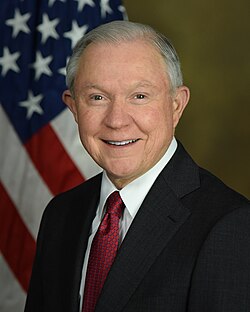
In October 2017, Attorney General Jeff Sessions withdrew the Holder memorandum that had interpreted Title VII's prohibition of sex discrimination as encompassing gender identity or transgender status.
Image source: Jeff Sessions
Jun 15, 2020
% complete
On June 15, 2020, in Bostock v. Clayton County (2020), alongside Altitude Express, Inc., the Supreme Court ruled that Title VII's prohibition of sex discrimination covers discrimination based on sexual orientation and gender identity.
Jul 26, 1990
% complete
The Americans with Disabilities Act of 1990 – called "the most important piece of federal legislation since the Civil Rights Act of 1964" – was influenced both by the structure and substance of the 1964 Act. Its Title III tracks Title II of the 1964 Act while expanding upon the list of public accommodations covered, extending nondiscrimination principles to people with disabilities.
Dec 11, 2019
% complete
The December 11, 2019 executive order on combating antisemitism stated that individuals facing discrimination based on race, color, or national origin do not lose protection under Title VI for also being members of groups sharing common religious practices. It directed agencies to enforce Title VI against discrimination rooted in antisemitism and consider the IHRA working definition of antisemitism, adopted May 26, 2016. This followed reinterpretation efforts by Kenneth Marcus during his time at the Office for Civil Rights (2004–2008) and complaints cited in a 2015 Palestine Legal report regarding Title VI.
Apr 2025
% complete
In April 2025, President Trump issued Executive Order 14281, which orders the Attorney General to initiate appropriate action to repeal or amend the implementing regulations for Title VI of the Civil Rights Act of 1964 for all agencies to the extent they contemplate disparate-impact liability.
Or browse the full history timeline directory, with more than 2,000 topics.
This Civil Rights Act of 1964 timeline was generated with the help of AI, using information found on the internet.
We work hard to keep these timelines accurate, but mistakes do get through. If you spot one, email us at [email protected] and we'll fix it for future visitors.
Generate yours with AI or build it from scratch, for free.
Export your timeline, add your own events, edit or remove AI-generated events, and much more
No credit card required.
Cancel anytime.
Cancel anytime.
You can create an unlimited number of timelines with up to 10 events on each one, customize how they look, export them to PDF, PNG, PowerPoint, CSV, and Excel, and share them with a link. Paid plans raise the event limit and add features like spreadsheet imports and collaborators.
Yes. You can cancel your subscription from your account page at any time, and you will not be charged again. Your subscription stays active for the rest of the period you already paid for.
Yes. We will email you a reminder before the annual renewal, and we will also email you a receipt.
Yes. You can email us within 15 days of any payment, and we will issue you a full refund.
Check out our pricing docs or send us an email anytime: [email protected].