-
Resources
-
Pricing
The Civilian Conservation Corps (CCC) was a New Deal program that employed young men in conservation and public works projects across the United States. More Less
Build a timeline like this one in minutes, for free. Start Yours →
1932
The CCC was started in early 1932 as a proposal to use unemployed men to improve existing reforestation areas.
Mar 21, 1933
Franklin D. Roosevelt asked Congress to establish a conservation work-relief program, submitting the legislation on March 21, 1933.
Mar 31, 1933
Congress passed the CCC legislation by voice vote on March 31, 1933, and Roosevelt signed it the same day.
Apr 5, 1933
Roosevelt issued Executive Order 6101, formally creating the CCC, appointing Robert Fechner as director, and assigning Army corps-area commanders to begin enrollment.
Image source: Civilian Conservation Corps
May 11, 1933
Following the second Bonus Army march on Washington, Roosevelt amended the program to provide CCC work opportunities for veterans.
Image source: Bonus Army
Jul 1, 1933
By July 1, 1933, the CCC had 1,463 working camps and 250,000 junior enrollees, along with veterans, Native Americans, and adults in the Local Experienced Men program.
Oct 1, 1933
Director Robert Fechner was directed to arrange the second period of CCC enrollment.
Jan 1934
By January 1934, approximately 300,000 men were enrolled in the CCC.
Jul 1934
The enrollment cap was increased by 50,000 to include men from Midwestern states affected by drought.
1935
Enrollment peaked at the end of 1935, when 500,000 men were serving in 2,600 camps operating in every state.
Image source: Civilian Conservation Corps
Apr 8, 1935 - Mar 31, 1937
Congress approved continued CCC funding through March 31, 1937, as part of the Emergency Relief Appropriation Act of 1935.
Image source: Emergency Relief Appropriation Act of 1935
Aug 31, 1935
Enrollment reached 505,782 people in about 2,900 camps by August 31, 1935, before declining the following year.
Apr 18, 1936
A Gallup poll found that 82 percent of respondents favored CCC camps, including 92 percent of Democrats and 67 percent of Republicans.
Jul 1, 1937
Public Law No. 163 extended CCC funding for three more years.
1933
About 3,800 of the Regular Army's officers and 4,600 enlisted men were assigned to administer the new CCC.
1933
Enrollees received $30 per month, with a compulsory $25 allotment sent to a family dependent, as well as housing, food, clothing, and medical care.
1933
Each camp operated under dual authority: military personnel supervised overall administration, while civilian technical staff directed fieldwork for the Interior or Agriculture departments.
Jul 1933
The War Department ordered Regular Army officers serving as instructors with ROTC and Organized Reserve units to return to their former duties.
Sep 1933
By the end of September 1933, Regular officers on CCC duty had fallen to about 2,000 while Reservists increased to approximately 2,200.
Oct 1934
By October 1934, Reserve officers had assumed command of almost all CCC companies and sub-districts.
Jul 1935
By July 1935, all CCC camps in the United States were segregated, reflecting prevailing state and federal racial policies.
Jun 28, 1937
The Civilian Conservation Corps was legally established and transferred from its original designation as the Emergency Conservation Work program.
Jan 1, 1938
The War Department limited the number of Regular officers assigned to CCC duty to 117.
1939
Congress ended the CCC's independent status and transferred it to the control of the Federal Security Agency.
Jul 1, 1939 - Sep 1939
Roosevelt directed that all Reservists be relieved from CCC duty because of benefit-equity requirements; the changeover was complete by September 1939, although many continued as civilian employees.
1933
About half of the male heads of households on Sioux reservations in South Dakota were employed by the CCC Indian Division during 1933.
1934
Congress passed the Indian Reorganization Act, ending allotments, helping preserve tribal lands, and encouraging tribes to re-establish self-government.
Image source: Indian Reorganization Act
Apr 1, 1935 - Mar 31, 1936
This period represented the greatest activity and amount of work accomplished by the CCC.
1937
Acting Regional Forester Clarence Strong estimated that CCC work reduced timber losses in the northern United States from more than one billion board feet before 1933 to about 80 million between 1933 and 1936.
1937
CCC forces contributed to disaster relief after floods in New York, Vermont, and the Ohio and Mississippi river valleys.
1937
The 1937 law required vocational and academic training for at least 10 hours per week.
1938
CCC personnel helped with response and cleanup after the 1938 hurricane in New England.
1941
Following the National Defense Vocational Training Act of 1941, CCC enrollees began participating in defense-oriented training.
1939
The CCC ideal shifted from the hardy manual worker toward the highly trained citizen soldier prepared for war.
1940
When the draft began, the policy was to make CCC alumni corporals and sergeants.
1940
By 1940, the CCC was no longer wholly a relief agency and was becoming a work-training system with increasingly young and inexperienced enrollees.
1940
Pride of the Bowery, the fourth film in the East Side Kid series, depicts friendship, trouble, and boxing at a CCC camp.
Image source: Pride of the Bowery
Jul 1940
With war underway abroad, the government directed an increasing number of CCC projects toward national-defense resources.
1941 - 1947
Some former CCC sites were reactivated as Civilian Public Service camps where conscientious objectors performed work of national importance instead of military service.
Image source: Civilian Public Service
Dec 1941
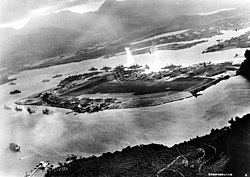
After the attack on Pearl Harbor, the Roosevelt administration directed all federal programs to emphasize the war effort.
Image source: Attack on Pearl Harbor
1942 - Apr 20, 1948
Appropriations for liquidating the CCC continued through April 20, 1948.
Jun 30, 1942
CCC operations were formally concluded at the end of the federal fiscal year on June 30, 1942, as wartime mobilization reduced the need for work relief.
Jul 2, 1942 - Jun 30, 1943
Congress provided funding for closing the remaining camps and reallocating their equipment; the process was virtually complete by June 30, 1943.
1959
The Student Conservation Association, founded in 1959, began offering conservation internships and summer trail-crew opportunities.
Image source: Student Conservation Association
1976
California Governor Jerry Brown established the California Conservation Corps.
Image source: California Conservation Corps
1985
The Corps Network began when the nation's first 24 corps directors organized to secure a federal advocate and share information about starting and managing conservation corps.
1991
The Montana Conservation Corps was established by Montana Human Resource Development Councils in Billings, Bozeman, and Kalispell.
Image source: Montana Conservation Corps
1995
Environmental Corps, now Texas Conservation Corps, was established as an American YouthWorks program for young people ages 17 to 28.
2004
Approximately 113 corps programs operated in 41 states and Washington, D.C., enrolling more than 23,000 young people during 2004.
2009
The American Experience PBS series portrayed life in the Civilian Conservation Corps in the first episode of its 22nd season.
Image source: American Experience
2012
Jeanette Ingold's young-adult novel Hitch tells the story of a teenager in the CCC.
2020
The Aina Corps performed environmental restoration work in Hawaii in 2020 with funding from the CARES Act.
Build a timeline like this one in minutes, for free. Start Yours →
Or browse the full history timeline directory, with more than 2,500 topics.
This Civilian Conservation Corps timeline was generated with the help of AI, using information found on the internet.
We work hard to keep these timelines accurate, but mistakes do get through. If you spot one, email us at [email protected] and we'll fix it for future visitors.
Generate yours with AI or build it from scratch, for free.
Export your timeline, add your own events, edit or remove AI-generated events, and much more
No credit card required.
15-day money-back guarantee.
You can create an unlimited number of timelines with up to 10 events on each one, customize how they look, export them to PDF, PNG, PowerPoint, CSV, and Excel, and share them with a link. Timelines made with Timeline Maker AI keep every event the generator created, and you can add up to 5 events of your own. Paid plans remove the event limit, add spreadsheet imports and hide Preceden's branding, and the higher-priced plan also adds collaborators, a custom logo and a custom domain.
Yes. You can cancel your subscription from your account page at any time, and you will not be charged again. Your subscription stays active for the rest of the period you already paid for.
Yes. We email you a reminder 15 days before your annual renewal, and we email you a receipt after every payment.
Yes. You can email us within 15 days of any payment, and we will issue you a full refund.
Check out our pricing docs or send us an email anytime: [email protected].