-
Use Cases
-
Resources
-
Pricing
The history of wildlife conservation traces humanity's evolving relationship with nature, from ancient hunting restrictions and the establishment of protected areas to international treaties, environmental movements, and modern efforts to preserve biodiversity in the face of habitat loss, climate change, and species extinction. More Less
1895
% complete
Founded in 1895 as the New York Zoölogical Society, the organization embraced a mandate to advance native wildlife conservation, promote the study of zoology, and create a first-class zoological park that would be free to the public.
Image source: Wildlife Conservation Society
Apr 26, 1895
% complete
The organization that would become the Wildlife Conservation Society was originally chartered by the government of the State of New York on April 26, 1895, laying the legal foundation for what would become a global conservation organization.
1896
% complete
In the late nineteenth century, William Temple Hornaday, then director of the New York Zoological Park (now the Bronx Zoo), carried out a direct-mail survey of wildlife conditions through the United States, documenting the state of the nation's fauna.
Image source: William Temple Hornaday
1897
% complete
Through the organization's annual reports, Hornaday publicized the alarming decline of birds and mammals across the United States, helping raise public awareness of the need for wildlife protection.
1897
% complete
In 1897, Hornaday hired field researcher Andrew J. Stone, expanding the society's capacity to gather firsthand information about wildlife populations and conditions in the field.
1906
% complete
Beginning in 1906, Hornaday featured Ota Benga, a member of the Mbuti people from the Congo, in a zoo exhibit at the Bronx Zoo, a deeply troubling episode now widely condemned as racist and exploitative.
Image source: Ota Benga
1918
% complete
Merriam, another eugenics supporter, partnered with conservationists in 1918 to form the Save-The-Redwoods-League, working to protect California's coast redwood forests from logging.
1992
% complete
After leading the Bronx Zoo for three decades, Conway became President of WCS in 1992, guiding the organization through a period of major institutional growth and global conservation expansion.
1993
% complete
Then known as the New York Zoölogical Society, the organization changed its name to the Wildlife Conservation Society in 1993, reflecting its evolution into a global conservation organization.
1901
% complete
In 1901, a small herd of American Bison were gathered in a 20-acre meadow just off what is now the Pelham Parkway roadway, an early effort to preserve the species from extinction.
Image source: American Bison Society
1905
% complete
Starting in 1905, Hornaday led a national campaign to reintroduce the almost extinct bison to government-sponsored refuges, one of the earliest large-scale wildlife restoration efforts in American history.
1905
% complete
Hornaday, Theodore Roosevelt and others formed the American Bison Society in 1905 to coordinate efforts to save the bison from extinction and restore it to the American landscape.
1907
% complete
The Bronx Zoo sent 15 bison to Wichita Reserve in 1907, a landmark translocation that helped reestablish wild bison herds on government lands in Oklahoma.
Image source: Wichita Mountains Wildlife Refuge
1908
% complete
Following the initial shipment to Wichita Reserve, the Bronx Zoo sent additional bison in later years, continuing its pioneering role in restoring the species to western refuges.
1908 - 1911
% complete
William Beebe's research on wild pheasants took him to Asia from 1908 to 1911, producing extensive field observations of pheasant species across the continent.
Image source: William Beebe
1918 - 1922
% complete
The results of Beebe's Asian expeditions were published as a series of books on the birds, establishing his reputation as a leading ornithologist and documenting little-studied pheasant species.
1922 - 1948
% complete
Beebe's field work resulted in the creation of the Society's Department of Tropical Research, which Beebe directed from 1922 until his retirement in 1948, advancing tropical ecology worldwide.
1930 - 1934
% complete
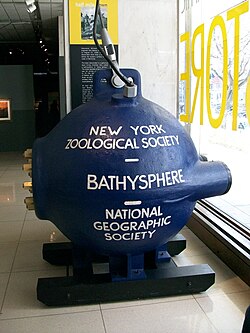
From 1930 to 1934, off the coast of Bermuda, Beebe conducted groundbreaking deep-sea research in an undersea vessel called the bathysphere, observing ocean life at unprecedented depths.
Image source: Bathysphere
1959
% complete
In 1959, WCS sponsored George Schaller's seminal study of mountain gorillas in Congo, foundational research that transformed scientific understanding of great apes and their conservation needs.
Image source: George Schaller
1941
% complete
Beginning with the African Plains exhibit in 1941, animals were grouped by continents and ecosystems, rather than genetic orders and families, revolutionizing how zoos presented wildlife.
Image source: Bronx Zoo
1946
% complete
In 1946, WCS helped found the Jackson Hole Wildlife Park in Wyoming, creating an important site for wildlife display and education in the Greater Yellowstone region.
Image source: Grand Teton National Park
1962
% complete
The Jackson Hole Wildlife Park, which WCS had helped found in 1946, became part of Grand Teton National Park in 1962, integrating its mission into the national park system.
1962
% complete
William G. Conway became director of the Bronx Zoo in 1962, ushering in decades of innovation in zoo design, animal care, and conservation leadership.
1969
% complete
Under Conway, the Bronx Zoo opened its World of Darkness for nocturnal species in 1969, a pioneering exhibit allowing visitors to observe active night animals in reversed lighting conditions.
1974
% complete
The Bronx Zoo opened its World of Birds in 1974, offering immersive avian displays that showcased bird diversity and behavior in naturalistic settings.
1988
% complete
The redesigned Central Park Zoo opened in 1988 under WCS management, transforming the historic urban zoo into a modern facility focused on naturalistic habitats.
Image source: Central Park Zoo
1992
% complete
The Queens Zoo opened in 1992 following WCS redesign efforts, adding another wildlife park to the society's growing network of New York City zoos.
Image source: Queens Zoo
1993
% complete
The Prospect Park Zoo reopened in 1993 after WCS-led renovations, completing the expansion of the society's network of city wildlife parks alongside the Central Park and Queens zoos.
Image source: Prospect Park Zoo
1994 - 1996
% complete
From 1994 through 1996, Archie Carr III of WCS helped establish the Cockscomb Basin Wildlife Sanctuary in Belize, a reserve dedicated to protecting endangered jaguars.
Image source: Cockscomb Basin Wildlife Sanctuary
2001
% complete
In 2001, in collaboration with the Madagascar Ministry of Environment and Forests, WCS launched a program to create the 372,470 hectare Makira Forest Protected Area, safeguarding Madagascar's rainforests and unique biodiversity.
Image source: Makira Natural Park
2009
% complete
The Manhatta Project is an initiative exploring the historical ecology of the New York area in 1609, prior to colonization, reconstructing the island's original ecosystems to inform urban conservation.
2017
% complete
In 2017, WCS partnered with carbon-reduction platform Cool Effect to allow users to fund ongoing carbon-reduction projects directly supporting the Makira Natural Park in Madagascar.
Jul 2020
% complete
In July 2020, the Wildlife Conservation Society apologized for its past racist actions, including the 1906 exhibition of Ota Benga, committing to confront and learn from this painful chapter of its history.
Or browse the full history timeline directory, with more than 2,000 topics.
This History of Wildlife Conservation timeline was generated with the help of AI, using information found on the internet.
We work hard to keep these timelines accurate, but mistakes do get through. If you spot one, email us at [email protected] and we'll fix it for future visitors.
Generate yours with AI or build it from scratch, for free.
Export your timeline, add your own events, edit or remove AI-generated events, and much more
No credit card required.
Cancel anytime.
Cancel anytime.
You can create an unlimited number of timelines with up to 10 events on each one, customize how they look, export them to PDF, PNG, PowerPoint, CSV, and Excel, and share them with a link. Paid plans raise the event limit and add features like spreadsheet imports and collaborators.
Yes. You can cancel your subscription from your account page at any time, and you will not be charged again. Your subscription stays active for the rest of the period you already paid for.
Yes. We will email you a reminder before the annual renewal, and we will also email you a receipt.
Yes. You can email us within 15 days of any payment, and we will issue you a full refund.
Check out our pricing docs or send us an email anytime: [email protected].