
-
Resources
-
Pricing
The Crédit Mobilier Scandal was a major American political scandal of the 1870s involving railroad construction contracts, bribery, and members of Congress. More Less
Build a timeline like this one in minutes, for free. Start Yours →
1864
The scandal's origins dated to 1864, when Congress chartered the Union Pacific Railroad to participate in constructing the eastern portion of the first transcontinental railroad.
1864
The associated construction corporation, Crédit Mobilier of America, was established in 1864 as part of the arrangement surrounding Union Pacific railroad construction.
Image source: Crédit Mobilier scandal
1864
In 1864, George Francis Train helped form Crédit Mobilier of America.
Image source: George Francis Train
1864
Thomas C. Durant, vice president of the Union Pacific Railroad, joined George Francis Train in forming Crédit Mobilier of America in 1864.
Image source: Thomas C. Durant
1864 - 1867
From 1864 to 1867, the Union Pacific and Crédit Mobilier arrangement operated during construction of the eastern portion of the first transcontinental railroad.
Image source: Union Pacific Railroad
1864
The Pacific Railroad Acts of 1864–68 authorized and chartered the Union Pacific Railroad and supported construction of a transcontinental line.
1864 - 1868
Through the Pacific Railroad Acts, Congress provided $100 million in capital investment, approximately $2.2 billion in 2025 terms, to complete the transcontinental line.
1864 - 1868
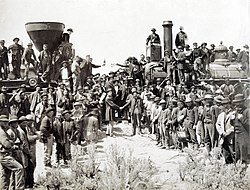
The authorized Union Pacific line was to run west from the Missouri River toward the Pacific coast as part of the first transcontinental railroad.
Image source: First transcontinental railroad
1864 - 1867
The Crédit Mobilier arrangement concerned construction of the eastern portion of the first transcontinental railroad, extending from the Missouri River toward Utah Territory.
1864 - 1867
The Crédit Mobilier scandal was a two-part fraud conducted from 1864 to 1867 by the Union Pacific Railroad and Crédit Mobilier of America during railroad construction.
1864 - 1867
The arrangement between the Union Pacific and Crédit Mobilier generated large profits for the construction company while the railroad was being built.
1864 - 1867
The arrangement generated $43,929,328 in profits for Crédit Mobilier, equivalent to more than $1.1 billion in 2025.
1865
The Pacific Railroad Acts remained part of the congressional framework for authorizing and financing the transcontinental railroad during 1865.
1866
Congressional railroad legislation continued in 1866 as part of the Pacific Railroad Acts of 1864–68.
1867
By 1867, the two-part fraud associated with Union Pacific and Crédit Mobilier had been conducted during construction of the railroad's eastern portion.
1867
Oakes Ames, a member of the House of Representatives from Massachusetts, replaced Thomas Durant at Crédit Mobilier in 1867.
Image source: Oakes Ames
1867
In 1867, Crédit Mobilier replaced Thomas Durant with Oakes Ames.
1868
The period covered by the Pacific Railroad Acts of 1864–68 concluded in 1868.
Image source: Pacific Railroad Acts
1870
Wilson's wife had died in 1870, leaving senators to rely on Wilson's account and Ames's corroboration during the later investigation.
Image source: Henry Wilson
1872
James Garfield denied any wrongdoing in connection with the Crédit Mobilier scandal.
1873
Although the Senate took no action against Wilson, his reputation for integrity was somewhat damaged because of his initial denial.
Feb 1873
The Senate accepted Wilson's explanation and took no action against him.
Feb 1873
Because Wilson's wife had died in 1870, senators relied on Wilson's word and on Oakes Ames's corroborating account.
Feb 1873
Senators considered Wilson's complicated explanation during the February 1873 investigation.
Feb 1873
Wilson claimed that he had paid for stock in his wife's name and with her money, while maintaining that he had never taken possession of the shares.
Feb 1873
During the February 1873 Senate investigation, Henry Wilson admitted involvement after initially denying it.
Feb 1873
The Senate investigated the Crédit Mobilier allegations in February 1873.
1880
Garfield went on to be elected president in 1880 despite the controversy.
Image source: James A. Garfield
1872
The story was broken by The New York Sun during the 1872 campaign of Ulysses S. Grant.
1872
The newspaper disclosure occurred during Ulysses S. Grant's 1872 campaign.
Image source: Ulysses S. Grant
1872
In 1872, the House of Representatives submitted the names of nine politicians to the Senate for investigation.
1872
The Senate received the names of nine politicians for investigation following the exposure of the scandal in 1872.
1872
During the 1872 campaign, Henry Wilson, Grant's running mate, initially denied involvement in the Crédit Mobilier matter.
Sep 4, 1872
On September 4, 1872, The New York Sun broke the Crédit Mobilier story.
Build a timeline like this one in minutes, for free. Start Yours →
Or browse the full history timeline directory, with more than 2,500 topics.
This Crédit Mobilier Scandal timeline was generated with the help of AI, using information found on the internet.
We work hard to keep these timelines accurate, but mistakes do get through. If you spot one, email us at [email protected] and we'll fix it for future visitors.
Generate yours with AI or build it from scratch, for free.
Export your timeline, add your own events, edit or remove AI-generated events, and much more
No credit card required.
15-day money-back guarantee.
You can create an unlimited number of timelines with up to 10 events on each one, customize how they look, export them to PDF, PNG, PowerPoint, CSV, and Excel, and share them with a link. Timelines made with Timeline Maker AI keep every event the generator created, and you can add up to 5 events of your own. Paid plans remove the event limit, add spreadsheet imports and hide Preceden's branding, and the higher-priced plan also adds collaborators, a custom logo and a custom domain.
Yes. You can cancel your subscription from your account page at any time, and you will not be charged again. Your subscription stays active for the rest of the period you already paid for.
Yes. We email you a reminder 15 days before your annual renewal, and we email you a receipt after every payment.
Yes. You can email us within 15 days of any payment, and we will issue you a full refund.
Check out our pricing docs or send us an email anytime: [email protected].