
-
Use Cases
-
Resources
-
Pricing
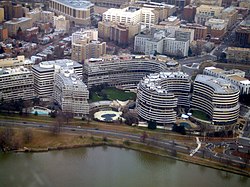
The Watergate Scandal was a major American political scandal in the early 1970s, triggered by a break-in at the Democratic National Committee headquarters at the Watergate office complex. President Richard Nixon's administration's attempted cover-up led to investigations, revelations of abuse of power, and ultimately Nixon's resignation—the first in U.S. presidential history. More Less
Nov 5, 1968
% complete
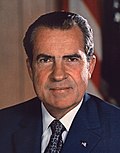
Richard Nixon was elected the 37th president of the United States in 1968, defeating Hubert Humphrey amid a turbulent year marked by the Vietnam War and domestic unrest.
Image source: 1968 United States presidential election
May 1969
% complete
When The New York Times exposed the bombing of Cambodia in May 1969, Nixon ordered the wiretapping of reporters and suspected leakers, reflecting his growing obsession with secrecy and leaks.
Image source: Watergate scandal
1971
% complete
In 1971, FBI director J. Edgar Hoover made Mark Felt deputy associate director and his apparent successor. Felt was later spurned after Hoover's death when Nixon selected L. Patrick Gray instead—a slight that motivated Felt's secret assistance to reporters as 'Deep Throat'.
Image source: Mark Felt
Feb 16, 1971 - Jul 12, 1973
% complete
By 1971, Nixon worried that his presidency would not be sufficiently preserved for posterity and had the Secret Service install microphones in his desk and throughout the Oval Office. From February 16, 1971 to July 12, 1973, the system recorded 3,432 hours of conversation—tapes that would later prove central to his downfall.
Image source: Nixon White House tapes
Jun 1971
% complete
In June 1971, The New York Times began publishing the Pentagon Papers: a leaked 7,000-page study of U.S. involvement in Vietnam, commissioned in 1967. The leak intensified Nixon's paranoia about leaks and enemies within the government.
Image source: Pentagon Papers
Jun 1971
% complete
Nixon fixated on files at the Brookings Institution concerning the Chennault Affair, which implicated him in the sabotage of 1968 Vietnam peace talks, and urged aides to 'get in and get those files—blow the safe and get it'.
Dec 1971
% complete
In December 1971, G. Gordon Liddy became general counsel for the Committee for the Re-Election of the President (CRP)—the fundraising arm of Nixon's re-election campaign—introduced by deputy campaign manager Jeb Stuart Magruder as 'our man in charge of dirty tricks'.
Image source: G. Gordon Liddy
Jan 1972
% complete
As Nixon prepared for his 1972 re-election campaign, aide Jack Caulfield proposed Operation Sandwedge: a private-sector intelligence operation against the Democrats, part of a broader culture of political espionage surrounding the campaign.
1972
% complete
CRP officials drafted outlandish schemes including Operation Diamond (kidnapping and drugging protesters at the 1972 Republican National Convention), Operation Emerald (a spy airliner to trail the Democratic nominee), Operation Turquoise (Cuban commandos sabotaging air-conditioning at the Democrats' Miami convention), and Operation Sapphire (a boat with sex workers to entrap Democrats).
May 1972
% complete
Following Hoover's May 1972 death, Colson asked the CRP to send counterprotestors to a protest at Hoover's state funeral in the Capitol rotunda. Nixon then selected L. Patrick Gray as acting FBI director, spurning Mark Felt.
Image source: J. Edgar Hoover
1972
% complete
Washington Post reporter Bob Woodward first met Mark Felt in 1970, and Felt became a key anonymous source on the scandal. No one else at the Post knew his identity; editor Howard Simons dubbed him 'Deep Throat', referencing both his deep background status and the 1972 pornographic film of the same name.
Aug 1972
% complete
In August 1972, the Government Accountability Office released an audit of Nixon's re-election campaign, referring $350,000 in questionable transactions to the Department of Justice for prosecution—an early sign of financial irregularities tied to the break-in.
1973
% complete
Tipped off by Dean, Senator Lowell Weicker and investigators uncovered likely tax fraud: Nixon had claimed deductions for an illegally backdated document donation to the National Archives—a loophole outlawed in 1969 after President Johnson exploited it.
Feb 7, 1973
% complete
On February 7, 1973, the Senate voted 77–0 to establish a select committee to investigate Watergate, naming Senator Sam Ervin of North Carolina as chairman. The televised hearings that followed exposed the scandal to the American public.
Image source: United States Senate Watergate Committee
Oct 30, 1973
% complete
On October 30, 1973, White House lawyer Fred Buzhardt informed Judge Sirica that two of the nine subpoenaed tapes—a June 20, 1972 Nixon-Mitchell call and an April 15, 1973 Nixon–Dean meeting—were 'missing', fueling suspicions of a cover-up.
Nov 21, 1973
% complete
On November 21, 1973, Buzhardt told special prosecutor Archibald Cox's successor Leon Jaworski that an 18-minute, 15-second segment was missing from a June 20, 1972 tape: a Nixon-Haldeman conversation thought to be Nixon's first discussion of Watergate after the break-in.
Image source: Nixon White House tapes
Jan 1974
% complete
In January 1974, an expert panel appointed by Judge Sirica concluded that the erased segment had been wiped in five to nine separate passes using the recorder's hand keys—not the foot pedal—suggesting deliberate erasure rather than accident.
Jan 1974
% complete
In January 1974, according to Colson, Nixon nearly removed CIA director William Colby over suspicions of CIA complicity in Watergate; that June, Senator Howard Baker released an inconclusive report on the matter. Helms deemed related notes 'incoherent', and Senate investigators suspected they referred to the then-secret CIA assassination attempts on Castro.
Apr 1974
% complete
In April 1974, Archibald Cox's replacement Leon Jaworski reissued the subpoena for the White House tapes, but Nixon provided only redacted transcripts, refusing to hand over the actual recordings.
Image source: Leon Jaworski
Jul 27, 1974
% complete
On July 27, 1974, the House Judiciary Committee voted 27-to-11 to recommend the first article of impeachment: obstruction of justice, marking the formal beginning of the end for Nixon's presidency.
Image source: Impeachment process against Richard Nixon
May 1972
% complete
Howard Hunt, who had helped arrange the 1954 Guatemalan coup d'état and the failed 1961 Bay of Pigs Invasion, joined Liddy in a burglary of journalist Hank Greenspun's Las Vegas office seeking Howard Hughes-related files. Although the burglary was reportedly abandoned after Hughes would not provide a getaway plane, evidence of forced entry was found, and Ehrlichman later told Nixon that Hunt and Liddy 'flew out [to Las Vegas], broke his safe, got something out'.
Jun 17, 1972
% complete
On June 17, 1972, operatives associated with Nixon's 1972 re-election campaign were caught burglarizing and planting listening devices in the Democratic National Committee headquarters at Washington, D.C.'s Watergate complex—the event that launched the scandal.
Nov 7, 1972
% complete
The cover-up initially worked, helping Nixon win a landslide re-election over George McGovern in November 1972, before revelations from the burglars' trial led to a Senate investigation.
Image source: 1972 United States presidential election
Dec 1972
% complete
Dean personally destroyed two of Howard Hunt's notebooks and an address book, and acting FBI director L. Patrick Gray burned the surrendered files around Christmas 1972, destroying key evidence of the administration's involvement.
Jan 6, 1973
% complete
On January 6, 1973, John Dean promised G. Gordon Liddy $30,000 annually, legal fees, and a 1975 pardon if he stayed silent; as early as January 8, Nixon discussed 'Goddamn hush money' with Charles Colson, deepening the obstruction of justice.
1974 - 1978
% complete
Concerns emerging from the burglaries and wiretappings resulted in the Privacy Act of 1974 and the Foreign Intelligence Surveillance Act, which limited the ability of federal agencies to collect, maintain, and share information on Americans.
Image source: Foreign Intelligence Surveillance Act
1974 - 2008
% complete
The paranoia of the 'Watergate era' inspired a subgenre of 1970s conspiracy thrillers such as The Conversation (1974), Three Days of the Condor (1975), and Washington: Behind Closed Doors (1977). Woodward and Bernstein's 1974 book All the President's Men was adapted into a 1976 film by Alan J. Pakula; other depictions include Oliver Stone's Nixon (1996) and Frost/Nixon (2008), adapted from a Tony-winning play.
Image source: All the President's Men (film)
Aug 7, 1974
% complete
On August 7, 1974, House minority leader John Rhodes, Senate minority leader Hugh Scott, and Senator Barry Goldwater—a respected Republican statesman—visited Nixon in the Oval Office and, although not explicitly urging resignation, informed him that he did not have enough support in Congress to survive impeachment.
Aug 9, 1974
% complete
Facing impeachment, on August 9, 1974, Nixon became the first U.S. president to resign from office, ending more than two years of crisis triggered by the Watergate break-in and cover-up.
Image source: Presidency of Richard Nixon
Nov 1974
% complete
The scandal tarnished Nixon's legacy and brought heavy Republican losses in the November 1974 midterm elections. New Democratic legislators known as 'Watergate Babies' swept into Congress and drove major governmental reforms.
Image source: Watergate Babies
Jun 1975
% complete
In June 1975, Nixon gave secret testimony to a federal grand jury, one of the few times a former president has testified before a grand jury, addressing questions arising from the Watergate investigations.
Nov 2, 1976
% complete
President Ford's pardon of Nixon effectively caused his loss to Jimmy Carter in the 1976 election; seven percent of voters decided against Ford explicitly due to the pardon, demonstrating the lasting electoral ramifications of Watergate.
Image source: Pardon of Richard Nixon
1977
% complete
In 1977, Nixon—financially distressed and hoping to improve his legacy—accepted $600,000 for a series of interviews with British journalist David Frost, which drew massive audiences and became iconic television moments.
Image source: David Frost's interviews with Richard Nixon
1978
% complete
In 1978, former FBI directors L. Patrick Gray and Mark Felt and FBI Domestic Intelligence head Edward Miller were indicted for their approval of 'surreptitious entries'. Nixon voluntarily testified in their defense in 1980, his only appearance in any Watergate-related trial.
Or browse the full history timeline directory, with more than 2,000 topics.
This Watergate Scandal timeline was generated with the help of AI, using information found on the internet.
We work hard to keep these timelines accurate, but mistakes do get through. If you spot one, email us at [email protected] and we'll fix it for future visitors.
Generate yours with AI or build it from scratch, for free.
Export your timeline, add your own events, edit or remove AI-generated events, and much more
No credit card required.
Cancel anytime.
Cancel anytime.
You can create an unlimited number of timelines with up to 10 events on each one, customize how they look, export them to PDF, PNG, PowerPoint, CSV, and Excel, and share them with a link. Paid plans raise the event limit and add features like spreadsheet imports and collaborators.
Yes. You can cancel your subscription from your account page at any time, and you will not be charged again. Your subscription stays active for the rest of the period you already paid for.
Yes. We will email you a reminder before the annual renewal, and we will also email you a receipt.
Yes. You can email us within 15 days of any payment, and we will issue you a full refund.
Check out our pricing docs or send us an email anytime: [email protected].