-
Use Cases
-
Resources
-
Pricing
The Anti-War Movement encompasses organized social and political activism opposing military conflicts, most notably during the Vietnam War era. It involved mass protests, draft resistance, teach-ins, and cultural expression, significantly influencing public opinion and government policy while inspiring later peace movements worldwide. More Less
Feb 27, 1783
% complete
During the American Revolutionary War, substantial opposition to British war intervention in America led the British House of Commons to vote against further war in America, paving the way for the Second Rockingham ministry and the Peace of Paris.
Image source: Anti-war movement
1815 - 1861
% complete
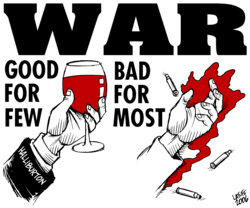
Substantial antiwar sentiment developed in the United States roughly between the end of the War of 1812 and the commencement of the Civil War, in what is called the Antebellum era.
1795
% complete
Immanuel Kant published his booklet 'Perpetual Peace' (Zum ewigen Frieden) in 1795, a foundational philosophical work arguing for lasting peace among states and laying intellectual groundwork for later anti-war thought.
Image source: Perpetual Peace: A Philosophical Sketch
1950
% complete
In 1950 Bertrand Russell was awarded the Nobel Prize in Literature 'in recognition of his varied and significant writings in which he champions humanitarian ideals and freedom of thought'.
Image source: Bertrand Russell
Jul 9, 1955
% complete
Albert Einstein, Bertrand Russell and eight other leading scientists and intellectuals signed the Russell-Einstein Manifesto issued on 9 July 1955, calling for an end to nuclear weapons.
Image source: Russell–Einstein Manifesto
Jul 15, 1955
% complete
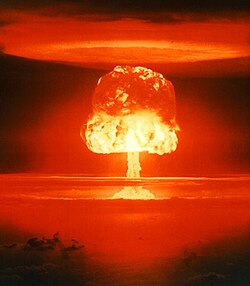
The Mainau Declaration of 15 July 1955 was signed by 52 Nobel Prize laureates, warning against the dangers of nuclear weapons.
Image source: Mainau Declaration
1974 - 1976
% complete
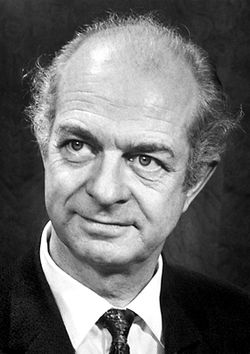
The Dubrovnik-Philadelphia Statement of 1974/1976 was signed by Linus Pauling and others, continuing the tradition of scientist-led appeals against war.
Image source: Linus Pauling
1796
% complete
English poet Robert Southey's 1796 poem After Blenheim is an early modern example of anti-war literature, written generations after the Battle of Blenheim but while Britain was again at war against France.
Image source: After Blenheim
1924
% complete
In 1924, Ernst Friedrich published Krieg dem Krieg! (War Against War!), an album of photographs drawn from German military and medical archives from the First World War.
Image source: Ernst Zermelo
1937
% complete
Pablo Picasso's 1937 painting Guernica used abstraction, rather than realism, to generate an emotional response to the loss of life from the Condor Legion and Aviazione Legionaria's bombing of Guernica during the Spanish Civil War.
Image source: Guernica (Picasso)
1950 - 1999
% complete
The second half of the 20th century witnessed a strong anti-war presence in other art forms, including anti-war music such as 'Eve of Destruction', 'And the Band Played Waltzing Matilda' and 'One Tin Soldier', and films such as MAS*H and Die Brücke, opposing the Cold War in general or specific conflicts such as the Vietnam War.
1969
% complete
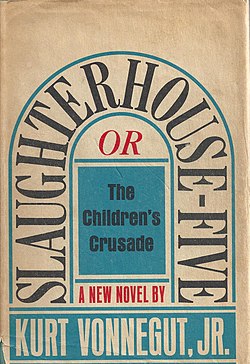
The American author Kurt Vonnegut used science fiction themes in his 1969 novel Slaughterhouse-Five, depicting the bombing of Dresden in World War II, which Vonnegut witnessed as a prisoner of war.
Image source: Slaughterhouse-Five
Jun 25, 2004
% complete
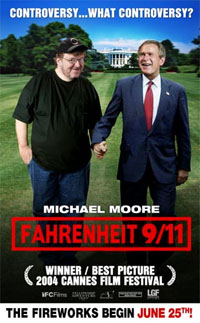
The war in Iraq generated significant artistic anti-war works, including American filmmaker Michael Moore's Fahrenheit 9/11, which holds the box-office record for documentary films.
Image source: Fahrenheit 9/11
May 2, 2006
% complete
Canadian musician Neil Young released his 2006 album Living with War, a significant artistic anti-war work responding to the war in Iraq.
Image source: Living with War
1914
% complete
In Britain in 1914, the Public Schools Officers' Training Corps annual camp was held at Tidworth Camp, near Salisbury Plain, on the eve of World War I.
1917 - 1918
% complete
The Espionage Act of 1917 and the Sedition Act of 1918 gave the American authorities the right to close newspapers and jail individuals for having anti-war views.
Image source: Espionage Act of 1917
Jun 16, 1918
% complete
On 16 June 1918, American socialist Eugene V. Debs made an anti-war speech and was arrested under the Espionage Act of 1917.
Image source: Eugene V. Debs
Dec 25, 1921
% complete
President Warren G. Harding commuted Eugene V. Debs's sentence on 25 December 1921, freeing the imprisoned socialist leader who had been jailed for his anti-war speech.
1964
% complete
Opposition to US involvement in the Vietnam War began slowly and in small numbers in 1964 on various college campuses in the United States, and grew quickly as the war grew deadlier.
Image source: Opposition to United States involvement in the Vietnam War
1967 - 1972
% complete
In 1967 a coalition of anti-war activists formed the National Mobilization Committee to End the War in Vietnam, which organized several large anti-war demonstrations between the late 1960s and 1972.
Image source: National Mobilization Committee to End the War in Vietnam
2001
% complete
There was initially little opposition to the 2001 Afghanistan War in the United States and the United Kingdom, which was seen as a response to the 11 September 2001 terrorist attacks and was supported by most of the American public.
Image source: War in Afghanistan (2001–2021)
2002 - Mar 20, 2003
% complete
The anti-war position gained renewed support and attention in the buildup to the 2003 invasion of Iraq by the U.S., with large demonstrations held around the world.
Image source: Protests against the Iraq War
Mar 10, 2003
% complete
The American country music band Dixie Chicks' opposition to the war caused many radio stations to stop playing their records, but they were supported by the equally anti-war country star Merle Haggard, who in the summer of 2003 released a song critical of US media coverage of the Iraq War.
Image source: The Chicks
Apr 2004
% complete
Opposition to the conflict, how it had been fought, and complications during the aftermath period divided public sentiment in the U.S., resulting in majority public opinion turning against the war for the first time in the spring of 2004, a turn which has held since.
Image source: Iraq War
Aug 25, 2008 - Sep 4, 2008
% complete
Anti-war groups protested during both the Democratic National Convention and the 2008 Republican National Convention protests held in Saint Paul, Minnesota, in September 2008.
Image source: 2008 Republican National Convention
2014
% complete
A series of demonstrations were held opposing the Russian military intervention in Ukraine that took place in Russia in 2014.
Image source: 2014 anti-war protests in Russia
Mar 2, 2014 - Mar 15, 2014
% complete
Protesters held two anti-war protest rallies on 2 and 15 March 2014, which were the largest in Russia since the 2011–2013 Russian protests against alleged electoral fraud by United Russia during the 2011 legislative election.
May 2021 - May 21, 2021
% complete
In May 2021, protests broke out following a flare-up of the Israel–Palestine conflict, which lasted from 6 May until 21 May when a ceasefire was signed.
Image source: 2021 Israel–Palestine crisis
Jan 2022
% complete
Beginning in 2022, the anti-war movement was renewed following tensions between Russia and Ukraine.
Image source: Anti-war protests in Russia (2022–present)
Feb 24, 2022
% complete
Protests escalated in Russia on 24 February 2022, after Russia invaded Ukraine.
Dec 2022
% complete
As of December 2022, more than 4,000 people, including Russian opposition politicians and journalists, had been prosecuted under Russia's 'fake news' laws for criticizing the war in Ukraine.
Image source: Russian 2022 war censorship laws
Jan 3, 2026
% complete
Following the capture of Nicolás Maduro on January 3, 2026 by US forces, there were small protests in Los Angeles and Las Vegas.
Feb 28, 2026
% complete
After the assassination of Ali Khamenei on 28 February 2026 by U.S. and Israeli forces, and the outbreak of the 2026 Iran War, anti-war protests emerged in several countries around the world.
Or browse the full history timeline directory, with more than 2,000 topics.
This Anti-War Movement timeline was generated with the help of AI, using information found on the internet.
We work hard to keep these timelines accurate, but mistakes do get through. If you spot one, email us at [email protected] and we'll fix it for future visitors.
Generate yours with AI or build it from scratch, for free.
Export your timeline, add your own events, edit or remove AI-generated events, and much more
No credit card required.
Cancel anytime.
Cancel anytime.
You can create an unlimited number of timelines with up to 10 events on each one, customize how they look, export them to PDF, PNG, PowerPoint, CSV, and Excel, and share them with a link. Paid plans raise the event limit and add features like spreadsheet imports and collaborators.
Yes. You can cancel your subscription from your account page at any time, and you will not be charged again. Your subscription stays active for the rest of the period you already paid for.
Yes. We will email you a reminder before the annual renewal, and we will also email you a receipt.
Yes. You can email us within 15 days of any payment, and we will issue you a full refund.
Check out our pricing docs or send us an email anytime: [email protected].