-
Resources
-
Pricing
Pontiac's War was a major Indigenous resistance movement against British control in the Great Lakes and Ohio Country after the French and Indian War. More Less
Build a timeline like this one in minutes, for free. Start Yours →
1760
British General Jeffery Amherst captured French Montréal in 1760, bringing most fighting in the North American theater of the French and Indian War to an end and placing the Great Lakes region under British control.
Image source: French and Indian War
1761
As early as 1761, Senecas sent war messages to tribes in the Great Lakes and Ohio Country, urging them to unite militarily and rise against British occupiers.
Image source: Pontiac's War
1761
The Cherokee Rebellion of 1761, in which Cherokee warriors took up arms against former British allies, reinforced Amherst's distrust of Native peoples and contributed to deteriorating relations.
Image source: Anglo-Cherokee War
1761
Although the war did not begin until 1763, British officials heard rumors as early as 1761 that discontented American Indians were planning an attack.
Feb 1761
General Jeffery Amherst decided in February 1761 to reduce the gifts given to Native peoples. The policy became an important source of resentment toward the new British administration.
Image source: Jeffery Amherst, 1st Baron Amherst
Jun 1761
In June 1761, Native people at Detroit informed the British commander about a Seneca plot, revealing that resistance planning was already being discussed among Native communities.
Jan 1, 1763 - Mar 31, 1763
Violence erupted after Native peoples learned in early 1763 that France was about to cede the pays d'en haut to Britain. Many sought French intervention and hoped for the revival of the Franco-Indian alliance.
Feb 1763
Tahaiadoris and Guyasuta originated the idea of gaining independence for all Indians west of the Allegheny Mountains. Pontiac appeared to embrace the idea by February 1763.
Apr 27, 1763
Pontiac spoke at a council on the banks of the Ecorse River, about 10 miles southwest of Detroit, on April 27, 1763, as he organized resistance to British rule.
Sep 1761
William Johnson held a large council with tribes at Detroit in September 1761. The meeting produced a tenuous peace, but war belts continued to circulate.
Aug 1763
The Board of Trade held General Amherst responsible for the uprising, and he was recalled to London in August 1763. Major General Thomas Gage replaced him.
Oct 7, 1763
The British Crown issued the Royal Proclamation of 1763 on October 7. It sought to reorganize British North America and created a boundary intended to separate colonists from Native peoples.
Image source: Royal Proclamation of 1763
1764 - Jul 1765
The Ohio Indians agreed to attend a formal peace conference with William Johnson. The agreement was finalized in July 1765.
Jul 1764 - Aug 1764
William Johnson conducted a treaty at Fort Niagara with about 2,000 Native attendees, primarily Haudenosaunee, during July and August 1764.
Image source: Treaty of Fort Niagara
1765
Although military conflict had essentially ended with the 1764 expeditions, the British decided in 1765 that occupying the Illinois Country, where Fort de Chartres remained in French hands, would require diplomacy.
1765
George Croghan traveled to the Illinois Country in the summer of 1765. Despite being injured during an attack by Kickapoos and Mascoutens, he met and negotiated with Pontiac.
Image source: George Croghan
1765
When Charlot Kaské wanted to burn George Croghan at the stake, Pontiac urged moderation, helping preserve the possibility of formal negotiations.
Jul 25, 1766
Pontiac traveled to New York and made a formal treaty with William Johnson at Fort Ontario on July 25, 1766, completing the peace process after the war's military phase.
1763
Historians have disagreed about whether the attempt to infect Native people with smallpox through blankets succeeded. Some concluded it caused deaths, while others argued that the outbreak predated the incident or that the attempt failed.
Image source: Siege of Fort Pitt
1851
The war became widely known as Pontiac's Conspiracy after Francis Parkman's The Conspiracy of Pontiac was published in 1851. Parkman's book remained the definitive account for nearly a century and is still in print.
Image source: Pontiac's War
1900 - 1999
During the 20th century, some historians argued that Parkman exaggerated Pontiac's influence and that naming the conflict after him was misleading. Francis Jennings wrote in 1988 that Pontiac was only a local Odawa war chief in a resistance involving many tribes.
May 1763
Pontiac's War began in May 1763 when a confederation of Native Americans dissatisfied with British rule attacked British forts and settlements in the Great Lakes region.
May 1763 - Oct 31, 1763
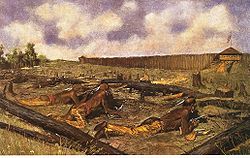
Pontiac led the siege of Fort Detroit after Native forces attacked British positions. The siege continued until Pontiac lifted it on October 31, 1763, after concluding that the French would not come to his aid.
May 16, 1763 - Jun 2, 1763
Before other British outposts learned of the siege at Detroit, Native forces captured five small forts in attacks conducted between May 16 and June 2, 1763.
Jun 22, 1763 - Aug 1, 1763
Lenape and other Native forces attacked Fort Pitt on June 22, 1763, and kept it under siege through July. The garrison suffered overcrowding, disease, and a smallpox outbreak.
Jun 29, 1763
General Amherst wrote that captured enemy Indians should be put to death and asked Colonel Henry Bouquet whether smallpox could be sent among the disaffected tribes. Bouquet replied that he would try to spread the disease through exposed blankets.
Jul 31, 1763
Pontiac defeated a British force at the Battle of Bloody Run on July 31, 1763, during the continuing struggle around Fort Detroit.
Image source: Battle of Bloody Run
Aug 1, 1763
On August 1, most Native forces broke off the siege of Fort Pitt to intercept approximately 500 British troops marching to relieve the fort under Colonel Bouquet.
Sep 14, 1763
At least 300 Senecas, Odawas, and Ojibwas attacked a British supply train along the Niagara Falls portage on September 14, 1763. Fort Niagara itself was not assaulted.
Dec 14, 1763
After rumors of a raid, at least 50 Paxton Boys traveled to Conestoga Town on December 14, 1763, and murdered the six people they found there.
Image source: Paxton Boys
1764
Indian raids on frontier settlements escalated during the spring and summer of 1764, prolonging the conflict after the major fighting around Detroit and Fort Pitt.
1764
In 1764, General Thomas Gage sent two expeditions west to crush the rebellion, rescue British prisoners, and arrest Native people held responsible for the war.
Feb 1764
Several hundred Paxton Boys and followers marched on Philadelphia in February 1764. British troops and Philadelphia associators discouraged them from committing further violence.
Aug 1, 1764 - Aug 10, 1764
John Bradstreet left Fort Schlosser in early August 1764 with about 1,200 soldiers and a large contingent of Native allies enlisted by Sir William Johnson.
Oct 3, 1764
After delays while Pennsylvania militia were mustered, Colonel Henry Bouquet departed Fort Pitt on October 3, 1764, with 1,150 men.
Build a timeline like this one in minutes, for free. Start Yours →
Or browse the full history timeline directory, with more than 2,500 topics.
This Pontiac's War timeline was generated with the help of AI, using information found on the internet.
We work hard to keep these timelines accurate, but mistakes do get through. If you spot one, email us at [email protected] and we'll fix it for future visitors.
Generate yours with AI or build it from scratch, for free.
Export your timeline, add your own events, edit or remove AI-generated events, and much more
No credit card required.
15-day money-back guarantee.
You can create an unlimited number of timelines with up to 10 events on each one, customize how they look, export them to PDF, PNG, PowerPoint, CSV, and Excel, and share them with a link. Timelines made with Timeline Maker AI keep every event the generator created, and you can add up to 5 events of your own. Paid plans remove the event limit, add spreadsheet imports and hide Preceden's branding, and the higher-priced plan also adds collaborators, a custom logo and a custom domain.
Yes. You can cancel your subscription from your account page at any time, and you will not be charged again. Your subscription stays active for the rest of the period you already paid for.
Yes. We email you a reminder 15 days before your annual renewal, and we email you a receipt after every payment.
Yes. You can email us within 15 days of any payment, and we will issue you a full refund.
Check out our pricing docs or send us an email anytime: [email protected].