-
Resources
-
Pricing
The Quasi-War was an undeclared naval conflict between the United States and France, fought primarily in the Atlantic and Caribbean from 1798 to 1800. More Less
Build a timeline like this one in minutes, for free. Start Yours →
1778
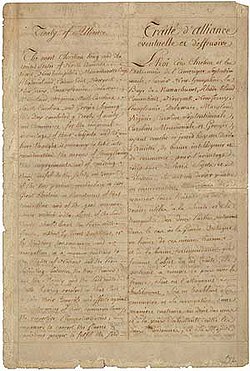
Under the 1778 Treaty of Alliance, the United States agreed to protect the French West Indies in return for French support during the American Revolutionary War.
Image source: Treaty of Alliance (1778)
1792
France became involved in the 1792–1797 War of the First Coalition against European powers including Great Britain and the Dutch Republic.
Image source: War of the First Coalition

1793
Congress suspended repayment of French loans incurred during the Revolutionary War, arguing that the execution of Louis XVI and dissolution of the former French regime had rendered existing agreements void.
Image source: Quasi-War
1794
Neutrality allowed New England shipowners to earn large profits by evading the British blockade of French ports, while Southern planters viewed French revolutionary policies with alarm.
1794 - 1801
The Jay Treaty contributed to a rapid expansion of trade with Britain. American exports to Britain rose from $33 million in 1794 to $94 million by 1801.
Image source: Jay Treaty
1794
The 1794 Jay Treaty between the United States and Great Britain intensified tensions with France, which was then at war with Britain.
1794
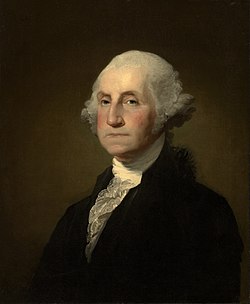
President George Washington issued an executive order forbidding American merchant ships from arming themselves, reinforcing United States neutrality.
Image source: George Washington
1794
To keep the United States out of European conflicts, Congress passed the Neutrality Act of 1794.
Image source: Neutrality Act of 1794
1794
France's abolition of slavery in 1794 alarmed the Southern planter class in the United States, which feared the example set by the French policy.
Image source: Timeline of abolition of slavery and serfdom
Oct 1796
The French government expanded permission for privateer attacks in October 1796 to cover all ships operating in American waters, regardless of nationality.
1797
Diplomatic efforts to resolve the conflict ended in the 1797 dispute known as the XYZ Affair, worsening relations between the United States and France.
Image source: XYZ Affair
Mar 2, 1797
The French Directory issued a decree permitting the seizure of neutral shipping that lacked a rôle d'équipage listing the nationalities of every crew member.
1798 - 1800
The Quasi-War was an undeclared war between the United States and the French First Republic. It was fought primarily through naval actions in American coastal waters and the Caribbean.
1785 - 1798
The last United States warship had been sold in 1785, leaving the country with only a small Revenue Cutter Service flotilla and a few neglected coastal forts.
Image source: United States Navy
1794
Because ships of the line were expensive and required specialized facilities, Congress compromised in 1794 by ordering six large frigates.
Image source: Original six frigates of the United States Navy
1798
By 1798, the first three of the six frigates ordered by Congress were nearly complete, giving the United States a stronger naval force for the conflict.
1798
Congress reconstituted the United States Navy in response to French attacks and the vulnerability of American commerce.
Jul 7, 1798
On July 7, 1798, Congress approved the use of force against French warships in American waters while seeking to prevent the conflict from escalating beyond those limits.
Jul 16, 1798
On July 16, 1798, Congress approved additional funding for USS Congress, USS Chesapeake, USS President, USS General Greene, and USS Adams.
Oct 1, 1796 - Dec 31, 1796
In late 1796, French privateers began seizing American ships trading with Britain. Their campaign was aided by the almost complete lack of a United States Navy.
Oct 1796 - Jun 1797
From October 1796 through June 1797, French vessels captured 316 ships, representing 6 percent of the American merchant fleet and causing estimated losses of $12 million to $15 million.
1798 - 1800
From the perspective of the United States Navy, the Quasi-War consisted of a series of ship-to-ship actions in United States coastal waters and the Caribbean, even as the conflict formed part of a wider European theater that had been active since 1793.
Jul 7, 1798
USS Delaware captured the French privateer La Croyable outside Egg Harbor, New Jersey, in one of the first significant ship-to-ship actions of the Quasi-War.
Image source: Capture of La Croyable
Nov 20, 1798
On November 20, 1798, the French frigates Insurgente and Volontaire captured the schooner USS Retaliation, commanded by Lieutenant William Bainbridge.
1799
By 1799, losses had been significantly reduced through informal cooperation with the Royal Navy. Merchant ships from the two nations were allowed to join each other's convoys.
Feb 9, 1799
On February 9, 1799, the American frigate Constellation captured the French Navy frigate L'Insurgente.
Image source: USS Constellation vs L'Insurgente
Jun 28, 1799
The schooner USS Retaliation, captured by French frigates in November 1798, was recaptured on June 28, 1799.
Jan 1, 1800
On January 1, 1800, an American merchant convoy escorted by USS Experiment fought off an attack by 14 French privateer barges in the Gulf of Gonâve.
Sep 1800
In September 1800, USS Pickering and its entire crew were lost at sea in a storm.
Image source: USS Pickering
Nov 1799
The replacement of the French First Republic by the Consulate in November 1799 opened the way for a more conciliatory diplomatic approach.
Image source: Coup of 18 Brumaire
1800
Although the agreement kept the United States neutral during the Napoleonic Wars, it did not resolve underlying tensions with European powers. Those tensions later contributed to the War of 1812.
Image source: Convention of 1800
1800
The ruling associated with the conflict became the basis for many similar actions in later conflicts, including the Vietnam War and the Gulf War.
Sep 30, 1800
The Convention of 1800, signed on September 30, ended the Quasi-War between the United States and France.
Sep 30, 1800
The Convention of 1800 affirmed the rights of Americans as neutrals at sea and abrogated the 1778 French alliance, but did not provide compensation for approximately $20 million in alleged American economic losses.
Oct 1, 1800 - Dec 31, 1800
By late 1800, combined United States and British naval operations, along with the more conciliatory stance of the new French government, had significantly reduced French privateer activity.
Build a timeline like this one in minutes, for free. Start Yours →
Or browse the full history timeline directory, with more than 2,500 topics.
This Quasi-War timeline was generated with the help of AI, using information found on the internet.
We work hard to keep these timelines accurate, but mistakes do get through. If you spot one, email us at [email protected] and we'll fix it for future visitors.
Generate yours with AI or build it from scratch, for free.
Export your timeline, add your own events, edit or remove AI-generated events, and much more
No credit card required.
15-day money-back guarantee.
You can create an unlimited number of timelines with up to 10 events on each one, customize how they look, export them to PDF, PNG, PowerPoint, CSV, and Excel, and share them with a link. Timelines made with Timeline Maker AI keep every event the generator created, and you can add up to 5 events of your own. Paid plans remove the event limit, add spreadsheet imports and hide Preceden's branding, and the higher-priced plan also adds collaborators, a custom logo and a custom domain.
Yes. You can cancel your subscription from your account page at any time, and you will not be charged again. Your subscription stays active for the rest of the period you already paid for.
Yes. We email you a reminder 15 days before your annual renewal, and we email you a receipt after every payment.
Yes. You can email us within 15 days of any payment, and we will issue you a full refund.
Check out our pricing docs or send us an email anytime: [email protected].