-
Resources
-
Pricing
The Black Hawk War was an 1832 conflict between the United States and a group of Sauk, Meskwaki, and allied Native people led by Black Hawk in Illinois and Wisconsin. It grew from disputes over land, treaty rights, and Indigenous resettlement and ended with the defeat and removal of Black Hawk's followers. More Less
Build a timeline like this one in minutes, for free. Start Yours →
1800 - 1899
As the United States colonized westward in the early 19th century, government officials sought to acquire increasing amounts of Native American land.
Image source: Black Hawk War
1804
Territorial governor William Henry Harrison negotiated a treaty in St. Louis in which a group of Sauk and Meskwaki leaders supposedly sold their lands east of the Mississippi for more than $2,200 in goods and annual payments of $1,000 in goods.
Image source: Treaty of St. Louis (1804)
1804
The 1804 treaty allowed the Sauk and Meskwaki to continue using the ceded land until the U.S. government sold it to American colonists.
May 1816
Black Hawk signed a treaty in May 1816 that affirmed the disputed 1804 land cession, but later insisted that the written terms differed from what had been spoken at the treaty conference.
Image source: Sikorsky UH-60 Black Hawk
1828
In 1828, the U.S. government finally began surveying the land ceded under the disputed treaty for American colonists.
1829
When the Sauks returned to their village after their annual winter hunt in the west, they found Saukenuk occupied by squatters anticipating the sale of the land.
Image source: Black Hawk State Historic Site
Sep 1829
After months of clashes with squatters, the Sauks left Saukenuk in September 1829 for their next winter hunt.
1830
Against the advice of Keokuk and Indian agent Thomas Forsyth, Black Hawk's faction returned to Saukenuk in the spring of 1830.
1815
After displacing the British as the dominant outside power following the War of 1812, the United States assumed the role of mediator in intertribal disputes.
1825 - 1830
U.S. efforts at mediation included multi-tribal treaty councils at Prairie du Chien in 1825 and 1830, where tribal boundaries were drawn.
Image source: First Treaty of Prairie du Chien
1828
The Sauks became divided over whether to resist implementation of the disputed 1804 treaty.
1828
Keokuk, who had helped defend Saukenuk against Americans during the War of 1812, led the faction that opposed resistance. Although he regarded the 1804 treaty as fraudulent, seeing American cities in 1824 convinced him that the Sauks could not successfully oppose the United States.
1829
Black Hawk, a war captain who had fought the United States during the War of 1812, emerged in 1829 as the leader of the faction resisting implementation of the land cession.
Mar 1829
After Andrew Jackson became president in March 1829, many competent Indian agents were replaced by Jackson loyalists whom historian John Hall characterized as unqualified.
1831
When the British Band returned to Saukenuk in 1831, Black Hawk's following had grown to about 1,500 people and included some Potawatomis.
Jul 1831
Violence threatened to undo American efforts to prevent intertribal warfare when a party of Meskwakis and Sauks killed 26 Menominees, including women and children, at Prairie du Chien in July 1831.
Oct 1, 1831 - Dec 31, 1831
In late 1831, Sauk civil chief Neapope returned from Fort Malden and told Black Hawk that the British and other Illinois tribes were prepared to support the Sauks against the United States.
Image source: Neapope
1832
When Wabokieshiek joined the British Band in 1832, he became the group's ranking Sauk civil chief.
Image source: Wabokieshiek
1832
The Winnebago Prophet had encouraged Black Hawk to come to Prophetstown, arguing that the 1831 agreement with General Gaines barred a return to Saukenuk but did not forbid the Sauks from moving to Prophetstown.
May 1, 1832
At a council outside Chicago on May 1, Potawatomi leaders including Billy Caldwell passed a resolution declaring any Potawatomi who supported Black Hawk to be a traitor to the tribe.
Jun 25, 1831
On June 25, 1831, General Edmund Gaines sent troops to Vandruff Island, across from Saukenuk.
1832
Estimates of British Band deaths during the conflict range from about 450 to 600 people, approximately half of the 1,100 people who entered Illinois with Black Hawk.
1832
Potawatomis living along Indian Creek were angered after settler William Davis dammed the creek, preventing fish from reaching their village.
Image source: Indian Creek massacre
Apr 5, 1832
On April 5, 1832, the British Band entered Illinois once again. The move marked the immediate beginning of the war crisis.
Apr 12, 1832
General Henry Atkinson arrived at Rock Island on April 12, 1832. He, Keokuk, and Meskwaki chief Wapello sent emissaries to the British Band as it ascended the Rock River.
Image source: Henry Atkinson (soldier)
May 14, 1832
U.S. officials convinced that the British Band was hostile mobilized a frontier militia and opened fire on a delegation from the Native Americans on May 14, 1832.
Image source: Battle of Stillman's Run
May 19, 1832
The first attack came on May 19, 1832, when Ho-Chunks ambushed six men near Buffalo Grove, Illinois, killing William Durley.
Jun 1832
After Whiteside's brigade disbanded, Atkinson organized a new force in June 1832 and named it the Army of the Frontier.
Jun 1832
After hearing that Atkinson was forming a new army, Black Hawk began sending out raiding parties in June 1832.
Jun 15, 1832
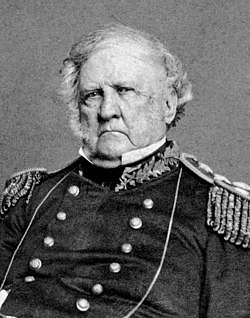
On June 15, 1832, President Andrew Jackson, displeased with Atkinson's handling of the war, appointed General Winfield Scott to take command.
Image source: Winfield Scott
Jun 24, 1832
On June 24, 1832, Black Hawk and about 200 warriors attacked the hastily constructed Apple River Fort near present-day Elizabeth, Illinois.
Image source: Apple River Fort
Jul 21, 1832
On July 21, 1832, militiamen caught up with the British Band near present-day Sauk City, Wisconsin.
Image source: Battle of Wisconsin Heights
Aug 27, 1832
On August 27, 1832, Black Hawk and Wabokieshiek surrendered at Prairie du Chien to Indian agent Joseph Street.
1832
After the war, Congress created the Mounted Ranger Battalion under Henry Dodge's command. It was expanded into the 1st Cavalry Regiment in 1833.
Image source: United States Mounted Rangers
Sep 1832
Following the September treaty with the Ho-Chunks, Scott and Reynolds conducted another treaty with the Sauks and Meskwakis, with Keokuk and Wapello serving as the primary representatives.
Sep 1832
In September 1832, General Winfield Scott and Governor John Reynolds conducted a treaty with the Ho-Chunks at Rock Island.
Oct 1832
The drive to purchase Potawatomi land west of the Mississippi began in October 1832, when commissioners in Indiana bought a large amount of Potawatomi land even though not all bands were represented at the treaty.
Image source: Potawatomi
Apr 1833
Most prisoners were released in the months after the surrender, but in April 1833 Black Hawk, Wabokieshiek, Neapope, and three others were transferred to Fort Monroe in Virginia.
Jun 4, 1833
Beginning June 4, 1833, Black Hawk and his companions were taken on a tour of Baltimore, Philadelphia, and New York City.
Sep 1833
The Potawatomi were compelled to sell their remaining land west of the Mississippi in a treaty held in Chicago in September 1833.
Image source: Treaty of Chicago
1836
The Sauks and Meskwakis sold their reservation to the United States in 1836, followed by additional land in Iowa the next year.
Image source: Sauk people
1837
Ho-Chunks remaining in Wisconsin were pressured to sign a removal treaty in 1837, despite the fact that leaders such as Waukon Decorah had been U.S. allies during the Black Hawk War.
Image source: Ho-Chunk
1842
The tribes sold their last lands in Iowa in 1842, and most of the Native people moved to a reservation in Kansas.
Image source: Meskwaki
Build a timeline like this one in minutes, for free. Start Yours →
Or browse the full history timeline directory, with more than 2,500 topics.
This Black Hawk War timeline was generated with the help of AI, using information found on the internet.
We work hard to keep these timelines accurate, but mistakes do get through. If you spot one, email us at [email protected] and we'll fix it for future visitors.
Generate yours with AI or build it from scratch, for free.
Export your timeline, add your own events, edit or remove AI-generated events, and much more
No credit card required.
15-day money-back guarantee.
You can create an unlimited number of timelines with up to 10 events on each one, customize how they look, export them to PDF, PNG, PowerPoint, CSV, and Excel, and share them with a link. Timelines made with Timeline Maker AI keep every event the generator created, and you can add up to 5 events of your own. Paid plans remove the event limit, add spreadsheet imports and hide Preceden's branding, and the higher-priced plan also adds collaborators, a custom logo and a custom domain.
Yes. You can cancel your subscription from your account page at any time, and you will not be charged again. Your subscription stays active for the rest of the period you already paid for.
Yes. We email you a reminder 15 days before your annual renewal, and we email you a receipt after every payment.
Yes. You can email us within 15 days of any payment, and we will issue you a full refund.
Check out our pricing docs or send us an email anytime: [email protected].