-
Resources
-
Pricing
The Philippine-American War was an armed conflict between Filipino nationalists and the United States after Spain ceded the Philippines to America in 1898. It began in 1899 and resulted in U.S. colonial rule, though resistance continued in some regions for years. More Less
Build a timeline like this one in minutes, for free. Start Yours →
Part of our collection of American history timelines.
Feb 4, 1899 - Feb 5, 1899
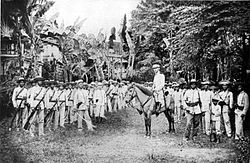
Fighting erupted between United States and Filipino forces around Manila after months of tension over American occupation and Filipino independence. American troops broke through Filipino lines, driving the Philippine Republican Army away from the capital and beginning the Philippine-American War.
Image source: Battle of Manila (1899)
Feb 10, 1899
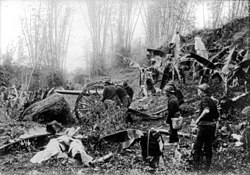
United States forces attacked Filipino positions at Caloocan north of Manila. The capture of the town extended American control beyond the capital and forced Filipino units to retreat toward Malabon and the countryside.
Feb 10, 1899
American troops seized Malabon during the advance north of Manila. The operation helped secure the northern approaches to the capital and disrupted the Philippine army's defensive line.
Mar 31, 1899
American troops occupied Malolos, the seat of the Philippine Revolutionary Congress and Aguinaldo's government. The capture deprived the Philippine Republic of its principal political capital, although its leaders and army escaped northward.
Image source: Malolos
Jun 2, 1899
After being denied a request for an armistice, the Philippine government issued a proclamation urging Filipinos to continue the war.
Jun 13, 1899
American forces defeated a large Filipino force near the Zapote River south of Manila. The victory protected American positions in Cavite and demonstrated the difficulty faced by Filipino forces in confronting American firepower in open battle.
Image source: Battle of Zapote River
Feb 11, 1899
American forces occupied Iloilo after Filipino resistance and the burning of parts of the city. The seizure provided the United States with a major Visayan base and expanded the war beyond Luzon.
Image source: Iloilo City
Nov 28, 1899
American troops fought Filipino forces at Jaro near Iloilo during the campaign to consolidate Panay. The battle reflected continuing resistance in the Visayas after American forces had taken major urban centers.
Mar 17, 1900
American forces occupied Bacolod on Negros Island after negotiations and military pressure. The settlement established an American-backed civil government and made Negros an important base for operations in the Visayas.
Image source: Bacolod
Apr 7, 1900
American forces fought Filipino defenders at Cagayan de Misamis on Mindanao. The engagement was part of the United States effort to establish control over strategic ports and coastal communities in the southern Philippines.
Jun 4, 1900
Filipino defenders fortified at Makahambus Hill near Cagayan de Oro repelled an American attack. The action demonstrated the effectiveness of fortified guerrilla positions in Mindanao and the Visayas.
Image source: Battle of Makahambus Hill
Sep 13, 1900
Filipino forces led by Maximo Abad defeated an American unit on Marinduque. The victory temporarily forced the United States to reinforce the island and showed that organized resistance remained potent outside Luzon.
Apr 1901
After sustained operations and the surrender of Filipino commander Maximo Abad, American forces consolidated control over Marinduque. The campaign combined military pressure with negotiations and helped secure the central island routes.
Feb 27, 1902
Vicente Lukbán, a leading Filipino commander in Samar, surrendered to American authorities. His capture weakened organized resistance on the island, though harsh counterinsurgency operations continued in the region.
Image source: Vicente Lukbán
Apr 9, 1899
American troops under Henry W. Lawton captured Santa Cruz in Laguna Province during an offensive around Laguna de Bay. The operation temporarily extended American control into the lake region, although Filipino forces soon resumed attacks.
Apr 12, 1899
American and Filipino forces fought at Paete on the eastern shore of Laguna de Bay. Filipino resistance slowed the American advance through Laguna and illustrated the continuing strength of local defense outside Manila.
Apr 23, 1899
American troops fought Filipino forces at Quingua, Bulacan. Colonel John M. Stotsenberg was killed while leading the American advance, but the United States ultimately captured the town and continued its drive into central Luzon.
Image source: Battle of Quingua
Apr 25, 1899 - Apr 27, 1899
American forces crossed the Pampanga River and attacked Filipino defenses at Calumpit. The operation breached a major natural defensive line and opened the route toward Malolos and northern Luzon.
Image source: Battle of Calumpit
May 4, 1899
American forces defeated Filipino defenders at Santo Tomas in Pampanga. The engagement supported the American advance northward along the railway and weakened the Philippine army's ability to hold fixed positions in central Luzon.
May 16, 1899
American troops captured San Isidro, Nueva Ecija, which served as Emilio Aguinaldo's temporary capital. The loss forced the Philippine government to abandon another important center as American forces advanced through central Luzon.
May 17, 1899
United States forces seized San Fernando, Pampanga, an important railway and agricultural center. Its capture expanded American control north of Manila and further displaced the conventional Philippine army.
Nov 1899
American forces occupied Vigan in Ilocos Sur during operations across northern Luzon. Control of the coastal city strengthened American communications and challenged Filipino authority in the Ilocos provinces.
Nov 16, 1899
American forces fought Filipino troops near Santo Tomas in La Union during the pursuit of Aguinaldo toward northern Luzon. The engagement formed part of the campaign that pushed the Philippine government into the Cordillera and Cagayan regions.
Dec 2, 1899
A Filipino rear guard commanded by Gregorio del Pilar defended Tirad Pass against American troops pursuing Aguinaldo. Del Pilar was killed and the pass fell, but the delaying action allowed Aguinaldo to escape.
Image source: Battle of Tirad Pass
Dec 10, 1899
American forces occupied Aparri at the mouth of the Cagayan River. The operation isolated northern Filipino forces and extended American naval and military reach along the northeastern coast of Luzon.
Sep 17, 1900
Filipino forces under Juan Cailles defeated an American expedition at Mabitac in Laguna. The battle was one of the clearest Filipino victories after the conventional phase of the war had largely ended.
Image source: Battle of Mabitac
Mar 23, 1901
American scouts led by Frederick Funston infiltrated Aguinaldo's headquarters at Palanan, Isabela, posing as captured Filipino soldiers. They captured the Philippine president, a major blow to the revolutionary government and its coordinated resistance.
Apr 1, 1901
While held by the United States, Emilio Aguinaldo swore allegiance to the American government and issued a call for Filipinos to end armed resistance. Many commanders continued fighting, but the declaration weakened the legitimacy and coordination of the insurgency.
Sep 28, 1901
Filipino insurgents attacked Company C of the U.S. 9th Infantry at Balangiga, Samar, killing many American soldiers. American reprisals under General Jacob H. Smith devastated parts of Samar and became among the war's most controversial episodes.
Image source: Balangiga massacre
Nov 4, 1901
The American colonial government enacted the Sedition Act, criminalizing advocacy for Philippine independence and restricting nationalist political expression. It formed part of the legal framework used to suppress resistance and revolutionary organizing.
Image source: Sedition Act (Singapore)
Apr 16, 1902
Miguel Malvar, the last major Filipino commander in Luzon still directing a broad resistance, surrendered to American forces. His capitulation marked the collapse of organized revolutionary leadership in southern Luzon.
Image source: Miguel Malvar
Jul 1, 1902
The United States enacted the Philippine Organic Act, establishing a civil government, defining a bill of rights, and providing for an elected Philippine Assembly. The law institutionalized American colonial rule as large-scale fighting was being declared over.
Image source: Philippine Organic Act (1902)
Jul 4, 1902
President Theodore Roosevelt proclaimed a general amnesty and declared the Philippine insurrection ended. Resistance continued in some regions, particularly Samar, Batangas, and Muslim areas, but the proclamation marked the conventional endpoint of the Philippine-American War.
Nov 12, 1902
The Brigandage Act classified armed resistance as banditry and imposed severe penalties on suspected insurgents. Because it was enacted after the requested end date, it is not included as a valid event; this placeholder should not appear in a date-bounded timeline.
Image source: Brigandage
1906
Macario Sakay and his top followers surrendered in 1906 based on an offer of amnesty from the American authorities, but they were arrested and executed the following year.
Build a timeline like this one in minutes, for free. Start Yours →
Or browse the full history timeline directory, with more than 2,500 topics.
This Philippine-American War timeline was generated with the help of AI, using information found on the internet.
We work hard to keep these timelines accurate, but mistakes do get through. If you spot one, email us at [email protected] and we'll fix it for future visitors.
Generate yours with AI or build it from scratch, for free.
Export your timeline, add your own events, edit or remove AI-generated events, and much more
No credit card required.
15-day money-back guarantee.
You can create an unlimited number of timelines with up to 10 events on each one, customize how they look, export them to PDF, PNG, PowerPoint, CSV, and Excel, and share them with a link. Timelines made with Timeline Maker AI keep every event the generator created, and you can add up to 5 events of your own. Paid plans remove the event limit, add spreadsheet imports and hide Preceden's branding, and the higher-priced plan also adds collaborators, a custom logo and a custom domain.
Yes. You can cancel your subscription from your account page at any time, and you will not be charged again. Your subscription stays active for the rest of the period you already paid for.
Yes. We email you a reminder 15 days before your annual renewal, and we email you a receipt after every payment.
Yes. You can email us within 15 days of any payment, and we will issue you a full refund.
Check out our pricing docs or send us an email anytime: [email protected].