-
Use Cases
-
Resources
-
Pricing
The American Indian Wars were a series of armed conflicts fought between Native American peoples and European colonizers and later the United States government, spanning from the early colonial period through the late 19th century. These wars arose from disputes over land, resources, sovereignty, and cultural differences as settlers expanded westward. The conflicts profoundly shaped the history of North America, resulting in massive loss of life, forced relocations such as the Trail of Tears, and the eventual confinement of many tribes to reservations. More Less
Mar 22, 1622
% complete
On March 22, 1622, warriors of the Powhatan Confederacy led by Opechancanough launched a coordinated surprise attack on English settlements along the James River in Virginia, killing about a quarter of the colonists. The attack began a decade of warfare that reshaped relations between the Powhatan and the Virginia colonists.
Image source: Indian massacre of 1622
Jul 1636 - Sep 1638
% complete
The Pequot War was an armed conflict between the Pequot tribe and English colonists of Massachusetts Bay and Connecticut, along with their Narragansett and Mohegan allies. The war culminated in the Mystic Massacre of 1637, which devastated the Pequot and broke their power in southern New England.
Image source: Pequot War
Jun 1675 - Aug 12, 1676
% complete
King Philip's War pitted Metacom (King Philip), leader of the Wampanoag and allied tribes, against New England colonists and their Native allies. One of the bloodiest wars per capita in American history, it ended with Metacom's death and the collapse of Native resistance in southern New England.
Image source: King Philip's War
May 28, 1754 - Feb 10, 1763
% complete
Sparked by George Washington's skirmish with French forces at Jumonville Glen, the French and Indian War was the North American theater of the Seven Years' War. Many Native nations fought alongside the French; Britain's victory reshaped the continent and set the stage for later conflicts.
Image source: French and Indian War
May 1763 - Jul 1766
% complete
Following the British victory in the French and Indian War, Ottawa leader Pontiac united Great Lakes tribes in an uprising against British military occupation and policies. The rebellion captured several forts and prompted the British Proclamation of 1763 restricting westward settlement.
Image source: Pontiac's War
Aug 10, 1680
% complete
Led by Po'pay, Pueblo peoples across New Mexico rose up against Spanish colonizers, killing hundreds and driving the Spanish from Santa Fe. The revolt kept the Spanish out of the region for twelve years and remains one of the most successful Indigenous uprisings in North America.
Image source: Pueblo Revolt
Nov 1872 - Jun 1, 1873
% complete
Kintpuash (Captain Jack) led a small band of Modoc resisting forced relocation from California to Oregon. From strongholds in the Lava Beds, they held off far larger U.S. forces for months before Captain Jack's capture and execution ended the war.
Image source: Modoc War
Jun 1877 - Oct 5, 1877
% complete
After violence erupted over removal from the Wallowa Valley, Chief Joseph led roughly 750 Nez Perce on a remarkable 1,170-mile fighting retreat through Idaho, Wyoming, and Montana. They surrendered just short of Canada, and Joseph became famous for his eloquent surrender speech.
Image source: Nez Perce War
May 30, 1878 - Sep 1878
% complete
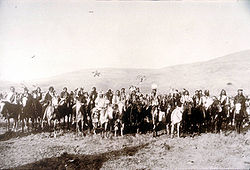
The Bannock and Paiute rose up in response to settler destruction of camas roots, a vital food source, and broken treaty promises. After months of skirmishing across Idaho and Oregon, U.S. forces defeated the Bannock, leading to further confinement on reservations.
1879 - Oct 14, 1880
% complete
Chiricahua Apache leader Victorio waged a brilliant guerrilla campaign across New Mexico, Texas, and Mexico after breaking from the San Carlos reservation. He was killed by Mexican forces at Tres Castillos in 1880, effectively ending the campaign.
Image source: Victorio's War
May 1885 - Sep 4, 1886
% complete
Geronimo led a band of Chiricahua Apaches off the San Carlos reservation, evading thousands of U.S. and Mexican troops for over a year. His surrender to General Nelson Miles in September 1886 marked the end of organized Apache resistance and is often cited as closing the Indian Wars era.
Image source: Geronimo
Sep 1711 - Feb 11, 1715
% complete
The Tuscarora War began when the Tuscarora attacked colonial settlements in North Carolina after years of encroachment and mistreatment. Colonial forces with allied Native tribes defeated the Tuscarora, many of whom migrated north to join the Iroquois Confederacy as its sixth nation.
Image source: Tuscarora War
Apr 15, 1715 - 1717
% complete
The Yamasee War erupted when the Yamasee and other tribes, angered by trade abuses and land loss, attacked South Carolina colonists. The conflict nearly destroyed the colony but ended with a colonial victory that shifted the balance of power toward the British in the Southeast.
1722 - Dec 15, 1725
% complete
Also known as Father Rale's War, this conflict saw Wabanaki Confederacy tribes, supported by New France, battle British settlers along the Maine frontier. The war ended with a treaty confirming British control over much of present-day Maine.
Image source: Dummer's War
May 1774 - Oct 10, 1774
% complete
Virginia militia under Lord Dunmore clashed with the Shawnee and Mingo over lands south of the Ohio River. The decisive Battle of Point Pleasant forced the Shawnee to cede hunting grounds in Kentucky, intensifying tensions on the frontier.
Image source: Lord Dunmore's War
1776 - 1794
% complete
During and after the American Revolution, the Cherokee, divided between pro-British and pro-American factions, fought frontier settlers across the Southeast. American punitive expeditions devastated Cherokee towns, forcing major land cessions by the mid-1790s.
Image source: Cherokee–American wars
1785 - Aug 20, 1794
% complete
A confederation of Great Lakes tribes under Little Turtle and Blue Jacket defeated two American armies before being crushed by General Anthony Wayne at the Battle of Fallen Timbers. The resulting Treaty of Greenville ceded most of present-day Ohio to the United States.
Image source: Northwest Indian War
Nov 7, 1811
% complete
Governor William Henry Harrison led U.S. forces against Prophetstown, the village of Shawnee leader Tenskwatawa (the Prophet) and his brother Tecumseh. Though tactically inconclusive, the battle weakened Tecumseh's confederacy ahead of the War of 1812.
Image source: Battle of Tippecanoe
1813 - Aug 14, 1814
% complete
Red Stick Creek warriors, influenced by Tecumseh's movement, attacked Fort Mims and battled American forces and rival Creeks. Andrew Jackson's decisive victory at Horseshoe Bend forced the Creek to cede vast territories in Alabama and Georgia.
Image source: Creek War
Nov 1817 - Oct 31, 1818
% complete
General Andrew Jackson led U.S. troops into Spanish Florida against Seminole raiders and escaped slaves harbored there. Jackson seized Pensacola and executed two British subjects, pressuring Spain to cede Florida to the United States in 1819.
Image source: Seminole Wars
Apr 5, 1832 - Aug 27, 1832
% complete
Sauk leader Black Hawk led a band of followers back into Illinois to reclaim ancestral lands, prompting panic among settlers. Militia and regular army forces pursued and defeated them at the Battle of Bad Axe, ending armed Native resistance east of the Mississippi.
Image source: Black Hawk War
Dec 23, 1835 - Aug 14, 1842
% complete
Triggered by Seminole resistance to removal under the Treaty of Payne's Landing, this was the longest and costliest of the Seminole Wars. Led by Osceola, who died in captivity after capture under a flag of truce, the Seminoles waged guerrilla warfare until most were forced west; some remained in Florida.
Image source: Second Seminole War
May 26, 1838 - Mar 1839
% complete
Under the Indian Removal Act of 1830, the U.S. Army forcibly removed approximately 16,000 Cherokee from their homelands in the Southeast, marching them to Indian Territory. Thousands died from disease, exposure, and starvation along the route.
Image source: Trail of Tears
1823
% complete
Often called the first western Plains Indian war, this conflict arose when Arikara warriors attacked fur traders on the upper Missouri River. Colonel Henry Leavenworth led a punitive expedition with Sioux allies against the Arikara villages, marking the first U.S. Army campaign against Plains tribes.
Image source: Arikara War
Nov 29, 1864 - 1865
% complete
Colorado militia under Colonel John Chivington attacked a peaceful Cheyenne and Arapaho village at Sand Creek, killing roughly 150 people, mostly women, children, and elders. The massacre ignited years of warfare across the Plains and shocked the nation.
Image source: Sand Creek massacre
1866 - Nov 6, 1868
% complete
Lakota chief Red Cloud led a successful campaign against U.S. forts along the Bozeman Trail in Wyoming and Montana. The Fetterman Fight of 1866 wiped out an entire U.S. detachment, and Red Cloud's victory forced the United States to abandon the forts and sign the Treaty of Fort Laramie in 1868.
Image source: Red Cloud's War
Nov 27, 1868
% complete
Lieutenant Colonel George Armstrong Custer led the 7th Cavalry in a dawn attack on Black Kettle's Southern Cheyenne village on the Washita River in Indian Territory. The attack killed Black Kettle and dozens of others, part of the winter campaign against the Plains tribes.
Image source: Battle of the Washita River
Feb 1876 - May 7, 1877
% complete
Sparked by gold seekers invading the Black Hills, the Great Sioux War pitted the Lakota and Northern Cheyenne against the U.S. Army. Sitting Bull and Crazy Horse won stunning victories at Rosebud and Little Bighorn before relentless campaigns forced the tribes onto reservations.
Image source: Great Sioux War of 1876
Jun 25, 1876 - Jun 26, 1876
% complete
Lt. Col. George Custer's 7th Cavalry attacked a massive gathering of Lakota, Northern Cheyenne, and Arapaho along the Little Bighorn River. Custer and more than 260 of his men were killed in one of the worst defeats the U.S. Army suffered in the Indian Wars.
Image source: Battle of the Little Bighorn
Dec 29, 1890
% complete
U.S. soldiers of the 7th Cavalry opened fire on Lakota Ghost Dancers near Wounded Knee Creek, South Dakota, killing around 250 men, women, and children. The massacre, following Sitting Bull's death, is widely regarded as the last major engagement of the American Indian Wars.
Image source: Wounded Knee Massacre
Or browse the full history timeline directory, with more than 2,000 topics.
This American Indian Wars timeline was generated with the help of AI, using information found on the internet.
We work hard to keep these timelines accurate, but mistakes do get through. If you spot one, email us at [email protected] and we'll fix it for future visitors.
Generate yours with AI or build it from scratch, for free.
Export your timeline, add your own events, edit or remove AI-generated events, and much more
No credit card required.
Cancel anytime.
Cancel anytime.
You can create an unlimited number of timelines with up to 10 events on each one, customize how they look, export them to PDF, PNG, PowerPoint, CSV, and Excel, and share them with a link. Paid plans raise the event limit and add features like spreadsheet imports and collaborators.
Yes. You can cancel your subscription from your account page at any time, and you will not be charged again. Your subscription stays active for the rest of the period you already paid for.
Yes. We will email you a reminder before the annual renewal, and we will also email you a receipt.
Yes. You can email us within 15 days of any payment, and we will issue you a full refund.
Check out our pricing docs or send us an email anytime: [email protected].