-
Use Cases
-
Resources
-
Pricing
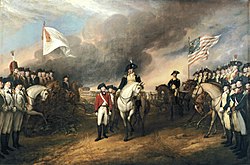
The American Revolutionary War (1775–1783) was the armed conflict between Great Britain and its thirteen North American colonies, which declared independence as the United States of America. Sparked by tensions over taxation and representation, the war featured landmark events such as the Battles of Lexington and Concord, the Declaration of Independence, the turning-point victory at Saratoga, and the decisive British surrender at Yorktown, ultimately resulting in American independence recognized by the Treaty of Paris. More Less
Feb 10, 1763
% complete
The Treaty of Paris ended the French and Indian War, ceding French territory in North America to Britain. The war's enormous cost led Britain to seek new revenue from its American colonies, setting the stage for the disputes that would spark the Revolution.
Image source: Treaty of Paris (1763)
Mar 22, 1765
% complete
The Stamp Act required colonists to pay a tax on printed materials, provoking widespread protests under the slogan 'no taxation without representation.' Colonial resistance was so fierce that Parliament repealed the act in 1766, but the dispute over taxation had begun.
Image source: Stamp Act 1765
Jun 29, 1767
% complete
The Townshend Acts imposed duties on imported goods such as glass, paint, paper, and tea. Colonists responded with boycotts of British goods, and tensions between colonists and British officials escalated sharply in Boston.
Image source: Townshend Acts
Mar 5, 1770
% complete
British soldiers fired into a crowd of colonists in Boston, killing five men. Propagandists like Paul Revere used engravings of the event to inflame anti-British sentiment throughout the colonies, making it a rallying point for resistance.
Image source: Boston Massacre
Dec 16, 1773
% complete
Colonists disguised as Mohawk Indians boarded three ships in Boston Harbor and dumped 342 chests of tea overboard to protest the Tea Act. The audacious act of defiance prompted Parliament to punish Massachusetts with the Coercive Acts.
Image source: Boston Tea Party
Mar 31, 1774 - Jun 22, 1774
% complete
Parliament passed a series of punitive laws closing Boston Harbor and restricting Massachusetts self-government in response to the Boston Tea Party. Other colonies rallied to Massachusetts' aid, deepening colonial unity against Britain.
Image source: Intolerable Acts
Sep 5, 1774 - Oct 26, 1774
% complete
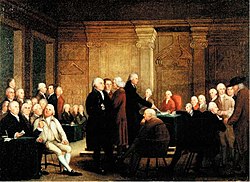
Delegates from twelve colonies met at Carpenters' Hall in Philadelphia to coordinate a response to the Coercive Acts. They organized a boycott of British goods and agreed to reconvene if their grievances were not addressed, laying groundwork for unified action.
Image source: First Continental Congress
May 10, 1775
% complete
Meeting in Philadelphia weeks after Lexington and Concord, the Second Continental Congress assumed the role of a national government, creating the Continental Army and appointing George Washington as its commander in chief.
Image source: Second Continental Congress
Jan 10, 1776
% complete
Thomas Paine's pamphlet argued passionately for independence from Britain and republicanism, selling hundreds of thousands of copies. It transformed public opinion and made the case for independence accessible to ordinary colonists.
Image source: Common Sense
Jul 4, 1776
% complete
Drafted primarily by Thomas Jefferson, the Declaration proclaimed the thirteen colonies free and independent states, asserting unalienable rights to life, liberty, and the pursuit of happiness. July 4 became celebrated as the birthdate of the United States.
Image source: United States Declaration of Independence
Feb 6, 1778
% complete
Following Saratoga, France signed treaties of alliance and commerce with the United States, formally entering the war against Britain. French money, supplies, naval power, and eventually troops proved vital to ultimate American victory.
Image source: Franco-American alliance
Apr 12, 1779
% complete
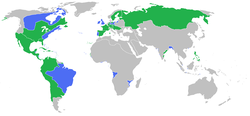
Spain allied with France and declared war on Britain, though it did not directly ally with the United States. Spanish forces besieged Gibraltar and threatened British possessions, stretching Britain's military commitments worldwide.
Image source: Spain and the American Revolutionary War
Jun 13, 1779 - Feb 7, 1783
% complete
Spanish and French forces besieged the British stronghold of Gibraltar for nearly four years without success. The siege tied down British resources and was part of the wider global conflict accompanying the American Revolution.
Image source: Great Siege of Gibraltar
Mar 1, 1781
% complete
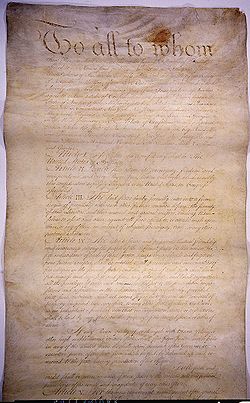
Maryland's ratification completed adoption of the Articles of Confederation, creating the first constitution of the United States. The document established a loose confederation of states with a weak central government to wage the war.
Image source: Articles of Confederation
Sep 3, 1783
% complete
Representatives of Britain and the United States signed the Treaty of Paris, in which Britain recognized American independence and ceded territory extending to the Mississippi River. The treaty formally concluded the Revolutionary War and established the United States as a sovereign nation.
Image source: Treaty of Paris (1783)
Apr 19, 1775
% complete
British troops marched from Boston to seize colonial military supplies at Concord. Warned by Paul Revere and others, militia confronted them at Lexington and Concord, where the 'shot heard round the world' began open armed conflict between Britain and the colonies.
Image source: Battles of Lexington and Concord
Apr 19, 1775 - Mar 17, 1776
% complete
New England militiamen surrounded British-held Boston for nearly a year after Lexington and Concord. After Washington fortified Dorchester Heights with cannons from Ticonderoga, the British evacuated the city on March 17, 1776, ending major fighting in New England.
Image source: Siege of Boston
May 10, 1775
% complete
Ethan Allen and Benedict Arnold led Green Mountain Boys in a surprise dawn assault that captured the British fort on Lake Champlain. Its cannons were later hauled to Boston to help force the British evacuation of the city.
Image source: Capture of Fort Ticonderoga
Jun 17, 1775
% complete
In one of the bloodiest battles of the war, British forces captured the fortified position near Boston but suffered over 1,000 casualties. Though a technical British victory, the battle demonstrated that colonial militia could stand up to professional redcoats.
Image source: Battle of Bunker Hill
Sep 1775 - Jun 1776
% complete
American forces under Richard Montgomery and Benedict Arnold invaded Canada, capturing Montreal and besieging Quebec City. The assault failed in a blizzard on December 31, 1775, and the exhausted Americans retreated in spring 1776, ending hopes of adding Canada to the rebellion.
Image source: Invasion of Quebec (1775)
Mar 17, 1776
% complete
After Washington placed artillery on Dorchester Heights, General William Howe withdrew British troops from Boston by sea. The first major American strategic victory boosted morale and freed Washington to move his army to defend New York.
Aug 27, 1776
% complete
The largest battle of the war saw British forces under Howe decisively defeat Washington's army on Long Island. Washington's skillful nighttime evacuation across the East River saved the Continental Army from destruction.
Image source: Battle of Long Island
Dec 26, 1776
% complete
On Christmas night, Washington ferried his army across the icy Delaware River and surprised Hessian troops at Trenton, capturing nearly 1,000 prisoners. The victory revived American morale after a string of defeats and encouraged re-enlistments.
Image source: Battle of Trenton
Jan 3, 1777
% complete
Days after Trenton, Washington outmaneuvered British forces and defeated them at Princeton, New Jersey. The back-to-back victories cleared most of New Jersey of British troops and restored American confidence during the critical winter.
Image source: Battle of Princeton
Sep 11, 1777
% complete
Howe's army flanked Washington's defenses along Brandywine Creek and drove the Continentals back, opening the road to Philadelphia. Despite the defeat, the American army escaped destruction and fought on.
Image source: Battle of Brandywine
Sep 19, 1777 - Oct 17, 1777
% complete
American forces under Horatio Gates and Benedict Arnold surrounded and forced the surrender of General John Burgoyne's entire army in upstate New York. The decisive victory convinced France to enter the war as an American ally, transforming the conflict into a global war.
Image source: Battles of Saratoga
Sep 26, 1777 - Jun 18, 1778
% complete
British forces captured the rebel capital, forcing Congress to flee to York, Pennsylvania. However, holding the city drained British resources and did not end the rebellion; the army abandoned Philadelphia the following June.
Image source: Philadelphia campaign
Dec 19, 1777 - Jun 19, 1778
% complete
Washington's army endured a brutal winter encampment marked by hunger, disease, and desertion. Under Baron von Steuben's training, however, the army emerged as a more disciplined and cohesive fighting force.
Image source: Valley Forge
Jun 28, 1778
% complete
Washington attacked the retreating British army in sweltering heat in New Jersey. After relieving Charles Lee on the field, Washington held the ground until nightfall, demonstrating the improved discipline of the Continental Army after Valley Forge.
Image source: Battle of Monmouth
Jul 16, 1779
% complete
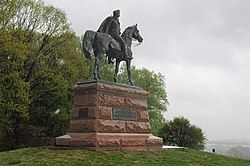
Anthony Wayne led a daring midnight bayonet assault that captured the British fortification on the Hudson River. The victory showcased the growing professionalism of the Continental light infantry.
Image source: Battle of Stony Point
Mar 29, 1780 - May 12, 1780
% complete
British forces under Henry Clinton besieged and captured Charleston, South Carolina, taking thousands of American prisoners in the worst American defeat of the war. The victory launched Britain's ambitious southern strategy.
Image source: Siege of Charleston
Aug 16, 1780
% complete
Charles Cornwallis crushed Horatio Gates' army in South Carolina, cementing British control of the southern interior. The disaster prompted Congress to give command in the South to Nathanael Greene.
Image source: Battle of Camden
Oct 7, 1780
% complete
Overmountain frontiersmen annihilated a Loyalist force in South Carolina, killing or capturing its entire command including Patrick Ferguson. The victory turned the tide in the Carolinas and undermined British hopes of Loyalist support.
Image source: Battle of Kings Mountain
Jan 17, 1781
% complete
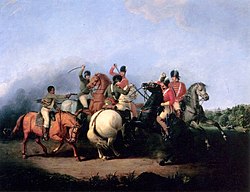
Daniel Morgan used brilliant tactics to rout Banastre Tarleton's British Legion in South Carolina, inflicting devastating casualties and capturing hundreds. The victory set in motion the chain of events leading to Cornwallis' march into Virginia.
Image source: Battle of Cowpens
Mar 15, 1781
% complete
Nathanael Greene fought Cornwallis to a costly standstill in North Carolina. Though technically a British victory, the heavy losses crippled Cornwallis' army and forced him to abandon the Carolinas and move north to Virginia.
Image source: Battle of Guilford Court House
Sep 5, 1781
% complete
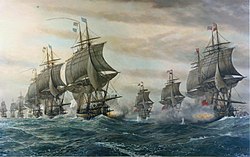
A French fleet under Admiral de Grasse defeated the Royal Navy off the Virginia Capes, cutting off Cornwallis' escape or resupply by sea. The naval victory sealed the fate of the British army trapped at Yorktown.
Image source: Battle of the Chesapeake
Sep 28, 1781 - Oct 19, 1781
% complete
Combined Franco-American forces under Washington and Rochambeau besieged Cornwallis' army at Yorktown, Virginia. With French naval support blocking escape, Cornwallis surrendered over 7,000 troops on October 19, effectively ending major combat in North America.
Image source: Siege of Yorktown
Or browse the full history timeline directory, with more than 2,000 topics.
This American Revolutionary War timeline was generated with the help of AI, using information found on the internet.
We work hard to keep these timelines accurate, but mistakes do get through. If you spot one, email us at [email protected] and we'll fix it for future visitors.
Generate yours with AI or build it from scratch, for free.
Export your timeline, add your own events, edit or remove AI-generated events, and much more
No credit card required.
Cancel anytime.
Cancel anytime.
You can create an unlimited number of timelines with up to 10 events on each one, customize how they look, export them to PDF, PNG, PowerPoint, CSV, and Excel, and share them with a link. Paid plans raise the event limit and add features like spreadsheet imports and collaborators.
Yes. You can cancel your subscription from your account page at any time, and you will not be charged again. Your subscription stays active for the rest of the period you already paid for.
Yes. We will email you a reminder before the annual renewal, and we will also email you a receipt.
Yes. You can email us within 15 days of any payment, and we will issue you a full refund.
Check out our pricing docs or send us an email anytime: [email protected].