
-
Use Cases
-
Resources
-
Pricing
The American Indian Movement (AIM) was a grassroots civil rights organization founded in 1968 in Minneapolis, Minnesota, to address issues of poverty, police brutality, and treaty rights affecting Native Americans. It gained national prominence through high-profile protests, including the occupation of Alcatraz Island (1969–1971), the Trail of Broken Treaties march (1972), and the 71-day occupation of Wounded Knee on the Pine Ridge Reservation in 1973. AIM played a pivotal role in raising awareness of Indigenous rights, fostering cultural pride, and influencing federal Indian policy. More Less
1968
% complete
One of AIM's first initiatives was organizing community patrols that monitored the Minneapolis Police Department for instances of brutality and discrimination against Native Americans. These patrols helped build trust within the urban Native community and established AIM's reputation as a grassroots advocate for Indigenous people.
Image source: American Indian Movement
Jul 1968
% complete
The American Indian Movement (AIM) was founded in Minneapolis, Minnesota, by Dennis Banks, Clyde Bellecourt, George Mitchell, and other urban Native Americans. Initially organized to address police brutality against Native people in Minneapolis, AIM quickly grew into a national movement advocating for Native American rights, sovereignty, and cultural renewal.
1972
% complete
AIM founded the Heart of the Earth Survival School in Minneapolis and similar institutions to provide culturally grounded education for Native children, teaching Indigenous languages, history, and values outside the assimilationist public school system. The schools became models for Native-controlled education nationwide.
Nov 20, 1969 - Jun 11, 1971
% complete
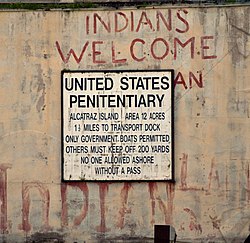
Native American activists, including some early AIM supporters, occupied Alcatraz Island in San Francisco Bay under the banner of 'Indians of All Tribes,' claiming it under the Treaty of Fort Laramie. The 19-month occupation drew national attention to Native American issues and inspired a wave of Indigenous activism across the country.
Image source: Occupation of Alcatraz
1970
% complete
AIM activists occupied an abandoned Navy communications station near Minneapolis to demand facilities for Native education and services. The action exemplified AIM's strategy of reclaiming unused federal property to serve Native communities.
Mar 8, 1970
% complete
AIM members joined local Native activists in Seattle in occupying Fort Lawton, a decommissioned military base, demanding that surplus federal land be returned to Native peoples. The protest contributed to the eventual establishment of the United Indians of All Tribes Foundation and Daybreak Star Cultural Center.
Image source: Fort Lawton
Oct 1972 - Nov 1972
% complete
AIM co-sponsored the Trail of Broken Treaties, a cross-country caravan of Native activists that converged on Washington, D.C., to present a twenty-point position paper demanding restoration of treaty rights and sovereignty. When housing arrangements fell through, protesters occupied the Bureau of Indian Affairs headquarters for six days.
Nov 2, 1972 - Nov 8, 1972
% complete
After arriving in Washington, D.C., demonstrators seized the Bureau of Indian Affairs building, occupying it for nearly a week. Protesters documented widespread mismanagement within the BIA before departing with documents; the action brought unprecedented media attention to Native grievances but strained relations between AIM and the federal government.
Feb 27, 1973 - May 8, 1973
% complete
AIM members and Oglala Lakota activists seized the hamlet of Wounded Knee, South Dakota, site of the 1890 massacre, to protest corruption in the Pine Ridge tribal government and demand federal fulfillment of treaties. The 71-day standoff with federal marshals and FBI agents involved frequent gunfights, left two Native activists dead, and made AIM internationally famous.
Image source: Wounded Knee Occupation
May 8, 1973
% complete
After 71 days, the occupiers surrendered following negotiations in which government officials promised to review treaty obligations and investigate Pine Ridge conditions. Although many promises went unfulfilled, the occupation forced national discussion of Native sovereignty and treaty rights.
Feb 11, 1978 - Jul 15, 1978
% complete
AIM helped organize the Longest Walk, a transcontinental spiritual march opposing legislation threatening tribal sovereignty, particularly bills abrogating treaties. Thousands of participants arrived in Washington, D.C., where they held rallies and successfully pressured Congress to defeat the most harmful proposed laws.
Image source: American Indian Movement
Feb 1970
% complete
AIM joined Pacific Northwest tribes in protesting violations of treaty-guaranteed fishing rights, supporting the 'fish-ins' movement that challenged state regulation of tribal fisheries. These actions helped build momentum toward landmark court victories affirming tribal treaty rights.
Feb 1972
% complete
The brutal killing of Oglala Lakota man Raymond Yellow Thunder in Gordon, Nebraska, prompted AIM to organize protests demanding justice. AIM's response to the case, including demonstrations in nearby Custer, South Dakota, galvanized support on the Pine Ridge Reservation and expanded AIM's presence in the Dakotas.
1973 - 1976
% complete
Following the Wounded Knee occupation, tensions between AIM supporters and tribal chairman Dick Wilson's GOON squad led to years of violence on Pine Ridge, with dozens of AIM members and supporters killed. The FBI's heavy presence on the reservation intensified conflict and set the stage for further tragedy.
Image source: Pine Ridge Indian Reservation
Jan 1974 - Sep 16, 1974
% complete
Dennis Banks and Russell Means stood trial in St. Paul, Minnesota, on charges stemming from the Wounded Knee occupation. In one of the longest federal trials in Minnesota history, Judge Fred Nichol dismissed all charges due to prosecutorial misconduct, a major legal victory for AIM.
Image source: United States v. Washington
Feb 12, 1974
% complete
In United States v. Washington, Federal Judge George Boldt reaffirmed treaty rights of Puget Sound tribes to half of the salmon harvest, vindicating years of activism including fish-ins supported by AIM. The decision became one of the most significant affirmations of tribal sovereignty in U.S. history.
Jun 26, 1975
% complete
A shootout at a ranch near Oglala on the Pine Ridge Reservation killed FBI agents Jack Coler and Ronald Williams as well as Native resident Joe Stuntz. The incident triggered one of the largest FBI manhunts in history and led to the prosecution of AIM member Leonard Peltier.
Image source: Leonard Peltier
Feb 24, 1976
% complete
The body of Mi'kmaq activist Anna Mae Pictou Aquash, a prominent AIM member, was discovered near Wanblee, South Dakota. Her murder, initially attributed by authorities to exposure, was later shown to be a homicide linked to paranoia and suspicion within AIM amid FBI infiltration, becoming a lasting symbol of the era's turmoil.
Image source: Anna Mae Aquash
Apr 1976
% complete
The U.S. Senate Church Committee exposed the FBI's COINTELPRO program, which had surveilled and disrupted civil rights groups including AIM through informants, disinformation, and provocation. The revelations confirmed AIM's long-standing claims of government repression and fueled ongoing demands for accountability.
Image source: COINTELPRO
Apr 18, 1977
% complete
AIM member Leonard Peltier was convicted and sentenced to two consecutive life terms for the deaths of the FBI agents at Oglala. His trial, marked by disputed evidence and allegations of misconduct, transformed Peltier into an international symbol of Native American political imprisonment, with Amnesty International and many others calling for his release.
Feb 2004
% complete
Former AIM member Arlo Looking Cloud was convicted of participating in the 1975 murder of Anna Mae Aquash and sentenced to life in prison. The trial shed light on the internal paranoia and FBI infiltration that plagued AIM in the mid-1970s.
Dec 2010
% complete
John Graham, another former AIM associate, was convicted in South Dakota for his role in the kidnapping and murder of Anna Mae Aquash, closing another chapter in the decades-long effort to resolve her killing.
1974
% complete
AIM leaders established the International Indian Treaty Council to bring Native American issues to the international stage. The ITCO gained consultative status at the United Nations and played a key role in developing the UN Declaration on the Rights of Indigenous Peoples.
Image source: International Indian Treaty Council
Aug 11, 1978
% complete
Spurred by decades of activism including AIM's campaigns, President Jimmy Carter signed the American Indian Religious Freedom Act, protecting the rights of Native Americans to practice traditional religions, access sacred sites, and use sacred objects — reversing long-standing federal suppression of Indigenous spiritual practices.
Image source: American Indian Religious Freedom Act
1987
% complete
AIM co-founder Russell Means sought the Libertarian Party's presidential nomination in 1987, finishing second at the party convention. His campaign highlighted Native sovereignty issues on a national political stage and demonstrated AIM leaders' continued engagement in mainstream politics.
Image source: Russell Means
1993
% complete
Internal disputes split AIM into two rival factions, one led by Russell Means based in Colorado and another led by Clyde Bellecourt in Minnesota. The division reflected longstanding ideological and personal conflicts but both factions continued advocacy for Native rights.
2009
% complete
AIM co-founder Clyde Bellecourt received numerous honors recognizing his decades of activism, including efforts in Native education, prison reform, and anti-mascot campaigns. His leadership helped institutionalize AIM's contributions to the broader Native American civil rights movement.
Image source: Clyde Bellecourt
Oct 22, 2012
% complete
Russell Means, one of AIM's most charismatic and visible leaders, died of cancer at age 72. His death prompted widespread reflection on his role in the Wounded Knee occupation and the modern Native American rights movement.
Jun 18, 2014
% complete
The U.S. Patent and Trademark Office canceled the Washington football team's trademarks, ruling the name disparaging — a victory for decades of activism against Native mascots in which AIM played a leading role. The team ultimately retired the name in 2020.
Image source: Washington Redskins name controversy
Jan 11, 2022
% complete
Clyde Bellecourt, a principal founder of AIM, died at age 85 in Minneapolis. Tributes honored his lifelong commitment to Native sovereignty, cultural preservation, and justice, cementing his legacy as a central figure of the Red Power movement.
Or browse the full history timeline directory, with more than 2,000 topics.
This American Indian Movement timeline was generated with the help of AI, using information found on the internet.
We work hard to keep these timelines accurate, but mistakes do get through. If you spot one, email us at [email protected] and we'll fix it for future visitors.
Generate yours with AI or build it from scratch, for free.
Export your timeline, add your own events, edit or remove AI-generated events, and much more
No credit card required.
Cancel anytime.
Cancel anytime.
You can create an unlimited number of timelines with up to 10 events on each one, customize how they look, export them to PDF, PNG, PowerPoint, CSV, and Excel, and share them with a link. Paid plans raise the event limit and add features like spreadsheet imports and collaborators.
Yes. You can cancel your subscription from your account page at any time, and you will not be charged again. Your subscription stays active for the rest of the period you already paid for.
Yes. We will email you a reminder before the annual renewal, and we will also email you a receipt.
Yes. You can email us within 15 days of any payment, and we will issue you a full refund.
Check out our pricing docs or send us an email anytime: [email protected].