-
Use Cases
-
Resources
-
Pricing
David Hume (1711–1776) was a Scottish Enlightenment philosopher, historian, and essayist, widely regarded as one of the most important figures in Western philosophy. His empiricist approach to knowledge, skeptical analysis of causation, religion, and the self, and influential works such as A Treatise of Human Nature and An Enquiry Concerning Human Understanding profoundly shaped modern thought. More Less
May 7, 1711
% complete
David Hume was born on 7 May 1711 [OS 26 April 1711] as David Home in a tenement on the north side of Edinburgh's Lawnmarket. He would become a Scottish philosopher, historian, economist and essayist known for his highly influential system of empiricism, philosophical scepticism and metaphysical naturalism.
1731
% complete
Hume's health improved somewhat, but in 1731, he was afflicted with a ravenous appetite and palpitations, health problems that troubled him during his early years as an aspiring writer.
1734
% complete
In 1734 Hume changed his family name's spelling from 'Home' to 'Hume' because the surname 'Home' (pronounced 'Hume') was not well known in England.
1735
% complete
Hume had little respect for the professors of his time, telling a friend in 1735 that "there is nothing to be learnt from a Professor, which is not to be met with in Books".
1745
% complete
In 1745, Hume applied for the Chair of Pneumatics and Moral Philosophy at the University of Edinburgh, though the application did not succeed.
1745
% complete
In 1745, during the Jacobite risings, Hume tutored the Marquess of Annandale, an engagement that ended in disarray after about a year. The legacy of religious civil war in Scotland and the recent memory of the 1715 and 1745 risings fostered in Hume a distaste for enthusiasm and factionalism.
1746
% complete
In 1746 Hume accepted an invitation from his cousin, Lieutenant-General James St Clair, to serve as his secretary, beginning his involvement in British military and diplomatic affairs.
Sep 29, 1746 - Oct 10, 1746
% complete
The resulting Raid on Lorient aimed to seize the port of the French East India Company and draw French forces away from Flanders, but the ill-supplied force withdrew after a brief siege, reportedly just as the town was preparing to capitulate.
Image source: Raid on Lorient
1748
% complete
Before 1745, Hume was more akin to an "independent whig". In 1748, he described himself as "a whig, though a very skeptical one", reflecting his nuanced political outlook shaped by Britain's turbulent political history.
1749
% complete
In 1749 he went to live with his brother in the countryside, although he continued to associate with Scottish Enlightenment figures. That year he also wrote his volume of Political Discourses.
1751 - 1752
% complete
Hume returned to Edinburgh in 1751, and in the following year the Faculty of Advocates hired him to be their Librarian, a job with little or no pay but which gave him "the command of a large library". He also published An Enquiry Concerning the Principles of Morals in 1751.
1753
% complete
In 1753 Hume moved from his house on Riddles Court on the Lawnmarket to a house on the Canongate at the other end of the Royal Mile in Edinburgh.
1762
% complete
In 1762 Hume moved from Jack's Land on the Canongate to James Court on the Lawnmarket in Edinburgh. He sold the house to James Boswell in 1766.
1763 - 1765
% complete
From 1763 to 1765 Hume was invited to attend Lord Hertford in Paris, where he became secretary to the British embassy in France, becoming a celebrated figure in Parisian society.
1765
% complete
In 1765 Hume served as a chargé d'affaires in Paris, writing "despatches to the British Secretary of State" while awaiting the arrival of a new ambassador.
Image source: Chargé d'affaires
Jan 1766
% complete
In January 1766 Hume left Paris to accompany Jean-Jacques Rousseau to England, arranging refuge for the famous philosopher who had fled persecution on the continent.
Image source: Jean-Jacques Rousseau
Mar 20, 1766
% complete
A previously unknown letter from Hume to Lord Hertford of 20 March 1766 (published by Felix Waldmann in 2014) communicated a proposal from George Colebrooke, Sir James Cockburn and John Stewart to acquire a half-share of slave plantations in Grenada. Hume lent £400 to Stewart on 8 February 1766, receiving £6 3s 4d interest on 25 June 1766; whether the money aided the purchase of a slave plantation is disputed among scholars.
1767 - 1769
% complete
In 1767 Hume was appointed Under Secretary of State for the Northern Department, serving until 1769. By 1769 his employers, the Seymour-Conway family, had procured a substantial pension for Hume.
Image source: Secretary of State for Northern Ireland
1768 - 1775
% complete
For instance, in 1768 Hume encouraged total revolt on the part of the Americans. In 1775 he became certain that a revolution would take place and said that he believed in the American principle and wished the British government would let them be.
Image source: American Revolution
1769 - 1771
% complete
In 1769 Hume returned to James's Court in Edinburgh, but in 1771 moved into a grand new house on St Andrew Square, where he lived until his death in 1776.
Image source: St Andrew Square, Edinburgh
Aug 25, 1776
% complete
David Hume died on 25 August 1776 at his home on St Andrew Square in Edinburgh. He never married and lived partly at his Chirnside family home in Berwickshire, which had belonged to the family since the 16th century.
Image source: David Hume
1738
% complete
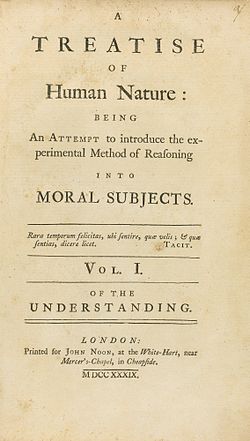
Hume worked for four years on his first major work, A Treatise of Human Nature, subtitled "Being an Attempt to Introduce the Experimental Method of Reasoning into Moral Subjects", completing it in 1738 at age 27. Beginning with this work, Hume strove to create a naturalistic science of man that examined the psychological basis of human nature.
Image source: A Treatise of Human Nature
1739 - 1740
% complete
The publication of A Treatise of Human Nature between 1739 and 1740 introduced Hume's naturalistic science of man, examining the psychological basis of human nature. In it, he asserted that "Nature, by an absolute and uncontroulable necessity has determin'd us to judge as well as to breathe and feel."
1740
% complete
According to the Treatise (1740), in every system of morality that Hume had read, the author begins by stating facts about the world as it is but always ends up suddenly referring to what ought to be the case. Hume's writings on ethics began with the 1740 Treatise and were refined in his An Enquiry Concerning the Principles of Morals (1751).
Image source: An Enquiry Concerning the Principles of Morals
1741
% complete
The Essays Moral and Political was published in 1741 and included in the later edition as Essays, Moral, Political, and Literary, helping establish Hume's reputation as an essayist.
Image source: Essays, Moral, Political, and Literary
1752
% complete
Hume's volume of Political Discourses, written in 1749 and published by Kincaid & Donaldson in 1752, was the only work he considered successful on first publication. It introduced several new ideas around which the "classical economics" of the 18th century was built.
1752
% complete
In 1752, Hume started his great historical work, The History of England, which took fifteen years and ran to over a million words, tracing events from the Invasion of Julius Caesar to the Revolution of 1688.
Image source: The History of England (Hume)
1753
% complete
Based on the footnote Hume appended to his essay "On National Characters" in 1753 (amended as an endnote for a posthumous 1777 edition), later scholars acknowledge its content is "especially shocking—and deeply puzzling", forming the basis of charges of racism against Hume.
1754
% complete
The Whig-dominated world of 1754 overwhelmingly disapproved of Hume's take on English history, whose coverage of 17th-century political upheavals relied in large part on the Earl of Clarendon's History of the Rebellion and Civil Wars in England (1646–69).
1754 - 1762
% complete
With the publication of his six-volume The History of England between 1754 and 1762, extending "from the Invasion of Julius Caesar to the Revolution in 1688", Hume achieved the fame that he coveted. The work was a bestseller, influential for nearly a century despite competition from imitations by Tobias Smollett (1757) and Oliver Goldsmith (1771). By 1894 there were at least 50 editions as well as abridgements and illustrated pocket editions.
1757
% complete
Hume's 1757 dissertation "The Natural History of Religion" argues that the monotheistic religions of Judaism, Christianity and Islam all derive from earlier polytheistic religions. His essays "Of the Standard of Taste" and "Of Tragedy" were also connected with this period.
1761
% complete
In 1761 all of Hume's works were banned on the Index Librorum Prohibitorum, reflecting the Church's condemnation of his sceptical writings on religion. Around the same time, Hume claimed to have authored an anonymous political pamphlet satirising the failure of the British Parliament to create a Scottish militia in 1760, writing to Alexander Carlyle in early 1761 claiming authorship, although authorship is disputed.
Image source: Index Librorum Prohibitorum
1777
% complete
The footnote Hume appended to his essay "On National Characters" in 1753 was amended as an endnote for a posthumous 1777 edition of his works, content later scholars describe as "especially shocking—and deeply puzzling".
1779
% complete
Hume also criticised the argument from design in his Dialogues Concerning Natural Religion (1779). A century later, the idea of order without design was rendered more plausible by Charles Darwin's discovery that adaptations of life result from natural selection of inherited characteristics.
Image source: Dialogues Concerning Natural Religion
1783
% complete
Hume's nephew and namesake, David Hume of Ninewells (1757–1838), was a co-founder of the Royal Society of Edinburgh in 1783, continuing the family's intellectual legacy.
Image source: Royal Society of Edinburgh
1783
% complete
Attention to Hume's philosophical works grew after the German philosopher Immanuel Kant, in his Prolegomena to Any Future Metaphysics (1783), credited Hume with awakening him from his "dogmatic slumber".
Image source: Prolegomena to Any Future Metaphysics
1787
% complete
Hume's influence on some of the American Founding Fathers can be seen in Benjamin Franklin's suggestion at the Philadelphia Convention of 1787 that no high office in any branch of government should receive a salary, a suggestion Hume had made in his emendation of James Harrington's The Commonwealth of Oceana.
Image source: Constitutional Convention (United States)
1915
% complete
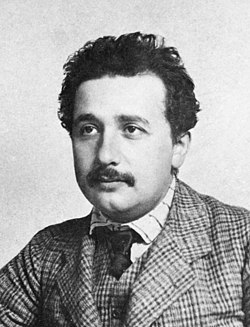
Albert Einstein, in 1915, wrote that he was inspired by Hume's positivism when formulating the theory of special relativity, demonstrating Hume's far-reaching influence beyond philosophy.
Image source: Special relativity
1936
% complete
Ayer, while introducing his classic exposition of logical positivism in 1936, claimed that his views were "the logical outcome of the empiricism of Berkeley and David Hume".
Image source: Language, Truth, and Logic
2003
% complete
In 2003 the philosopher Jerry Fodor described Hume's Treatise as "the founding document of cognitive science", highlighting its enduring relevance to modern psychology and cognitive science. Don Garrett (2002) coined the term "copy principle" for Hume's doctrine that all ideas are ultimately copied from some original impression.
Or browse the full history timeline directory, with more than 2,000 topics.
This David Hume timeline was generated with the help of AI, using information found on the internet.
We work hard to keep these timelines accurate, but mistakes do get through. If you spot one, email us at [email protected] and we'll fix it for future visitors.
Generate yours with AI or build it from scratch, for free.
Export your timeline, add your own events, edit or remove AI-generated events, and much more
No credit card required.
Cancel anytime.
Cancel anytime.
You can create an unlimited number of timelines with up to 10 events on each one, customize how they look, export them to PDF, PNG, PowerPoint, CSV, and Excel, and share them with a link. Paid plans raise the event limit and add features like spreadsheet imports and collaborators.
Yes. You can cancel your subscription from your account page at any time, and you will not be charged again. Your subscription stays active for the rest of the period you already paid for.
Yes. We will email you a reminder before the annual renewal, and we will also email you a receipt.
Yes. You can email us within 15 days of any payment, and we will issue you a full refund.
Check out our pricing docs or send us an email anytime: [email protected].