
-
Use Cases
-
Resources
-
Pricing
Oct 30, 1960
% complete
Diego Armando Maradona was born on October 30, 1960, in Lanús, Buenos Aires Province, Argentina. Raised in a poor family in Villa Fiorito, he grew up playing football in the streets and quickly showed extraordinary talent with the ball at his feet.
Image source: Diego Maradona
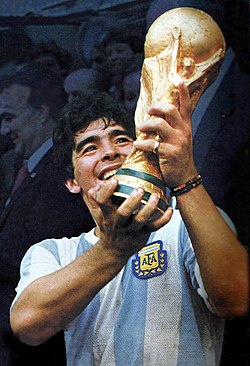
Jan 1, 1971
% complete
At age 10, Maradona joined Los Cebollitas, the youth team of Argentinos Juniors. He became a star attraction, leading the team to a long unbeaten run and dazzling spectators with his dribbling skills as a young boy.
Oct 20, 1976
% complete
Maradona made his professional debut for Argentinos Juniors just ten days before his sixteenth birthday, becoming one of the youngest players ever to appear in the Argentine Primera División. He scored his first professional goal shortly afterward.
Image source: Argentinos Juniors
Feb 27, 1977
% complete
Maradona made his senior international debut for Argentina against Hungary at age 16, becoming one of the youngest players to represent the country. Despite his talent, he was controversially left out of the squad that won the 1978 World Cup at home.
Image source: Argentina national football team
Sep 7, 1979
% complete
Maradona captained Argentina to victory at the 1979 FIFA World Youth Championship in Japan, winning the Golden Ball as the tournament's best player. His performances announced him as one of the most exciting talents in world football.
Image source: 1979 FIFA World Youth Championship
Jun 13, 1982 - Jul 11, 1982
% complete
Maradona played in his first FIFA World Cup in Spain in 1982. Although he showed flashes of brilliance and scored twice against Hungary, Argentina was eliminated in the second round, and Maradona was sent off against Brazil in his final match of the tournament.
Image source: 1982 FIFA World Cup
May 31, 1986 - Jun 29, 1986
% complete
Maradona captained Argentina at the 1986 FIFA World Cup in Mexico and delivered arguably the greatest individual performance in tournament history. He scored five goals and made five assists, winning the Golden Ball as the best player of the tournament.
Jun 22, 1986
% complete
In the quarterfinal against England, Maradona scored the infamous 'Hand of God' goal, punching the ball past goalkeeper Peter Shilton unnoticed by the referee. The goal became one of the most controversial moments in World Cup history.
Image source: Argentina v England (1986 FIFA World Cup)
Jun 22, 1986
% complete
Just four minutes after the Hand of God, Maradona scored what is widely regarded as the 'Goal of the Century,' slaloming past five English players from his own half before scoring. The goal cemented his legend as perhaps the greatest player of all time.
Jun 29, 1986
% complete
Maradona led Argentina to a 3–2 victory over West Germany in the final at the Estadio Azteca, providing the assist for the winning goal. It was Argentina's second World Cup title and Maradona's crowning achievement as captain.
Image source: 1986 FIFA World Cup final
Jun 8, 1990 - Jul 8, 1990
% complete
Despite playing through injury, Maradona captained Argentina to the 1990 World Cup final in Italy, famously eliminating hosts Italy in the semifinals in Naples. Argentina lost 1–0 to West Germany in the final, settling for runners-up medals.
Image source: 1990 FIFA World Cup
Jun 21, 1994 - Jul 17, 1994
% complete
Maradona appeared in his fourth World Cup in the United States, scoring a memorable goal against Greece. However, he was sent home after testing positive for ephedrine, ending his World Cup career in disgrace as Argentina faltered without him.
Image source: 1994 FIFA World Cup
Feb 20, 1981
% complete
Maradona fulfilled a childhood dream by transferring from Argentinos Juniors to Boca Juniors. He helped the club win the 1981 Metropolitano championship and became an idol of the Boca faithful before moving abroad.
Image source: Boca Juniors
Jun 1, 1982
% complete
After the 1982 World Cup, Maradona moved to FC Barcelona for a then-world-record fee of around £5 million. His time in Spain was marked by brilliant performances but also injuries, illness, and conflicts, including a notorious brawl in the 1984 Copa del Rey final.
Image source: FC Barcelona
Jul 5, 1984
% complete
Maradona joined Italian club Napoli for a world-record £6.9 million fee. In Naples, he would reach the peak of his club career, transforming a modest southern Italian side into champions and becoming a beloved icon of the city.
Image source: SSC Napoli
May 10, 1987
% complete
Maradona inspired Napoli to their first Serie A championship in club history, a historic triumph for southern Italy. He finished as the league's top scorer that season and became a near-religious figure in Naples.
Image source: 1986–87 Serie A
May 17, 1989
% complete
Maradona captained Napoli to victory in the 1988–89 UEFA Cup, defeating VfB Stuttgart in the final. It was the club's first major European trophy and further solidified his status as Napoli's greatest-ever player.
Apr 29, 1990
% complete
Maradona guided Napoli to their second Serie A title in 1990, confirming the club's place among Italy's elite during his era. He also led them to multiple Coppa Italia and Supercoppa Italiana victories during his seven years at the club.
Image source: 1989–90 Serie A
Sep 1, 1992
% complete
After serving his ban, Maradona left Napoli and joined Spanish side Sevilla under coach Carlos Bilardo. His stint lasted only one season, marked by flashes of skill but declining fitness, before a falling-out with the club's management.
Image source: Sevilla FC
Oct 1, 1993
% complete
Maradona returned to Argentine football with Newell's Old Boys in Rosario. His spell was brief and troubled, but he still earned a recall to the national team during this period under coach Alfio Basile.
Image source: Newell's Old Boys
Oct 1, 1995 - Oct 25, 1997
% complete
Maradona returned to Boca Juniors for a final stint from 1995 to 1997, where he continued to display glimpses of genius despite fitness struggles. He played his last official match on October 25, 1997, and retired shortly afterward at age 36.
Mar 17, 1991
% complete
Maradona tested positive for cocaine while playing for Napoli and received a 15-month ban from football. The suspension marked the beginning of a well-publicized struggle with drug addiction that shadowed the rest of his career.
Jan 1, 2000
% complete
In a FIFA internet poll for Player of the Century, Maradona finished first among online voters, sharing the award with Pelé after a separate panel vote. The recognition confirmed his standing among the greatest footballers in history.
Jan 1, 1994 - Dec 31, 1995
% complete
During the mid-1990s, Maradona had short and unsuccessful spells managing Deportivo Mandiyú and Racing Club in Argentina. These early coaching experiences foreshadowed his later, more prominent managerial roles.
Oct 30, 1997
% complete
Maradona officially retired from professional football on his 37th birthday in 1997. His farewell matches followed in subsequent years, and he struggled with health issues and addiction during his transition away from playing.
Nov 3, 2008
% complete
Maradona was appointed manager of the Argentina national team in November 2008. After a rocky qualifying campaign, he led the team to the 2010 World Cup in South Africa, where they reached the quarterfinals before losing 4–0 to Germany.
May 1, 2011 - Jul 10, 2012
% complete
Following his departure from the national team, Maradona coached Dubai-based club Al-Wasl in the UAE Pro-League. His tenure lasted about a year and ended without major silverware, though it kept him involved in global football.
May 1, 2018 - Jan 1, 2019
% complete
Maradona took on a role as chairman of Belarusian club Dynamo Brest in 2018, a short-lived executive position. He later moved into management again with Mexican second-division side Dorados de Sinaloa.
Image source: FC Dynamo Brest
Sep 5, 2019 - Nov 25, 2020
% complete
Maradona's final managerial post was with Gimnasia y Esgrima La Plata in Argentina, where he was warmly embraced by fans. He remained in charge until his death in November 2020, having improved the team's fortunes considerably.
Image source: Club de Gimnasia y Esgrima La Plata
Nov 3, 2020
% complete
In early November 2020, Maradona underwent emergency surgery for a subdural hematoma. He recovered initially but died of acute pulmonary edema less than two weeks later, prompting nationwide mourning in Argentina.
Image source: Diego Maradona
Nov 25, 2020
% complete
Diego Maradona died of a heart attack on November 25, 2020, at age 60. Argentina declared three days of national mourning, and millions lined the streets of Buenos Aires for his funeral procession, honoring the man many consider the greatest footballer of all time.
Or browse the full history timeline directory, with more than 2,000 topics.
This Diego Maradona timeline was generated with the help of AI, using information found on the internet.
We work hard to keep these timelines accurate, but mistakes do get through. If you spot one, email us at [email protected] and we'll fix it for future visitors.
Generate yours with AI or build it from scratch, for free.
Export your timeline, add your own events, edit or remove AI-generated events, and much more
No credit card required.
Cancel anytime.
Cancel anytime.
You can create an unlimited number of timelines with up to 10 events on each one, customize how they look, export them to PDF, PNG, PowerPoint, CSV, and Excel, and share them with a link. Paid plans raise the event limit and add features like spreadsheet imports and collaborators.
Yes. You can cancel your subscription from your account page at any time, and you will not be charged again. Your subscription stays active for the rest of the period you already paid for.
Yes. We will email you a reminder before the annual renewal, and we will also email you a receipt.
Yes. You can email us within 15 days of any payment, and we will issue you a full refund.
Check out our pricing docs or send us an email anytime: [email protected].