-
Use Cases
-
Resources
-
Pricing
The history of San Diego spans thousands of years, beginning with the indigenous Kumeyaay people. European contact began in 1542 with Juan Rodríguez Cabrillo, followed by the founding of Mission San Diego de Alcalá in 1769, the first Spanish mission in California. San Diego later became part of Mexico after independence in 1821, then was ceded to the United States following the Mexican-American War in 1848. Incorporated as California's first city in 1850, it grew rapidly through the 20th century driven by the U.S. Navy, tourism, and biotechnology. More Less
Sep 28, 1542
% complete
Portuguese explorer Juan Rodríguez Cabrillo sailing for Spain became the first European to land at San Diego Bay, naming it San Miguel. His arrival marked the first European contact with the indigenous peoples of the area.
Image source: San Diego
Nov 10, 1602
% complete
Spanish navigator Sebastián Vizcaíno surveyed the California coast and renamed the harbor San Diego in honor of Saint Didacus of Alcalá, the name that would endure to the present day.
Image source: Sebastián Vizcaíno
Jul 14, 1769
% complete
Governor Gaspar de Portolá led the first overland Spanish expedition into Alta California, arriving at San Diego Bay and establishing the first European settlement in what is now California.
Image source: Portolá expedition
Jul 16, 1769
% complete
Father Junípero Serra founded Mission San Diego de Alcalá on Presidio Hill, the first of twenty-one Spanish missions in California. It served as a center for converting local Kumeyaay to Christianity and anchoring Spanish colonial presence.
Image source: Mission San Diego de Alcalá
May 14, 1770
% complete
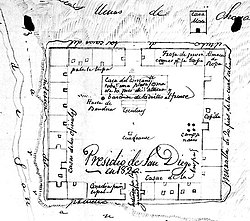
A Spanish military fort was built atop Presidio Hill overlooking Old Town, becoming the first permanent European settlement on the Pacific coast of the United States.
Image source: Presidio of San Diego
Aug 1774
% complete
Mission San Diego de Alcalá was moved from Presidio Hill to its current location in Mission Valley to be closer to water and arable land, expanding agricultural operations and the neophyte population.
Nov 4, 1775
% complete
Hundreds of Kumeyaay warriors attacked and burned Mission San Diego de Alcalá, one of the largest indigenous uprisings in Alta California, protesting Spanish encroachment on their lands and forced conversion.
Jan 1, 1835
% complete
Following Mexico's independence from Spain, secularization laws transformed the mission lands, and San Diego was formally incorporated as a Mexican pueblo with Juan María Osuna elected its first alcalde.
Image source: Old Town, San Diego
Dec 6, 1846
% complete
During the Mexican–American War, U.S. forces under General Stephen Kearny clashed with Californio lancers led by Andrés Pico near present-day Escondido. The bloody engagement ended inconclusively but marked a key moment in the American conquest of California.
Image source: Battle of San Pasqual
Jan 24, 1848 - 1855
% complete
News of gold discovery drew prospectors through San Diego, which served as a supply port, though the town's growth lagged behind northern California during this era.
Image source: California Gold Rush
Feb 2, 1848
% complete
The treaty ending the Mexican–American War transferred California, including San Diego, from Mexico to the United States, opening the region to American settlement.
Image source: Treaty of Guadalupe Hidalgo
1857
% complete
Thomas Whaley constructed his Greek Revival home in Old Town, later serving as a courthouse, theater, and store; it is now famed as one of America's most haunted houses.
Image source: Whaley House (San Diego, California)
1867
% complete
Developer Alonzo Horton purchased about 960 acres of waterfront land south of Old Town, founding 'New San Diego' downtown and shifting the city's commercial center toward the bay.
Image source: Alonzo Horton
Mar 27, 1885
% complete
After an earlier incorporation lapsed due to financial collapse, San Diego was permanently reincorporated as an American city, laying the foundation for modern municipal government.
Image source: History of San Diego
Nov 15, 1885
% complete
Completion of a direct rail link connected San Diego to the transcontinental network, triggering a real estate boom that swelled the city's population from thousands to tens of thousands.
Image source: California Southern Railroad
Feb 19, 1888
% complete
The grand Victorian beachfront resort opened on Coronado Island, quickly becoming one of the world's most famous hotels and drawing celebrities, presidents, and tourists to the San Diego area.
Image source: Hotel del Coronado
1890 - 1920
% complete
Sugar magnate John D. Spreckels poured capital into San Diego, building streetcars, newspapers like The San Diego Union, hotels, and infrastructure that shaped the city's early twentieth-century development.
Image source: John D. Spreckels
Jul 21, 1905
% complete
A boiler explosion aboard the USS Bennington in San Diego Bay killed 66 sailors, prompting an emergency response by the city and leading to a naval cemetery at Fort Rosecrans.
Image source: USS Bennington (PG-4)
Jan 1, 1915 - Jan 1, 1917
% complete
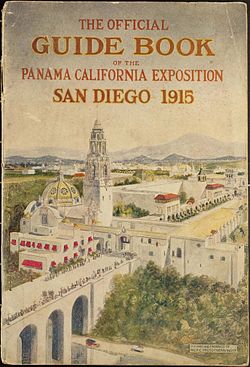
Celebrating the completion of the Panama Canal, the exposition transformed Balboa Park with ornate Spanish Colonial Revival buildings such as the California Tower, cementing San Diego's identity and boosting tourism.
Image source: Panama–California Exposition
Feb 12, 1923
% complete
The Navy dedicated Naval Training Center and expanded fleet facilities in San Diego Harbor, beginning the city's transformation into a premier military port that would dominate its economy.
Image source: Naval Base San Diego
Apr 28, 1927
% complete
Ryan Airlines in San Diego built the Spirit of St. Louis in just sixty days, the aircraft Charles Lindbergh flew on the first solo nonstop transatlantic flight, launching San Diego's aviation industry reputation.
Image source: Spirit of St. Louis
1935
% complete
Major Reuben Fleet relocated Consolidated Aircraft from Buffalo to San Diego, where it produced the B-24 Liberator and later Convair planes, making aerospace a pillar of the regional economy.
Image source: Convair
Dec 7, 1941 - 1945
% complete
World War II brought hundreds of thousands of servicemen and defense workers to San Diego, with shipyards and aircraft plants operating around the clock, permanently expanding the city's population and economy.
Image source: California during World War II
Oct 2, 1916
% complete
Founded after animals left from the Panama–California Exposition inspired Dr. Harry Wegeforth, the San Diego Zoo grew into one of the most famous zoos globally, pioneering cageless exhibits and conservation programs.
Image source: San Diego Zoo
Sep 10, 1945
% complete
The largest ship in the world at its launching, the carrier USS Midway served nearly fifty years and is now berthed downtown as the USS Midway Museum, a top San Diego attraction.
Image source: USS Midway (CV-41)
Mar 21, 1964
% complete
SeaWorld opened on Mission Bay, becoming a major tourist attraction alongside the San Diego Zoo and helping establish the city's family-vacation destination image.
Image source: SeaWorld San Diego
1965
% complete
Postwar industrialization of Tijuana and cross-border commerce made San Diego the anchor of a binational metropolitan region, shaping immigration, trade, and cultural exchange for decades.
Image source: San Diego–Tijuana
Mar 21, 1970
% complete
From a small fan convention begun in 1970, San Diego Comic-Con evolved into the world's largest pop culture event, annually drawing over 130,000 attendees and shaping film and television marketing worldwide.
Image source: San Diego Comic-Con
Jan 25, 1998
% complete
Qualcomm Stadium hosted the Denver Broncos' first Super Bowl victory before a record television audience, highlighting San Diego's role as a major sports and event host city.
Image source: Super Bowl XXXII
Apr 8, 2004
% complete
The San Diego Padres moved into Petco Park in the East Village, catalyzing downtown redevelopment and revitalizing the urban core around the ballpark district.
Image source: Petco Park
Oct 21, 2007
% complete
The Witch Creek, Harris, and other fires forced mass evacuations of half a million residents, destroyed thousands of homes, and prompted major changes in regional fire preparedness.
Image source: October 2007 California wildfires
Or browse the full history timeline directory, with more than 2,000 topics.
This History of San Diego timeline was generated with the help of AI, using information found on the internet.
We work hard to keep these timelines accurate, but mistakes do get through. If you spot one, email us at [email protected] and we'll fix it for future visitors.
Generate yours with AI or build it from scratch, for free.
Export your timeline, add your own events, edit or remove AI-generated events, and much more
No credit card required.
Cancel anytime.
Cancel anytime.
You can create an unlimited number of timelines with up to 10 events on each one, customize how they look, export them to PDF, PNG, PowerPoint, CSV, and Excel, and share them with a link. Paid plans raise the event limit and add features like spreadsheet imports and collaborators.
Yes. You can cancel your subscription from your account page at any time, and you will not be charged again. Your subscription stays active for the rest of the period you already paid for.
Yes. We will email you a reminder before the annual renewal, and we will also email you a receipt.
Yes. You can email us within 15 days of any payment, and we will issue you a full refund.
Check out our pricing docs or send us an email anytime: [email protected].