
-
Use Cases
-
Resources
-
Pricing
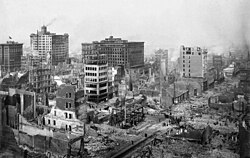
The 1906 San Francisco Earthquake struck on April 18, devastating the city with violent shaking and subsequent fires that burned for days. One of the deadliest natural disasters in U.S. history, it destroyed over 80% of San Francisco and led to major advances in earthquake science and building codes. More Less
1860 - 1906
% complete
Before the 1906 quake there were decades of minor earthquakes – more than at any other time in the historical record for northern California. Previously interpreted as precursory activity, they have been found to have a strong seasonal pattern and are now believed to be caused by large seasonal sediment loads in coastal bays that overlie faults, erosion sediments left over from hydraulic mining in the later years of the California gold rush.
Image source: 1906 San Francisco earthquake
Apr 1906
% complete
In April 1906, tenor Enrico Caruso and members of the Metropolitan Opera Company came to San Francisco to give a series of performances at the Grand Opera House, a venue constructed in 1875 primarily financed by Bank of California co-founder William Ralston, the 'man who built San Francisco.'
Apr 1906
% complete
As with the 1857 Fort Tejon earthquake, there were fewer aftershocks than would have been expected for a shock of that size. Very few of them were located along the trace of the 1906 rupture, tending to concentrate near the ends of the rupture or on other structures away from the San Andreas Fault, such as the Hayward Fault.
Apr 18, 1906
% complete
Remotely triggered events included an earthquake swarm in the Imperial Valley area, which culminated in an earthquake of about 6.1 MI at 16:30 PST on April 18, 1906.
Apr 18, 1906
% complete
The 1906 rupture propagated both northward and southward for a total of 296 miles (476 km), with shaking felt from Oregon to Los Angeles, and as far inland as central Nevada.
Apr 18, 1906
% complete
A magnitude 7.9 earthquake struck the coast of Northern California at 05:12 am Pacific Standard Time on Wednesday, April 18, 1906. The 1906 earthquake preceded the development of the Richter scale, but the most widely accepted estimate on the modern moment magnitude scale is 7.9, with proposed values from 7.7 to 8.3.
Apr 19, 1906
% complete
Another remotely triggered event occurred at 12:31 PST on April 19, 1906, with an estimated magnitude of about 5.0 MI, and an epicenter beneath Santa Monica Bay.
2019
% complete
In 2019, using an old photograph and a recorded eyewitness account, researchers were able to refine the location of the hypocenter of the earthquake as offshore from San Francisco or near San Juan Bautista, confirming previous estimates.
1906 - 1910
% complete
Until 1910, a few countries, especially in Europe, followed the call for an exclusion of the earthquake hazard from all fire insurance contracts following the 1906 earthquake.
1906 - 2000
% complete
Though San Francisco rebuilt quickly, the disaster diverted trade, industry, and population growth south to Los Angeles, which during the 20th century became the largest and most important urban area in the West.
1908
% complete
The 1908 Lawson Report, a study of the 1906 quake led and edited by Professor Andrew Lawson of the University of California, showed that the same San Andreas Fault which had caused the disaster in San Francisco ran close to Los Angeles as well. The most important characteristic of the shaking intensity noted in the report was the clear correlation of intensity with underlying geologic conditions. It included photographs documenting the disaster.
1909
% complete
In 1909, the columns and lintel of a ruined mansion were relocated to Golden Gate Park, where, known as Portals of the Past, they became an enduring monument to the city's grief and a symbol of its endurance. The haunting image became an icon of the 1906 earthquake, due largely to photographs by Worden.
Jul 1909 - Dec 1909
% complete
After the 1906 earthquake, global discussion arose concerning a legally flawless exclusion of the earthquake hazard from fire insurance contracts. In the second half of 1909, the California State Legislature enacted the California Standard Form of Fire Insurance Policy, which did not contain any earthquake clause.
1913
% complete
In an article written in 1913, John C. Branner, who was the first to begin study of the San Andreas fault in 1891, complained that the Federal Government had not conducted the serious studies needed to gather data about earthquakes on the west coast. He said public discussion was being stifled by fears that acknowledgement of earthquakes would drive away business and investors, and that geologists were told not to gather information about the 1906 earthquake, and certainly to not publish it.
1915
% complete
Reconstruction was swift, and largely completed by 1915, in time for the 1915 Panama–Pacific International Exposition which celebrated the reconstruction of the city and its 'rise from the ashes.'
Image source: Panama–Pacific International Exposition
2005
% complete
In 2005, the city's Board of Supervisors voted unanimously in support of a resolution written by novelist James Dalessandro ('1906') and city historian Gladys Hansen ('Denial of Disaster') to recognize the figure of 3,000+ as the official total.
2017
% complete
A 2017 study found that the fire had the effect of increasing the share of land used for nonresidential purposes: 'Overall, relative to unburned blocks, residential land shares on burned blocks fell while nonresidential land shares rose by 1931.' The study also provides insight into what held the city back from making these changes before 1906: the presence of old residential buildings.
1906 - 1907
% complete
The refugee camps had a peak population of 16,448 people, but by 1907 most people had moved out.
1906
% complete
Following the 1906 San Francisco earthquake, more than 40,000 people were relocated to a makeshift tent city in Golden Gate Park and were treated by the faculty of the Affiliated Colleges. Until 1906, the school faculty had provided care at the City-County Hospital (now the San Francisco General Hospital), but did not have a hospital of its own.
Apr 1906
% complete
During the first few days after news of the disaster reached the rest of the world, relief efforts reached over $5,000,000, equivalent to $179,170,000 in 2025.
Apr 1906
% complete
Property losses from the disaster have been estimated to be more than $400 million in 1906 dollars, equivalent to $10.4 billion in 2024 dollars. An insurance industry source tallies insured losses at $235 million, the equivalent to $6.13 billion in 2024 dollars.
Apr 18, 1906
% complete
The fires that followed the earthquake cost an estimated $350 million at the time (equivalent to $9.1 billion in 2024). The original California flag used in the 1846 Bear Flag Revolt at Sonoma, stored in a state building in San Francisco, was also destroyed in the fire.
Apr 29, 1906
% complete
Eleven days after the earthquake a rare Sunday baseball game was played in New York City (which would not allow regular Sunday baseball until 1919) between the Highlanders (soon to be the Yankees) and the Philadelphia Athletics to raise money for quake survivors.
Jul 1, 1906
% complete
On July 1, 1906, non-military authorities assumed responsibility for relief efforts, and the Army withdrew from the city.
Apr 1907
% complete
In April 1907, one of the buildings was renovated for outpatient care with 75 beds, expanding medical services established after the earthquake.
Oct 1907
% complete
Gold transfers from European insurance companies to policyholders in San Francisco led to a rise in interest rates, subsequently to a lack of available loans and finally to the Knickerbocker Trust Company crisis of October 1907 which led to the Panic of 1907.
Image source: Panic of 1907
Jun 30, 1908
% complete
The last official refugee camp was closed on June 30, 1908, more than two years after the earthquake displaced tens of thousands of residents.
1906
% complete
A newsreel documentary made soon after the earthquake captured the devastation. The resulting work fed the general public's fascination for sensationalist content, but was also of interest to seismologists, architects, and urban planners.
Image source: 1906 San Francisco earthquake
1906
% complete
Will Irwin published The City That Was, a series of 1906 articles for The Sun in New York City, later collected as a booklet, documenting the destruction of San Francisco.
1915
% complete
Since 1915, the city has officially commemorated the disaster each year by gathering the remaining survivors at Lotta's Fountain, a fountain in the city's financial district that served as a meeting point during the disaster for people to look for loved ones and exchange information.
Image source: Lotta's Fountain
1936
% complete
San Francisco, a 1936 disaster movie presenting a fictionalized account of the earthquake, starred Clark Gable and became one of the most famous cinematic depictions of the disaster.
Image source: San Francisco (1936 film)
2001
% complete
The earthquake is the setting for Earthquake in the Early Morning, a 2001 book in the children's series Magic Tree House by Mary Pope Osbourne, introducing young readers to the disaster.
2005
% complete
In 2005 the National Film Registry added San Francisco Earthquake and Fire, April 18, 1906, a newsreel documentary made soon after the earthquake, to its list of American films worthy of preservation.
2006
% complete
The 1906 Centennial Alliance was set up as a clearing-house for various centennial events commemorating the earthquake. Eleven survivors attended the centennial commemorations in 2006, including Irma Mae Weule (1899–2008), who was the oldest survivor of the quake at the time of her death in August 2008, aged 109.
2007
% complete
Libera Armstrong (1902–2007) attended the 2006 anniversary but died in 2007, aged 105. Vivian Illing (1900–2009) was believed to be the second-oldest survivor at the time of her death, aged 108, leaving Herbert Hamrol (1903–2009) as the last known remaining survivor at the time of his death, aged 106.
Apr 18, 2009
% complete
William Del Monte and another survivor, Rose Cliver (1902–2012), then 106, attended the earthquake reunion celebration on April 18, 2009, the 103rd anniversary of the earthquake. William Del Monte, then 103, and Jeanette Scola Trapani (1902–2009), 106, stated that they stopped attending events commemorating the earthquake when it became too much trouble for them.
Apr 15, 2010
% complete
Nancy Stoner Sage (1905–2010) died, aged 105, in Colorado just three days short of the 104th anniversary of the earthquake on April 18, 2010. William Del Monte attended the event at Lotta's Fountain in 2010.
May 2012 - Jul 2015
% complete
107-year-old George Quilici (1905–2012) died in May 2012, and 113-year-old Ruth Newman (1901–2015) died in July 2015, further thinning the ranks of earthquake survivors.
2014
% complete
Following the earthquake, San Francisco is rebuilt and later renamed San Fransokyo in Disney's 2014 animated film Big Hero 6, blending the city with Tokyo in a futuristic setting.
Image source: Big Hero 6 (film)
Jan 2016
% complete
William Del Monte (1906–2016), who died 11 days shy of his 110th birthday, was thought to be the last survivor of the 1906 San Francisco earthquake.
Or browse the full history timeline directory, with more than 2,000 topics.
This San Francisco Earthquake of 1906 timeline was generated with the help of AI, using information found on the internet.
We work hard to keep these timelines accurate, but mistakes do get through. If you spot one, email us at [email protected] and we'll fix it for future visitors.
Generate yours with AI or build it from scratch, for free.
Export your timeline, add your own events, edit or remove AI-generated events, and much more
No credit card required.
Cancel anytime.
Cancel anytime.
You can create an unlimited number of timelines with up to 10 events on each one, customize how they look, export them to PDF, PNG, PowerPoint, CSV, and Excel, and share them with a link. Paid plans raise the event limit and add features like spreadsheet imports and collaborators.
Yes. You can cancel your subscription from your account page at any time, and you will not be charged again. Your subscription stays active for the rest of the period you already paid for.
Yes. We will email you a reminder before the annual renewal, and we will also email you a receipt.
Yes. You can email us within 15 days of any payment, and we will issue you a full refund.
Check out our pricing docs or send us an email anytime: [email protected].