-
Use Cases
-
Resources
-
Pricing
San Francisco's history spans from the founding of the Yerba Buena settlement in 1776 by Spanish colonists to its explosive growth during the California Gold Rush of 1848-1849. The city became a major port and financial center on the West Coast, was devastated by the 1906 earthquake and fire but rebuilt rapidly, and later became the epicenter of social movements including the Beat Generation, hippie counterculture of the 1960s, and LGBTQ rights activism. In recent decades, San Francisco has transformed into a leading center of technology and innovation, home to Silicon Valley's influence and major tech companies. More Less
Nov 4, 1769
% complete
An overland expedition led by Gaspar de Portolá became the first documented European party to see the San Francisco Bay, mistaking it for an inland lake at first. The discovery opened the region to Spanish colonization.
Image source: Portolá expedition
Sep 17, 1776
% complete
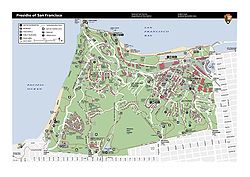
The Spanish built a fortified military post at the Golden Gate to protect the bay and support the nearby mission. The Presidio remained a military installation for over two centuries under Spanish, Mexican, and American control.
Image source: Presidio of San Francisco
Oct 9, 1776
% complete
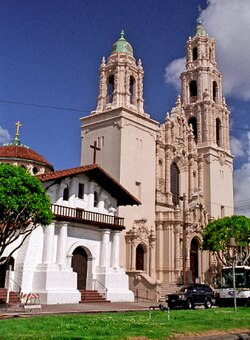
Spanish Franciscans established Mission Dolores, the oldest surviving building in San Francisco. The mission converted local Ohlone people to Christianity and agriculture, becoming the anchor of the small colonial settlement of Yerba Buena.
Image source: Mission San Francisco de Asís
1835
% complete
Englishman William Richardson established a small trading settlement on the shore of the bay near today's Portsmouth Square. Yerba Buena grew slowly as a port for hide and tallow trade with ships from around the world.
Image source: Yerba Buena, California
Jul 7, 1846
% complete
American naval forces raised the U.S. flag in Yerba Buena's plaza, claiming the town for the United States during the Mexican-American War. Mexico formally ceded California in the Treaty of Guadalupe Hidalgo in 1848.
Image source: Battle of Monterey
Apr 3, 1847
% complete
Alcalde Washington Bartlett officially changed the settlement's name from Yerba Buena to San Francisco, aligning it with the name of the nearby bay and signaling ambitions for growth.
Image source: History of San Francisco
1848 - 1850
% complete
San Francisco's population swelled from roughly 1,000 to more than 25,000 in two years. Ships were abandoned in the harbor as crews deserted for the goldfields, and some vessels were converted into stores, hotels, and jails.
Image source: California gold rush
Jan 24, 1848 - 1855
% complete
James W. Marshall discovered gold at Sutter's Mill, triggering one of the largest human migrations in history. Tens of thousands of fortune seekers, known as forty-niners, poured into San Francisco, transforming it almost overnight.
Image source: California Gold Rush
Apr 15, 1850
% complete
San Francisco was formally incorporated as a city, and later that year became the seat of the newly created San Francisco County. It quickly developed banks, newspapers, theaters, and a notorious red-light district known as the Barbary Coast.
1851 - 1856
% complete
Frustrated by crime and corruption in the booming city, citizens organized extralegal vigilance committees that hanged suspected criminals and drove out officials they deemed corrupt, highlighting the rough justice of the frontier city.
Image source: San Francisco Committee of Vigilance
Aug 2, 1873
% complete
Andrew Smith Hallidie's Clay Street Hill Railroad began operation, testing the world's first practical cable car system. The grip technology proved ideal for San Francisco's steep hills and became an enduring symbol of the city.
Image source: San Francisco cable car system
May 6, 1882 - 1943
% complete
Federal legislation barred Chinese laborers from entering the United States, the first major law restricting immigration by nationality. San Francisco's Chinatown, already the largest Chinese community in America, faced discrimination and restrictive housing policies.
Image source: Chinese Exclusion Act
1906 - 1915
% complete
In a remarkable feat of urban reconstruction, San Francisco rebuilt itself in less than a decade. New steel-frame buildings, wider streets, and grand civic structures rose from the ashes, restoring the city's status as the West's leading metropolis.
Image source: San Francisco
Apr 18, 1906
% complete
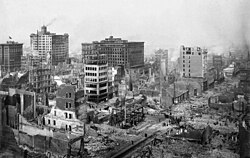
A massive earthquake estimated at magnitude 7.9 struck at 5:12 am, rupturing along the San Andreas Fault. Shaking toppled buildings across the city, but the fires that followed caused most of the destruction.
Image source: 1906 San Francisco earthquake
Apr 18, 1906 - Apr 21, 1906
% complete
Fires raged for four days after the earthquake, destroying about 80 percent of the city and leaving more than half its residents homeless. Roughly 3,000 people died, making it one of the deadliest disasters in U.S. history.
Feb 20, 1915 - Dec 4, 1915
% complete
San Francisco hosted a world's fair celebrating the completion of the Panama Canal and showcasing the city's rebirth. The fair drew millions of visitors; only the Palace of Fine Arts survives from the exposition grounds today.
Image source: Panama–Pacific International Exposition
Oct 17, 1989
% complete
A magnitude 6.9 earthquake struck just before Game 3 of the World Series at Candlestick Park, killing 63 people across the Bay Area. A section of the Bay Bridge collapsed, and the damaged Embarcadero Freeway was later demolished, opening up the waterfront.
Image source: 1989 Loma Prieta earthquake
Jan 5, 1933
% complete
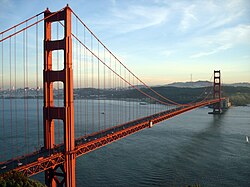
Engineer Joseph Strauss oversaw the start of work on the suspension bridge spanning the Golden Gate strait. Workers battled fog, wind, and currents, using innovative safety measures including a net that saved numerous lives.
Image source: Golden Gate Bridge
Nov 12, 1936
% complete
The Bay Bridge connected San Francisco to Oakland across the bay, becoming the longest fixed-link bridge in the world at the time. It transformed regional transportation and commerce between the two cities.
Image source: San Francisco–Oakland Bay Bridge
May 27, 1937
% complete
The iconic International Orange suspension bridge opened, instantly becoming a global landmark. At 4,200 feet, its main span was the longest in the world until 1964, and it remains one of the most photographed structures on Earth.
Feb 18, 1939 - Sep 29, 1940
% complete
A world's fair was held on artificial Treasure Island built in the bay, celebrating the new bridges. After the fair, the island became a naval base and later served as an airport site and redevelopment area.
Image source: Golden Gate International Exposition
Jun 26, 1945
% complete
Delegates from 50 nations met at the War Memorial Opera House and signed the charter establishing the United Nations, cementing San Francisco's role as the birthplace of the postwar international order.
Image source: United Nations Conference on International Organization
1955 - 1960
% complete
Poets and writers including Allen Ginsberg and Jack Kerouac made North Beach the heart of the Beat movement. Ginsberg's debut reading of 'Howl' at the Six Gallery in October 1955 became a landmark of countercultural literature.
Image source: Beat Generation
Jun 1967 - Oct 1967
% complete
As many as 100,000 young people converged on the Haight-Ashbury neighborhood, celebrating hippie culture, psychedelic music, and communal living. The event made San Francisco the epicenter of 1960s counterculture.
Image source: Summer of Love
Sep 11, 1972
% complete
Bay Area Rapid Transit launched passenger service, connecting San Francisco with the East Bay through a transbay tube. BART was among the first modern automated rail systems in the United States.
Image source: Bay Area Rapid Transit
Nov 8, 1977
% complete
Harvey Milk won election as one of the first openly gay elected officials in California, representing the Castro district. His victory marked a milestone for LGBTQ political representation in America.
Image source: Harvey Milk
Nov 27, 1978
% complete
Former supervisor Dan White shot and killed Mayor George Moscone and Harvey Milk at City Hall. The lenient sentence White received sparked the White Night riots, galvanizing the city's LGBTQ community politically.
Image source: Assassinations of George Moscone and Harvey Milk
1995 - 2000
% complete
Internet startups flocked to San Francisco's South of Market district, driving soaring rents, gentrification, and prosperity. When the bubble burst in 2000, many companies collapsed, though the tech industry soon rebounded.
Image source: Dot-com bubble
Feb 12, 2004 - Mar 11, 2004
% complete
Mayor Gavin Newsom directed the county clerk to issue marriage licenses to same-sex couples, and about 4,000 couples married before courts halted the practice. The move energized the national movement for marriage equality.
Image source: San Francisco 2004 same-sex weddings
Nov 1, 2010
% complete
The Giants defeated the Texas Rangers to capture the franchise's first championship since moving west in 1958. They won again in 2012 and 2014, sparking jubilant civic celebrations.
Image source: 2010 World Series
2011 - 2019
% complete
A surge of tech companies and workers transformed neighborhoods like SoMa and the Mission, pushing rents and home prices to among the highest in the nation while intensifying debates over displacement, homelessness, and inequality.
Image source: San Francisco housing shortage
Or browse the full history timeline directory, with more than 2,000 topics.
This History of San Francisco timeline was generated with the help of AI, using information found on the internet.
We work hard to keep these timelines accurate, but mistakes do get through. If you spot one, email us at [email protected] and we'll fix it for future visitors.
Generate yours with AI or build it from scratch, for free.
Export your timeline, add your own events, edit or remove AI-generated events, and much more
No credit card required.
Cancel anytime.
Cancel anytime.
You can create an unlimited number of timelines with up to 10 events on each one, customize how they look, export them to PDF, PNG, PowerPoint, CSV, and Excel, and share them with a link. Paid plans raise the event limit and add features like spreadsheet imports and collaborators.
Yes. You can cancel your subscription from your account page at any time, and you will not be charged again. Your subscription stays active for the rest of the period you already paid for.
Yes. We will email you a reminder before the annual renewal, and we will also email you a receipt.
Yes. You can email us within 15 days of any payment, and we will issue you a full refund.
Check out our pricing docs or send us an email anytime: [email protected].