
-
Use Cases
-
Resources
-
Pricing
Ebola outbreaks refer to recurring epidemics of Ebola virus disease (EVD), a severe and often fatal hemorrhagic fever first identified in 1976 near the Ebola River in the Democratic Republic of the Congo. The most significant outbreak occurred in West Africa between 2014 and 2016, killing over 11,000 people and prompting an unprecedented global health response. Subsequent outbreaks have continued to emerge primarily in Central Africa, driving advances in vaccines, treatments, and outbreak preparedness. More Less
Jun 27, 1976 - Nov 1976
% complete
Nearly simultaneous with the Zaire outbreak, a separate strain later named Sudan ebolavirus emerged in Nzara and Maridi, Sudan. It caused 284 cases and 151 deaths, spread through hospital workers and close contact, before being contained by November 1976.
Image source: Ebolavirus
Aug 26, 1976 - Oct 1976
% complete
The first recognized Ebola outbreak struck Yambuku, Zaire, beginning with a schoolteacher treated for suspected malaria. Contaminated needles amplified transmission, resulting in 318 cases and 280 deaths, an 88% case fatality rate. The outbreak ended after quarantine measures and hospital closures.
Image source: 1976 Zaire Ebola virus outbreak
Sep 1976
% complete
The Ebola virus was first identified in September 1976 during an outbreak near the Ebola River in Zaire (now the Democratic Republic of the Congo). Scientists at the Institute of Tropical Medicine in Antwerp and the CDC isolated the virus, a filovirus causing severe hemorrhagic fever with high fatality rates.
Image source: Ebola
Jun 1977
% complete
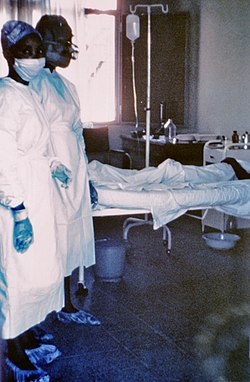
A single fatal case of Ebola occurred in Tandala, Zaire, in June 1977, when a nine-year-old girl died of hemorrhagic fever. Retrospective investigation suggested earlier undetected cases, indicating the virus had circulated silently between outbreaks.
Jul 31, 1979 - Oct 6, 1979
% complete
Sudan ebolavirus re-emerged in Nzara, Sudan, in 1979, causing 34 cases and 22 deaths. The outbreak originated in the same cotton factory implicated in 1976 and was contained within three months through isolation measures.
Nov 1994
% complete
A Swiss ethologist performing a necropsy on a wild chimpanzee in the Tai Forest, Ivory Coast, became infected with a new ebolavirus species, Tai Forest ebolavirus. She survived, marking the first recognized human infection with this species and linking chimpanzees as a source.
Oct 1989
% complete
A new filovirus, later named Reston virus, was discovered among imported crab-eating macaques at a quarantine facility in Reston, Virginia. Though highly lethal to monkeys, it appeared non-pathogenic to humans, and several workers developed asymptomatic infections.
Image source: Reston virus
Aug 2007 - Feb 2008
% complete
An outbreak in Bundibugyo District, Uganda, revealed a genetically distinct species, Bundibugyo ebolavirus. It caused 149 cases and 37 deaths with a lower fatality rate than other species, expanding scientific understanding of ebolavirus diversity.
Image source: Bundibugyo ebolavirus
2014 - 2015
% complete
Experimental treatments such as ZMapp, favipiravir, and convalescent plasma were used under compassionate protocols during the West African epidemic. While results were inconclusive due to study limitations, they accelerated development of evidence-based Ebola therapeutics.
Image source: ZMapp
Oct 2014
% complete
Clinical trials of experimental vaccines, including rVSV-ZEBOV (Ervebo) and cAd3-ZEBOV, launched in late 2014 amid the epidemic. The rVSV-ZEBOV ring vaccination trial in Guinea in 2015 demonstrated high efficacy, paving the way for eventual licensure.
Image source: RVSV-ZEBOV vaccine
Aug 12, 2019
% complete
During the Kivu epidemic, a randomized controlled trial found monoclonal antibody treatments mAb114 and REGN-EB3 significantly reduced Ebola mortality compared to ZMapp. The findings established effective therapeutics for future outbreaks and changed standard of care.
Image source: Atoltivimab/maftivimab/odesivimab
Nov 11, 2019 - Dec 19, 2019
% complete
The European Medicines Agency approved Ervebo (rVSV-ZEBOV) on November 11, 2019, followed by US FDA approval on December 19, 2019 — the first licensed Ebola vaccine. Prequalified by WHO, it became a cornerstone of outbreak response strategies.
Oct 14, 2020
% complete
The US FDA approved Inmazeb (atoltivimab, maftivimab, and odesivimab-ebgn), a REGN-EB3-based triple antibody cocktail, as the first approved treatment for Zaire ebolavirus infection in adults and children, followed shortly by approval of Ebanga (mAb114).
Dec 1994 - Feb 1996
% complete
Zaire ebolavirus caused successive outbreaks in northeastern Gabon linked to chimpanzee and gorilla carcasses. The outbreaks in Mekouka, Mayibout, and Booué produced dozens of cases and deaths, underscoring wildlife-to-human spillover pathways.
Jan 1995 - Jul 16, 1995
% complete
The Kikwit outbreak in Zaire began with a laboratory worker and spread through hospitals and families, causing 315 cases and 254 deaths. International teams from WHO, CDC, and Médecins Sans Frontières helped contain it, highlighting the need for rapid global response systems.
Image source: List of Ebola outbreaks
Oct 2000 - Jan 2001
% complete
Sudan ebolavirus emerged in Gulu, Uganda, spreading to Mbarara and Masindi. The outbreak caused 425 cases and 224 deaths, the largest recorded before 2014. Traditional burial practices amplified transmission until safe burial protocols were introduced.
Image source: 2026 Ebola epidemic
Oct 2001 - Jun 2003
% complete
A series of Zaire ebolavirus outbreaks across the Gabon–Republic of Congo border region killed both humans and great apes. The 2001–2002 outbreak caused over 120 cases, and the 2002–2003 Mbomo outbreak killed roughly 128 people, with gorilla die-offs documented in the region.
Apr 2004 - Jun 2004
% complete
An outbreak of Sudan ebolavirus in Yambio County, southern Sudan, produced 17 cases and 7 deaths. Rapid response by WHO and local health authorities contained the outbreak within two months.
May 2005 - Jun 2005
% complete
A small outbreak in Etoumbi, Cuvette-Ouest region of the Republic of Congo, caused several suspected cases and deaths. The village was quarantined, and the outbreak ended quickly, likely linked to handling of infected animal carcasses.
Nov 2008 - Feb 2009
% complete
Zaire ebolavirus struck the Kasai Occidental province of the Democratic Republic of the Congo, causing 32 cases and 15 deaths. The outbreak was declared over in February 2009 following containment efforts.
May 2011
% complete
A lone case of Sudan ebolavirus occurred in Luwero District, Uganda, killing a twelve-year-old girl. No further transmission was detected, but the case prompted heightened surveillance in the region.
Jun 2012 - Nov 2012
% complete
Multiple small outbreaks occurred in 2012: Sudan ebolavirus in Kibaale, Uganda (24 cases, 17 deaths), Bundibugyo ebolavirus in Isiro, DR Congo (57 cases), and another Sudan ebolavirus cluster in Luwero. All were contained by late 2012.
May 11, 2017 - Jul 2, 2017
% complete
Zaire ebolavirus resurfaced in the remote Likati health zone of Bas-Uele Province, DR Congo, causing 8 cases and 4 deaths. The rapid deployment of vaccines and mobile laboratories marked a new era of swift outbreak response.
May 8, 2018 - Jul 24, 2018
% complete
An outbreak in Bikoro, Iboko, and Wangata in Équateur Province, DR Congo, caused 54 cases and 33 deaths. For the first time, ring vaccination with rVSV-ZEBOV was deployed at scale during an active outbreak, helping contain it within two months.
Image source: 2018 Équateur Province Ebola outbreak
Aug 1, 2018 - Jun 25, 2020
% complete
The Kivu Ebola epidemic in North Kivu and Ituri provinces became the second-largest Ebola outbreak ever, with over 3,400 cases and 2,300 deaths. Armed conflict, community mistrust, and population displacement severely hampered response efforts for nearly two years.
Image source: Kivu Ebola epidemic
Jun 1, 2020 - Nov 18, 2020
% complete
While still fighting the Kivu epidemic, DR Congo faced a new outbreak in Équateur Province starting June 2020. It caused 130 cases and 55 deaths; genomic analysis showed it was unrelated to the eastern outbreak, demonstrating independent spillover events.
Feb 7, 2021 - May 3, 2021
% complete
DR Congo declared its twelfth Ebola outbreak on February 7, 2021, in Biena and Katwa health zones of North Kivu. Linked to persistence in a survivor of the Kivu epidemic, it caused 12 cases and 6 deaths before being declared over in May 2021.
Dec 2013
% complete
The deadliest Ebola epidemic in history began in December 2013 in Meliandou, Guinea, likely sparked by contact with an infected bat colony. The initial cases went unrecognized, allowing the virus to spread into neighboring Liberia and Sierra Leone.
Image source: Western African Ebola epidemic
Aug 2014 - Oct 2014
% complete
Travelers infected in West Africa were diagnosed in the United States, Spain, and other countries in 2014. Cases in Dallas and Madrid involved healthcare worker transmissions, prompting enhanced screening at international airports and revised infection control protocols worldwide.
Aug 8, 2014
% complete
The World Health Organization declared the West African Ebola epidemic a Public Health Emergency of International Concern on August 8, 2014. By then the disease had killed nearly 1,000 people and was overwhelming fragile health systems in Guinea, Liberia, and Sierra Leone.
May 9, 2015
% complete
Liberia, once the hardest-hit country, was declared free of Ebola transmission by WHO on May 9, 2015, after 42 days without a confirmed case. The country experienced brief flare-ups afterward before its final declaration in 2016.
Jan 14, 2016
% complete
WHO announced the end of the West African Ebola epidemic on January 14, 2016, after Liberia passed its final surveillance milestone. The epidemic caused over 28,600 cases and more than 11,300 deaths, transforming global pandemic preparedness policy.
Feb 14, 2021 - Jun 19, 2021
% complete
Guinea reported a resurgence of Zaire ebolavirus near Gouéké in N'Zérékoré region, five years after the 2014–2016 epidemic. Genomic sequencing suggested the virus persisted in a survivor and was reactivated rather than arising from a new spillover. The outbreak caused 23 cases and 12 deaths.
Image source: Western African Ebola virus epidemic
Or browse the full history timeline directory, with more than 2,000 topics.
This Ebola Outbreaks timeline was generated with the help of AI, using information found on the internet.
We work hard to keep these timelines accurate, but mistakes do get through. If you spot one, email us at [email protected] and we'll fix it for future visitors.
Generate yours with AI or build it from scratch, for free.
Export your timeline, add your own events, edit or remove AI-generated events, and much more
No credit card required.
Cancel anytime.
Cancel anytime.
You can create an unlimited number of timelines with up to 10 events on each one, customize how they look, export them to PDF, PNG, PowerPoint, CSV, and Excel, and share them with a link. Paid plans raise the event limit and add features like spreadsheet imports and collaborators.
Yes. You can cancel your subscription from your account page at any time, and you will not be charged again. Your subscription stays active for the rest of the period you already paid for.
Yes. We will email you a reminder before the annual renewal, and we will also email you a receipt.
Yes. You can email us within 15 days of any payment, and we will issue you a full refund.
Check out our pricing docs or send us an email anytime: [email protected].