-
Use Cases
-
Resources
-
Pricing
The SARS (Severe Acute Respiratory Syndrome) outbreak was a viral respiratory illness caused by the SARS coronavirus (SARS-CoV), first identified in Guangdong Province, China, in November 2002. It spread to more than two dozen countries across Asia, Europe, North America, and South America before being contained by July 2003 through international public health cooperation, quarantine measures, and travel advisories. More Less
Nov 2002 - Jul 2003
% complete
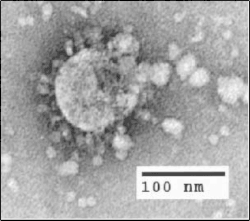
By the time the WHO declared SARS contained in July 2003, the 2002–2004 outbreak had infected over 8,000 people from 30 countries and territories and resulted in at least 774 deaths worldwide, making it one of the most significant epidemics of the early 21st century.
Image source: SARS
May 2003 - Jun 2003
% complete
By May and June 2003, sustained public health measures including isolation, quarantine, and contact tracing brought new SARS cases sharply down across affected regions. The decline paved the way for the WHO to begin declaring regions free of local transmission.
Jul 2003 - Dec 2003
% complete
Even after the WHO declared SARS contained on 5 July 2003, health authorities maintained surveillance for possible re-emergence of the virus. Continued vigilance proved warranted, as isolated SARS cases would surface again in the following months.
Jul 2003 - May 2004
% complete
Despite the WHO's declaration of containment in July 2003, several SARS cases were reported until May 2004. These sporadic cases, including laboratory-associated infections, delayed the complete end of the 2002–2004 outbreak period.
Jul 5, 2003
% complete
On 5 July 2003, the World Health Organization declared SARS contained, marking the end of the major phase of the outbreak roughly eight months after it began. The declaration followed weeks without new cases in previously affected areas.
Jan 2004 - May 2004
% complete
In the winter and spring of 2004, a small number of additional SARS cases were confirmed before the outbreak finally subsided. By May 2004, no further cases were being reported, effectively ending the 2002–2004 SARS outbreak.
Dec 2004 - Mar 2005
% complete
The winter of 2004–2005 was the first winter without a single case of SARS since the initial outbreak in late 2002. The absence of cases signaled that the virus had been successfully eliminated from human circulation.
Jan 2005 - May 2005
% complete
By 2005, no cases of severe acute respiratory syndrome had been reported that year or in late 2004. As Jim Yardley of the New York Times wrote in May 2005, it was the first winter without a case since the initial outbreak in late 2002.
May 2005
% complete
In May 2005, Jim Yardley of the New York Times wrote: 'Not a single case of the severe acute respiratory syndrome has been reported this year [2005] or in late 2004.' His reporting highlighted that it was the first winter without a case since the initial outbreak in late 2002.
Nov 2002
% complete
The outbreak was first identified in Foshan, Guangdong, China, in November 2002. This marked the earliest recognition of the mysterious respiratory illness that would soon spread beyond southern China and become a global public health emergency.
Nov 2002 - Feb 2003
% complete
Following its emergence in Foshan in November 2002, SARS spread through communities and hospitals in Guangdong province during late 2002 and early 2003. The initial period of transmission occurred largely before international health authorities were fully informed of the outbreak's scale.
Nov 2002 - Jul 2003
% complete
The major part of the SARS outbreak lasted about eight months, from November 2002 to July 2003. During this period the disease infected over 8,000 people from 30 countries and territories and resulted in at least 774 deaths worldwide.
Nov 16, 2002
% complete
On 16 November 2002, an outbreak of severe acute respiratory syndrome (SARS) began in China's Guangdong province, bordering Hong Kong. The illness was caused by the SARS coronavirus (SARS-CoV or SARS-CoV-1), which would go on to infect over 8,000 people across 30 countries and territories.
2003
% complete
Scientists identified severe acute respiratory syndrome coronavirus (SARS-CoV or SARS-CoV-1) as the cause of the 2002–2004 outbreak. The identification of the novel coronavirus enabled diagnostic testing and informed the public health strategies used to contain the epidemic.
Image source: SARS-CoV-1
Feb 2003
% complete
In February 2003, Liu Jianlun became Hong Kong's SARS index patient. A doctor who had treated patients in Guangdong, he carried the virus to Hong Kong, where his stay at a hotel led to further transmission that ultimately seeded outbreaks around the world.
Image source: 2002–2004 SARS outbreak
Feb 2003 - Mar 2003
% complete
From Hong Kong, SARS spread rapidly via international air travel in February and March 2003. Infected travelers carried the virus to numerous countries, contributing to the more than 8,000 infections eventually recorded across 30 countries and territories.
Feb 2003 - Jul 2003
% complete
Over the course of the 2002–2004 outbreak, SARS spread to more than 30 countries and territories, infecting over 8,000 people. International air travel played a key role in carrying the virus far beyond its origins in southern China.
Feb 15, 2003
% complete
China later reported that the SARS outbreak in Guangdong had peaked in mid-February 2003. Despite this peak in the province where the disease emerged, the virus was already poised to spread internationally through travelers from the region.
Nov 2002 - Jul 2003
% complete
Throughout the outbreak, health-care workers were disproportionately affected. In China's initial report to the WHO alone, 105 of the 305 reported cases were health-care workers, underscoring the risks faced by medical staff treating SARS patients in hospitals.
Feb 2003
% complete
In February 2003, the World Health Organization (WHO) was formally notified of the SARS outbreak. The notification set in motion international surveillance efforts as cases continued to multiply in China and began appearing elsewhere in Asia and beyond.
Feb 11, 2003
% complete
The People's Republic of China notified the World Health Organization (WHO) about the outbreak on 11 February 2003, reporting 305 cases including 105 health-care workers and five deaths. This notification came roughly three months after the outbreak began in Guangdong province.
Mar 2003
% complete
In March 2003, the World Health Organization issued a global alert about the SARS outbreak. The unprecedented alert warned health authorities worldwide about the atypical pneumonia spreading from Asia and urged heightened surveillance and containment measures.
Mar 2003 - Apr 6, 2003
% complete
The Ministry of Education in Singapore announced that all primary schools, secondary schools, and junior colleges were to be shut until 6 April 2003. The sweeping closure was part of Singapore's aggressive efforts to curb the spread of SARS within the city-state.
Mar 2003 - May 2003
% complete
Alongside school closures, Singapore deployed quarantine measures, temperature screening, and isolation of suspected cases during the spring of 2003. These measures became a model for epidemic response and helped bring Singapore's SARS outbreak under control.
Mar 2003 - Jun 2003
% complete
At the height of the outbreak in spring 2003, SARS disrupted travel, commerce, and everyday life across affected regions in Asia and beyond. Quarantines, travel advisories, and public fear significantly reduced movement between cities and countries battling the virus.
May 3, 2003
% complete
On 3 May, the 2003 FIFA Women's World Cup was abruptly moved to the United States due to the SARS outbreak. The tournament had originally been scheduled to be held in China, but concerns over the epidemic forced organizers to relocate the event on short notice.
Image source: 2003 FIFA Women's World Cup
Dec 2019
% complete
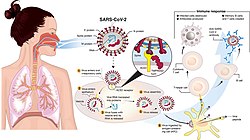
In late December 2019, SARS-CoV-2, a coronavirus in the same genus as the one that caused SARS, was discovered in Wuhan, Hubei, China. The discovery of the novel virus recalled memories of the 2002–2004 SARS outbreak and prompted immediate investigation.
Image source: SARS-CoV-2
Dec 2019
% complete
The newly discovered SARS-CoV-2 strain causes COVID-19, a respiratory disease related to but distinct from SARS. Unlike SARS-CoV-1, the new coronavirus proved capable of sustained global transmission, echoing and exceeding the earlier outbreak's impact.
Image source: COVID-19
Jan 2020 - Feb 2020
% complete
In early 2020, COVID-19 spread from Wuhan to other areas of Asia, following patterns reminiscent of the 2003 SARS outbreak. Countries that had experienced SARS drew on lessons learned from that epidemic as they responded to the emerging threat.
Image source: COVID-19 pandemic
Mar 2020
% complete
In early 2020, COVID-19 spread worldwide, marking the start of the COVID-19 pandemic. The pandemic represented the legacy of the SARS outbreak, as the new coronavirus belonged to the same genus as SARS-CoV-1 and benefited from the globalized travel networks that had also fueled SARS's spread in 2003.
Or browse the full history timeline directory, with more than 2,000 topics.
This SARS Outbreak timeline was generated with the help of AI, using information found on the internet.
We work hard to keep these timelines accurate, but mistakes do get through. If you spot one, email us at [email protected] and we'll fix it for future visitors.
Generate yours with AI or build it from scratch, for free.
Export your timeline, add your own events, edit or remove AI-generated events, and much more
No credit card required.
Cancel anytime.
Cancel anytime.
You can create an unlimited number of timelines with up to 10 events on each one, customize how they look, export them to PDF, PNG, PowerPoint, CSV, and Excel, and share them with a link. Paid plans raise the event limit and add features like spreadsheet imports and collaborators.
Yes. You can cancel your subscription from your account page at any time, and you will not be charged again. Your subscription stays active for the rest of the period you already paid for.
Yes. We will email you a reminder before the annual renewal, and we will also email you a receipt.
Yes. You can email us within 15 days of any payment, and we will issue you a full refund.
Check out our pricing docs or send us an email anytime: [email protected].