-
Use Cases
-
Resources
-
Pricing
Edgar Allan Poe (1809–1849) was an American writer, poet, editor, and literary critic best known for his dark, macabre tales and poems. A pioneer of Gothic fiction and detective fiction, Poe's works—including 'The Raven,' 'The Tell-Tale Heart,' and 'The Fall of the House of Usher'—have had a lasting influence on literature worldwide. More Less
1750
% complete
Poe's grandfather, David Poe, had emigrated from County Cavan, Ireland, around 1750, establishing the family line in America that would eventually produce the famed writer.
Image source: Edgar Allan Poe
Jan 19, 1809
% complete
Edgar Poe was born in Boston, Massachusetts, on January 19, 1809, the second child of American actor David Poe Jr. He would grow up to become one of America's most influential writers of poetry and short stories.
1810
% complete
In 1810, Poe's father abandoned the family, leaving his mother Eliza to care for the children alone. This abandonment marked the beginning of a turbulent childhood for young Edgar.
1811
% complete
When Eliza Poe died in 1811 from pulmonary tuberculosis, young Edgar was taken in by John and Frances Allan of Richmond, Virginia. Though never formally adopted, he took their name as part of his own.
1812
% complete
The Allan family had Poe baptized into the Episcopal Church in 1812, formalizing his place within the household of John and Frances Allan in Richmond.
1815
% complete
The family sailed to the United Kingdom in 1815, where John Allan pursued business interests, bringing young Poe along to Europe for several formative years.
1820
% complete
Poe moved with the Allans back to Richmond, Virginia, in 1820, returning to America after his schooling in Scotland and England.
1825
% complete
By summer 1825, Allan celebrated his expansive new wealth by purchasing a two-story brick house called Moldavia, providing a grander home for the family including Poe.
Mar 1825
% complete
In March 1825, Allan's uncle and business benefactor William Galt died, said to be one of the wealthiest men in Richmond, leaving Allan several acres of real estate estimated at $750,000 (equivalent to $21,000,000 in 2025).
Feb 28, 1829
% complete
Frances Allan, Poe's beloved foster mother, died on February 28, 1829. Her death prompted a temporary rapprochement between Poe and John Allan.
Oct 1830
% complete
In October 1830, Allan married his second wife Louisa Patterson, further straining his already difficult relationship with Poe.
1815
% complete
Poe attended the grammar school in Irvine, Ayrshire, Scotland, where Allan had been born, before rejoining the family in London in 1816.
1816 - 1817
% complete
While living in London, Poe studied at a boarding school in Chelsea until summer 1817, receiving an education during his years abroad with the Allans.
Feb 1826
% complete
Poe may have become engaged to Sarah Elmira Royster before he registered at the University of Virginia in February 1826 to study ancient and modern languages. His dorm room at 13 West Range is preserved today.
Image source: University of Virginia
Jul 1826
% complete
After Jefferson died in July 1826, a fellow student later reported that Poe had been present at the funeral of the university's founder.
Image source: Thomas Jefferson
1824
% complete
In 1824, Poe served as the lieutenant of the Richmond youth honor guard as the city celebrated the visit of the Marquis de Lafayette, the famed Revolutionary War hero.
May 27, 1827
% complete
As Poe was unable to support himself, he decided to enlist in the United States Army as a private on May 27, 1827, using the assumed name 'Edgar A. Perry'.
Image source: United States Army
Nov 8, 1827
% complete
Poe's 1st Regiment of Artillery was posted to Fort Moultrie in Charleston, South Carolina, before embarking on the brig Waltham on November 8, 1827. The island later inspired his tale 'The Gold-Bug'.
Image source: Fort Moultrie
Apr 15, 1829
% complete
Poe was finally discharged on April 15, 1829, after securing a replacement to finish his enlistment, allowing him to pursue other opportunities.
Jul 1, 1830
% complete
Poe traveled to West Point and matriculated as a cadet on July 1, 1830, continuing his military education after his Army service.
Image source: United States Military Academy
Feb 8, 1831
% complete
On February 8, 1831, Poe was tried for gross neglect of duty and disobedience of orders for refusing to attend formations, classes, and church, effectively ending his West Point career.
Apr 1827
% complete
Instead of remaining in Richmond, Poe traveled to Boston in April 1827, sustaining himself with odd jobs as a clerk and newspaper contributor while pursuing his literary ambitions.
Sep 1829
% complete
That September, Poe received 'the very first words of encouragement I ever remember to have heard' in a review by influential critic John Neal, prompting Poe to dedicate one of the poems to Neal in his second book, Al Aaraaf, Tamerlane and Minor Poems, published in Baltimore in 1829.
Image source: John Neal
Feb 1831
% complete
Poe left for New York in February 1831 and then released a third volume of poems, simply titled Poems, continuing his efforts to establish himself as a writer.
Oct 1833
% complete
The Baltimore Saturday Visiter awarded Poe a prize in October 1833 for his often overlooked short story 'MS. Found in a Bottle', an early sign of recognition for his fiction.
Image source: MS. Found in a Bottle
1835 - Jan 1837
% complete
In 1835, Poe became assistant editor of the Southern Literary Messenger, but White discharged him within a few weeks, allegedly for being drunk on the job. He remained associated with the Messenger until January 1837.
Image source: Southern Literary Messenger
1838 - 1844
% complete
In 1838, Poe relocated to Philadelphia, where he lived at five different residences between 1838 and 1844, one of which at 532 N. 7th Street is now preserved as a historic site.
1839
% complete
In the summer of 1839, Poe became assistant editor of Burton's Gentleman's Magazine, one of several editorial positions he held during his Philadelphia years.
Image source: Burton's Gentleman's Magazine
1839
% complete
Also in 1839, the collection Tales of the Grotesque and Arabesque was published in two volumes, though Poe received little remuneration from it and the volumes received generally mixed reviews.
Image source: Tales of the Grotesque and Arabesque
Jun 1840
% complete
In June 1840, Poe published a prospectus announcing his intentions to start his own journal called The Stylus, originally intended to be called The Penn since it would have been based in Philadelphia. He bought advertising space in the June 6, 1840, issue of Philadelphia's Saturday Evening Post.
Image source: Stylus
Jul 1841
% complete
In July 1841, Poe published an essay called 'A Few Words on Secret Writing' in Graham's Magazine, showcasing his fascination with cryptography. Two ciphers he published in 1841 under the name 'W. Tyler' were not solved until 1992 and 2000 respectively.
Image source: The Gold-Bug
Sep 1842
% complete
Poe failed to appear for a meeting with Thomas to discuss an appointment in mid-September 1842, claiming to have been sick, though Thomas believed that he had been drunk.
Jan 29, 1845
% complete
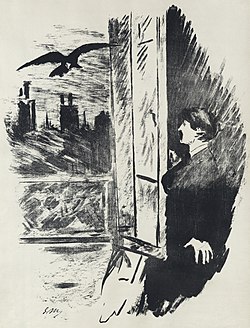
On January 29, 1845, Poe's poem 'The Raven' appeared in the Evening Mirror and quickly became a popular sensation. It made Poe a household name almost instantly, though he was paid only $9 (equivalent to $311 in 2025) for its publication.
Image source: The Raven
1846
% complete
The Broadway Journal failed in 1846, and Poe moved to a cottage in Fordham, New York, in the Bronx, where he would spend the final years caring for his ailing wife.
Image source: Edgar Allan Poe Cottage
1848
% complete
Eureka: A Prose Poem, an essay written in 1848, included a cosmological theory that presaged the Big Bang theory by 80 years, as well as the first plausible solution to Olbers' paradox.
Image source: Eureka: A Prose Poem
Aug 1, 1831
% complete
Poe returned to Baltimore in March 1831 to live with his aunt, brother, and cousin. His elder brother Henry had been seriously ill due in part to complications from alcoholism, and he died on August 1, 1831.
Image source: Henry Poe
Sep 22, 1835
% complete
Poe returned to Baltimore, where he obtained a license to marry his cousin Virginia on September 22, 1835, though it is unknown if they were actually married at that time.
Image source: Virginia Eliza Clemm Poe
May 16, 1836
% complete
On May 16, 1836, when he was 27, Poe officially married his 13-year-old cousin Virginia at a Presbyterian wedding ceremony performed by Amasa Converse at their Richmond boarding house, with a witness falsely attesting Clemm's age as 21.
Jan 1842
% complete
One evening in January 1842, Virginia showed the first signs of consumption, or tuberculosis, while singing and playing the piano, which Poe described as the breaking of a blood vessel in her throat.
Jan 30, 1847
% complete
Virginia died of tuberculosis at the Fordham cottage on January 30, 1847, a devastating loss that deeply affected Poe for the remainder of his life.
Oct 3, 1849
% complete
On October 3, 1849, Poe was found semiconscious in Baltimore, 'in great distress, and... in need of immediate assistance', under circumstances that remain mysterious to this day.
Image source: Death of Edgar Allan Poe
Oct 7, 1849
% complete
Poe was taken to Washington Medical College, where he died on Sunday, October 7, 1849, at 5:00 in the morning, aged 40, before his planned journal The Stylus ever began publishing.
1850
% complete
Griswold, who bore a grudge against Poe since 1842, wrote a biographical article called 'Memoir of the Author', included in an 1850 volume of the collected works, which damaged Poe's reputation for decades.
Image source: Rufus Wilmot Griswold
1863
% complete
In 1863, a medium named Lizzie Doten published Poems of the Inner Life, which compiled several poems she claimed were written by the channeled spirits of dead authors, including Poe.
Image source: Lizzie Doten
1872
% complete
One theory dating from 1872 suggests that Poe's death resulted from cooping, a form of electoral fraud, in which citizens were forced to vote for a particular candidate, sometimes leading to violence and even murder.
1949 - Jan 19, 2009
% complete
Between 1949 and 2009, a bottle of cognac and three roses were left at Poe's original grave marker every January 19 by an unknown visitor affectionately referred to as the 'Poe Toaster'. Sam Porpora claimed on August 15, 2007, that he had started the tradition in 1949. The last appearance was on January 19, 2009, Poe's bicentennial.
Image source: Poe Toaster
2009
% complete
In 2009, the intersection of Charles and Boylston streets in Boston, two blocks north of his birthplace, was designated 'Edgar Allan Poe Square' in honor of the writer.
Dec 2009
% complete
In December 2009, one copy of Poe's exceedingly rare first book sold at Christie's auctioneers in New York City for $662,500, a record price paid for a work of American literature.
Image source: Tamerlane (poem)
2013
% complete
In 2013, The Guardian cited Pym as one of the greatest novels ever written in the English language, noting its influence on later authors such as Doyle, Henry James, B. Traven, and others. Wells noted, 'Pym tells what a very intelligent mind could imagine about the south polar region a century ago.'
Image source: The Narrative of Arthur Gordon Pym of Nantucket
Oct 5, 2014
% complete
Fundraising completed in March 2014 for a permanent memorial sculpture known as Poe Returning to Boston at Edgar Allan Poe Square. The public unveiling on October 5, 2014, was attended by former U.S. poet laureate Robert Pinsky.
Image source: Poe Returning to Boston
Or browse the full history timeline directory, with more than 2,000 topics.
This Edgar Allan Poe timeline was generated with the help of AI, using information found on the internet.
We work hard to keep these timelines accurate, but mistakes do get through. If you spot one, email us at [email protected] and we'll fix it for future visitors.
Generate yours with AI or build it from scratch, for free.
Export your timeline, add your own events, edit or remove AI-generated events, and much more
No credit card required.
Cancel anytime.
Cancel anytime.
You can create an unlimited number of timelines with up to 10 events on each one, customize how they look, export them to PDF, PNG, PowerPoint, CSV, and Excel, and share them with a link. Paid plans raise the event limit and add features like spreadsheet imports and collaborators.
Yes. You can cancel your subscription from your account page at any time, and you will not be charged again. Your subscription stays active for the rest of the period you already paid for.
Yes. We will email you a reminder before the annual renewal, and we will also email you a receipt.
Yes. You can email us within 15 days of any payment, and we will issue you a full refund.
Check out our pricing docs or send us an email anytime: [email protected].