-
Use Cases
-
Resources
-
Pricing
Dante Alighieri (1265–1321) was an Italian poet, philosopher, and political thinker widely regarded as one of the greatest writers in world literature. Born in Florence, he is best known for his epic poem The Divine Comedy, a visionary journey through Hell, Purgatory, and Paradise. His works, written in the Tuscan vernacular rather than Latin, helped establish Italian as a literary language. Dante's life was marked by political exile from Florence, his enduring love for Beatrice, and his profound influence on Western literature and culture. More Less
1100
% completado
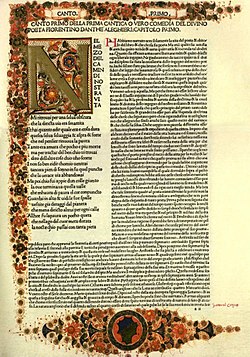
Dante claimed that his family descended from the ancient Romans (Inferno, XV, 76), but the earliest relative he could mention by name was his great-great-grandfather Cacciaguida degli Elisei (Paradiso, XV, 135), born no earlier than about 1100.
Image source: Dante Alighieri
1260
% completado
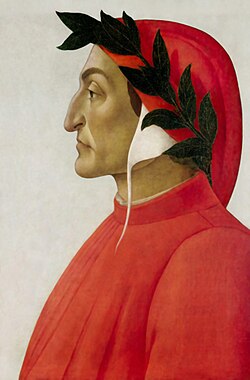
The Ghibellines took over Florence at the Battle of Montaperti in 1260, forcing out many of the Guelphs, the faction to which Dante's family belonged. This shaped the turbulent political environment of Dante's childhood.
Image source: Battle of Montaperti
May 1265
% completado
Dante Alighieri, most likely baptized Durante di Alighiero degli Alighieri, was born in Florence around May 1265, though the exact date is unknown. The sun was in Gemini between approximately May 11 and June 11 that year (Julian calendar).
1266
% completado
The Guelphs fought the Ghibellines at the Battle of Benevento in 1266, retaking Florence from the Ghibellines and restoring their dominance in the city where Dante grew up.
Image source: Battle of Benevento
1301
% completado
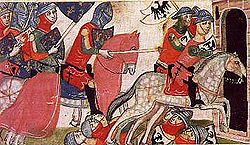
The exact date of Dante's marriage is not known; the only certain information is that, before his exile in 1301, he had fathered three children with Gemma: Pietro, Jacopo and Antonia.
Jun 11, 1289
% completado
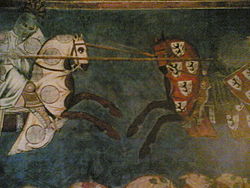
Dante fought with the Guelph cavalry of Florence against the Arezzo Ghibellines at the Battle of Campaldino on June 11, 1289, serving as a feditore responsible for the first attack.
Image source: Battle of Campaldino
1295
% completado
To further his political career, Dante obtained admission to the Guild of Physicians and Apothecaries around 1295, a necessary step for holding public office in Florence.
1300
% completado
Dante served as city prior, Florence's highest position, for two months in 1300. He was later accused of corruption and financial wrongdoing by the Black Guelphs for his conduct during this term.
Nov 1, 1301
% completado
Charles of Valois, brother of King Philip IV of France, had been appointed peacemaker for Tuscany by the Pope. On November 1, 1301, he entered Florence with the Black Guelphs, who in the next six days destroyed much of the city and killed many of their enemies.
Image source: Charles, Count of Valois
1302
% completado
The poet was still in Rome in 1302, as the Pope, who had backed the Black Guelphs, had 'suggested' that Dante stay there, keeping him away from Florence during the coup.
Mar 1302
% completado
In March 1302, Dante, a White Guelph by affiliation, along with the Gherardini family, was condemned to exile for two years and ordered to pay a large fine. He was accused of corruption and financial wrongdoing by the Black Guelphs.
1306 - 1307
% completado
In 1306–07, Dante was a guest of Moroello Malaspina in the region of Lunigiana during his years of exile from Florence.
1308 - 1310
% completado
Some speculative sources claim Dante visited Paris between 1308 and 1310, and other, less trustworthy sources say he went to Oxford. These claims, first made in Giovanni Boccaccio's book on Dante several decades after his death, seem inspired by readers impressed with the poet's wide learning.
1310
% completado
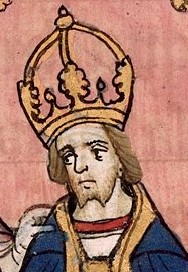
In 1310, Holy Roman Emperor Henry VII of Luxembourg marched into Italy at the head of 5,000 troops, raising Dante's hopes of returning to Florence.
Image source: Henry VII, Holy Roman Emperor
Apr 1311
% completado
Dante's Immensa Dei dilectione testante to Henry VII of Luxembourg confirms his residence 'beneath the springs of Arno, near Tuscany' in April 1311.
1312
% completado
In 1312, Henry assaulted Florence and defeated the Black Guelphs, but there is no evidence that Dante was involved in the attack.
1313
% completado
Henry VII died from a fever in 1313, and with him died any hope for Dante to see Florence again.
1315
% completado
In 1315, Florence was forced by Uguccione della Faggiuola, the military officer controlling the town, to grant an amnesty to those in exile, including Dante.
1318
% completado
Dante's final days were spent in Ravenna, where he had been invited to stay in the city in 1318 by its prince, Guido II da Polenta.
1290
% completado
When Beatrice died in 1290, Dante sought refuge in Latin literature. His interactions with Beatrice set an example of so-called courtly love, a phenomenon developed in French and Provençal poetry of prior centuries.
Image source: Beatrice Portinari
1295
% completado
The New Life (1295) contains many of Dante's love poems in Tuscan, which was not unprecedented; the vernacular had been regularly used for lyric works before, all during the thirteenth century. His use of the Florentine dialect helped establish the modern-day standardized Italian language.
Image source: La Vita Nuova
1304 - 1307
% completado
Dante wrote the Convivio around 1304–07, in which he declared that the memory of his youthful romance with Beatrice belonged to the past, though she would later return to his imagination with renewed force in the Divine Comedy.
Image source: Convivio
1314 - 1315
% completado
An early indication that the Divine Comedy was underway is a notice by Francesco da Barberino, tucked into his Documenti d'Amore (Lessons of Love), probably written in 1314 or early 1315.
Image source: Divine Comedy
1317
% completado
It is known that the Inferno had been published by 1317; this is established by quoted lines interspersed in the margins of contemporary dated records from Bologna, though it is uncertain whether the poem's parts were published in full or a few cantos at a time.
Image source: Inferno (Dante)
Sep 14, 1321
% completado
Dante died in Ravenna on September 14, 1321, aged about 56, of quartan malaria contracted while returning from a diplomatic mission to the Republic of Venice.
1329
% completado
In 1329, Bertrand du Pouget, Cardinal and nephew of Pope John XXII, classified Dante's Monarchia as heretical and sought to have his bones burned at the stake.
Image source: Monarchia
1348
% completado
The first formal biography of Dante was the Vita di Dante (also known as Trattatello in laude di Dante), written after 1348 by Giovanni Boccaccio.
1483
% completado
Bernardo Bembo, praetor of Venice, erected a tomb for Dante in 1483. A copy of Dante's death mask, probably carved in 1483 perhaps by Pietro and Tullio Lombardo, has been displayed since 1911 in the Palazzo Vecchio.
1500 - 1600
% completado
Some 16th-century English Protestants, such as John Bale and John Foxe, argued that Dante was a proto-Protestant because of his opposition to the pope.
1800 - 1900
% completado
The 19th century saw a 'Dante revival', a product of the medieval revival, which was itself an important aspect of Romanticism. Throughout the century, Dante's reputation grew and solidified.
1841
% completado
Thomas Carlyle profiled Dante in 'The Hero as Poet', the third lecture in On Heroes, Hero-Worship, & the Heroic in History (1841), declaring: 'Dante is the spokesman of the Middle Ages; the Thought they lived by stands here, in everlasting music.' Leigh Hunt, Henry Francis Cary and Henry Wadsworth Longfellow were among Dante's translators of the era.
Image source: On Heroes, Hero-Worship, & the Heroic in History
1865
% completado
By 1865, the 600th anniversary of Dante's birth, he had become established as one of the greatest literary icons of the Western world.
1876
% completado
Princeton University Library holds 160 volumes of Dante's works and books about his life, including two 15th-century editions of the Divine Comedy. The collection was bequeathed to the university by the scholar Henry Clark Barlow in 1876.
1913
% completado
Italy's first dreadnought battleship was completed in 1913 and named Dante Alighieri in honor of the poet.
Image source: Italian battleship Dante Alighieri
Apr 30, 1921
% completado
On April 30, 1921, in honor of the 600th anniversary of Dante's death, Pope Benedict XV promulgated the encyclical In praeclara summorum, naming Dante the 'pride and glory of humanity' and highlighting the philosophical and theological debt of Dante to Thomas Aquinas and thomism.
Image source: In praeclara summorum
1965
% completado
Dante's House Museum in Florence, Italy opened in Dante's residence in 1965 and was refurbished in 2020.
Image source: Dante Alighieri
Dec 7, 1965
% completado
On December 7, 1965, Pope Paul VI promulgated the Latin motu proprio titled Altissimi cantus, which was dedicated to Dante's figure and poetry.
2007
% completado
In 2007, a reconstruction of Dante's face was undertaken in a collaborative project.
2008
% completado
In June 2008, nearly seven centuries after Dante's death, the city council of Florence passed a motion rescinding his sentence, and the Municipality of Florence officially apologized for expelling Dante 700 years earlier.
2015
% completado
A celebration was held in 2015 at Italy's Senate of the Republic for the 750th anniversary of Dante's birth.
Oct 2020
% completado
A cross dedicated to Dante was blessed by Pope Francis in October 2020.
May 2021
% completado
In May 2021, a symbolic re-trial was held virtually in Florence to posthumously clear Dante's name, seven centuries after his exile.
Or browse the full history timeline directory, with more than 2,000 topics.
This Dante Alighieri timeline was generated with the help of AI, using information found on the internet.
We work hard to keep these timelines accurate, but mistakes do get through. If you spot one, email us at [email protected] and we'll fix it for future visitors.
Generate yours with AI or build it from scratch, for free.
Export your timeline, add your own events, edit or remove AI-generated events, and much more
No credit card required.
Cancel anytime.
Cancel anytime.
You can create an unlimited number of timelines with up to 10 events on each one, customize how they look, export them to PDF, PNG, PowerPoint, CSV, and Excel, and share them with a link. Paid plans raise the event limit and add features like spreadsheet imports and collaborators.
Yes. You can cancel your subscription from your account page at any time, and you will not be charged again. Your subscription stays active for the rest of the period you already paid for.
Yes. We will email you a reminder before the annual renewal, and we will also email you a receipt.
Yes. You can email us within 15 days of any payment, and we will issue you a full refund.
Check out our pricing docs or send us an email anytime: [email protected].