-
Use Cases
-
Resources
-
Pricing
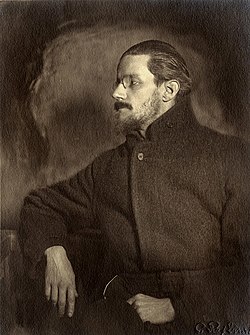
James Joyce (1882–1941) was an Irish novelist and poet, widely regarded as one of the most influential writers of the 20th century. Born in Dublin, he revolutionized modern fiction through innovative narrative techniques such as stream of consciousness in works including Dubliners (1914), A Portrait of the Artist as a Young Man (1916), Ulysses (1922), and Finnegans Wake (1939). His experimental prose and profound exploration of language shaped the course of modernist literature. More Less
Feb 2, 1882
% complete
James Augustine Aloysius Joyce was born on February 2, 1882, at 41 Brighton Square in Rathgar, a suburb of Dublin, Ireland. He was the eldest surviving son of John Stanislaus Joyce, a tax collector with declining fortunes, and Mary Jane Murray, an accomplished pianist. His birth into a large, once-comfortable Catholic family that gradually fell into poverty would deeply shape his literary vision of Dublin life.
Image source: James Joyce
Sep 1, 1888
% complete
At the age of six, Joyce was enrolled at Clongowes Wood College, a prestigious Jesuit boarding school in County Kildare. Though he left in 1891 when his father could no longer afford the fees, his experiences there—including bullying by a schoolmate and a harsh punishment from a prefect—would later form the basis of the opening chapters of his autobiographical novel 'A Portrait of the Artist as a Young Man.'
Image source: Clongowes Wood College
Apr 1, 1893 - Jun 30, 1898
% complete
After a period without formal schooling due to the family's financial troubles, Joyce was admitted to Belvedere College, another Jesuit institution in Dublin, largely through the intervention of a priest who secured reduced fees. He excelled academically, winning multiple prizes for essays and examinations, and began to develop his interest in languages, literature, and drama.
Image source: Belvedere College
Sep 1, 1898
% complete
Joyce entered University College Dublin to study modern languages, focusing on English, French, and Italian. During his university years he became increasingly critical of Irish nationalism and the Catholic Church, wrote essays and reviews, and delivered a famous paper titled 'Drama and Life,' asserting that literature should not be bound by conventional morality.
Image source: University College Dublin
Oct 31, 1902
% complete
Joyce graduated from University College Dublin with a Bachelor of Arts degree in modern languages. Shortly afterward, feeling constrained by the cultural and political atmosphere of Ireland, he made his first trip to Paris, ostensibly to study medicine, but soon returned to Dublin when his mother fell gravely ill.
Jan 1, 1904
% complete
In 1904, Joyce privately printed his satirical poem 'The Holy Office,' a biting attack on the Irish Literary Revival figures such as W.B. Yeats and George Russell whom he saw as pretentious and parochial. The poem signaled his combative stance toward the Dublin literary establishment and his determination to forge an independent artistic path.
Image source: Howl (poem)
Aug 13, 1903
% complete
Mary Jane Murray Joyce died of cancer on August 13, 1903. Her death devastated Joyce, who had returned from Paris to be at her bedside. Her refusal of last rites due to her son's skepticism reportedly haunted him, and the event deepened his sense of alienation from the Catholic Church, a theme that permeates much of his work.
Jun 16, 1904
% complete
On June 16, 1904, Joyce had his first date with Nora Barnacle, a young woman from Galway working as a chambermaid in Dublin. This date would become immortalized as 'Bloomsday,' the single day on which Joyce's novel 'Ulysses' takes place. Nora became Joyce's lifelong companion, muse, and eventually his wife.
Image source: Nora Barnacle
Jul 27, 1905
% complete
Joyce's first child, Giorgio, was born in Trieste on July 27, 1905. Fatherhood added financial pressure to the family's already precarious existence, but Joyce continued to write steadily during this period, completing many of the short stories that would form 'Dubliners.'
Image source: Lucia Joyce
Jul 26, 1907
% complete
Lucia Anna Joyce was born in Trieste on July 26, 1907. She would grow up to train as a dancer and later struggle with mental illness, spending much of her adult life in psychiatric institutions. Her condition became a source of great anguish for Joyce in his later years.
Jan 1, 1917
% complete
English feminist and editor Harriet Shaw Weaver became Joyce's devoted patron in 1917, providing him with regular anonymous gifts and later substantial sums that allowed him to write without constant financial desperation. Weaver remained his most loyal supporter, championing even his most difficult works when others despaired of them.
Image source: Harriet Shaw Weaver
Jul 4, 1931
% complete
After twenty-seven years together, Joyce and Nora finally married on July 4, 1931, at Kensington Register Office in London. The decision was partly prompted by concerns about inheritance and legal protection for Nora and their children, as well as Joyce's growing anxiety about his own health and mortality.
Dec 29, 1931
% complete
John Stanislaus Joyce, the model for Simon Dedalus in Joyce's fiction, died in Dublin on December 29, 1931. Despite their estrangement and the father's alcoholism and financial irresponsibility, Joyce grieved deeply, and his father's vivid personality and songs remained a lifelong influence on his memory of Dublin.
Image source: John Stanislaus Joyce
Oct 8, 1904
% complete
Disillusioned with Ireland after a street altercation and frustrated by publishers' rejections, Joyce left Dublin with Nora Barnacle on October 8, 1904, beginning what he called his 'voluntary exile' in continental Europe. They traveled first to Zurich and then settled in Pola (now Pula, Croatia) and later Trieste, where Joyce taught English and continued writing.
Jul 1, 1906 - Mar 1, 1907
% complete
From July 1906 to March 1907, Joyce worked in Rome as a correspondence clerk at a bank while also teaching English. He found the city disappointing, famously remarking that Rome reminded him of a man who makes a living by exhibiting to travelers his grandmother's corpse. The experience nonetheless provided material for the story 'Two Gallants' and sharpened his views on empire and money.
Jun 1, 1915
% complete
As Italy entered World War I and Trieste became unsafe, Joyce moved his family to Zurich, Switzerland, in June 1915. There he suffered severe eye problems, including glaucoma and iritis, which would plague him for the rest of his life and require numerous painful surgeries.
Jul 8, 1920
% complete
Encouraged by Ezra Pound, Joyce moved to Paris in July 1920, initially intending only a brief stay. The city became his home for nearly two decades and the center of his creative life, where he befriended Sylvia Beach, Valery Larbaud, and other figures of the expatriate modernist movement.
Dec 1, 1940
% complete
As German forces occupied France, Joyce and his family fled Paris in December 1940, obtaining transit visas arranged with help from Irish diplomat Charles Bewley and others. They reached Zurich just before Christmas, where Joyce hoped to complete new work and recover his health amid the turmoil of wartime Europe.
Jan 13, 1941
% complete
James Joyce died in Zurich on January 13, 1941, at the age of fifty-eight, following surgery for a perforated duodenal ulcer. He was buried in the Fluntern Cemetery, initially without full Catholic rites. His grave, marked by a simple stone bearing his name, remains a site of pilgrimage for readers, and his works continue to be studied as towering achievements of twentieth-century literature.
Aug 22, 1906
% complete
By late 1906, Joyce had completed the fifteen short stories that make up 'Dubliners,' a collection depicting the paralysis and moral stagnation of middle-class Dublin life. Despite its completion, the book would face years of delays and censorship battles before finally being published in 1914.
Image source: Dubliners
May 29, 1907
% complete
Joyce's first published book, 'Chamber Music,' appeared in May 1907. The collection of thirty-six lyric poems, written in a delicate musical style influenced by Elizabethan song, received modest attention but demonstrated Joyce's early mastery of traditional verse forms before he turned fully to prose experimentation.
Image source: Chamber Music (poetry collection)
Nov 1, 1907
% complete
Following an earlier abandoned draft called 'Stephen Hero,' Joyce began rewriting his autobiographical novel as 'A Portrait of the Artist as a Young Man' around 1907–1908. The novel traces the intellectual and spiritual awakening of Stephen Dedalus, charting his rejection of Catholicism and Irish nationalism in favor of artistic self-exile.
Image source: A Portrait of the Artist as a Young Man
Feb 2, 1914 - Sep 1, 1915
% complete
At the urging of poet Ezra Pound, 'A Portrait of the Artist as a Young Man' was serialized in the London magazine 'The Egoist' beginning on February 2, 1914, Joyce's thirty-second birthday. Pound's advocacy proved crucial in bringing Joyce's work to an international modernist audience.
Mar 1, 1914
% complete
Joyce began serious work on 'Ulysses' in 1914, though he had conceived the idea as early as 1906. The novel would take seven years to complete, following Leopold Bloom, Stephen Dedalus, and Molly Bloom through a single day—June 16, 1904—in Dublin, employing radical experimental techniques for each of its eighteen episodes.
Image source: Ulysses (novel)
Jun 15, 1914
% complete
After nearly a decade of disputes with printers and publishers over allegedly obscene passages and perceived slights to real people, 'Dubliners' was published by Grant Richards in London on June 15, 1914. The collection's unflinching realism and innovative use of 'epiphany' established Joyce as a significant modern voice in fiction.
Dec 29, 1916
% complete
The complete novel was published by B.W. Huebsch in New York on December 29, 1916, followed by a British edition from The Egoist Press in 1917. Its stream-of-consciousness technique and Künstlerroman structure were hailed as groundbreaking, cementing Joyce's reputation among avant-garde writers and critics.
Feb 21, 1921
% complete
In February 1921, copies of 'Ulysses' serialized in 'The Little Review' led to an obscenity conviction in New York, and the magazine's editors Margaret Anderson and Jane Heap were fined. The ruling effectively banned the book in the United States, making its legal status a cause célèbre until the landmark 1933 court decision lifting the ban.
Feb 2, 1922
% complete
Shakespeare and Company, Sylvia Beach's Paris bookshop, published the first edition of 'Ulysses' on February 2, 1922, Joyce's fortieth birthday. Unable to find mainstream publishers willing to risk obscenity charges, Joyce relied on Beach's courage. The novel was immediately banned in Britain and the United States but was celebrated by writers like T.S. Eliot and Virginia Woolf as a landmark of modernism.
Dec 6, 1933
% complete
In the case United States v. One Book Called Ulysses, Judge John M. Woolsey ruled on December 6, 1933, that 'Ulysses' was not obscene, finding it a sincere and honest book whose erotic passages served legitimate artistic purposes. The decision allowed Random House to publish the first American edition in 1934 and marked a turning point in censorship law.
Image source: United States v. One Book Called Ulysses
May 4, 1939
% complete
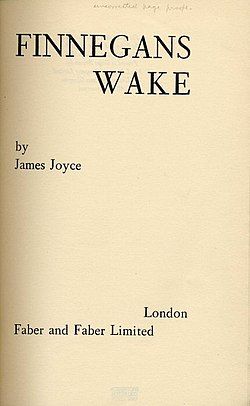
After seventeen years of composition, Joyce published 'Finnegans Wake' on May 4, 1939. Written in a dense multilingual dream language, the book recounts the nocturnal musings of Humphrey Chimpden Earwicker in a circular narrative. Even sympathetic readers found it nearly impenetrable, but it has since been recognized as one of the most ambitious experiments in the history of literature.
Image source: Finnegans Wake
Or browse the full history timeline directory, with more than 2,000 topics.
This James Joyce timeline was generated with the help of AI, using information found on the internet.
We work hard to keep these timelines accurate, but mistakes do get through. If you spot one, email us at [email protected] and we'll fix it for future visitors.
Generate yours with AI or build it from scratch, for free.
Export your timeline, add your own events, edit or remove AI-generated events, and much more
No credit card required.
Cancel anytime.
Cancel anytime.
You can create an unlimited number of timelines with up to 10 events on each one, customize how they look, export them to PDF, PNG, PowerPoint, CSV, and Excel, and share them with a link. Paid plans raise the event limit and add features like spreadsheet imports and collaborators.
Yes. You can cancel your subscription from your account page at any time, and you will not be charged again. Your subscription stays active for the rest of the period you already paid for.
Yes. We will email you a reminder before the annual renewal, and we will also email you a receipt.
Yes. You can email us within 15 days of any payment, and we will issue you a full refund.
Check out our pricing docs or send us an email anytime: [email protected].