-
Use Cases
-
Resources
-
Pricing
James II of England (also James VII of Scotland) was the last Catholic monarch of England, Scotland, and Ireland. His attempts to promote religious tolerance for Catholics and his absolutist tendencies led to widespread opposition, culminating in the Glorious Revolution of 1688, when he was deposed in favor of his daughter Mary II and her husband William III of Orange. More Less
Oct 14, 1633
% complete
James was born on 14 October 1633 at St James's Palace in London, the second surviving son of King Charles I and his wife, Henrietta Maria of France. He was designated Duke of York at birth.
Image source: James II of England
1642
% complete
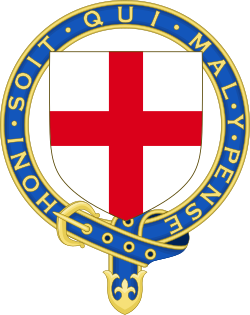
In 1642, James was invested with the Order of the Garter, one of the highest honours of English chivalry, during a period of growing political tension between his father, Charles I, and Parliament.
Image source: Order of the Garter
Aug 1642
% complete
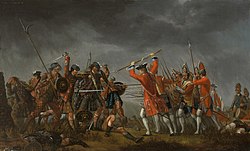
In August 1642, long-running political disputes between Charles I and his opponents in Parliament led to the outbreak of the First English Civil War, plunging England into conflict and shaping James's youth.
Image source: First English Civil War
Nov 1, 1642
% complete
During the Civil War, James spent most of four years in the Royalist wartime capital of Oxford, where he was made a Master of Arts by the University on 1 November 1642 and served as colonel of a volunteer regiment of foot.
Image source: University of Oxford
Jan 1644
% complete
In January 1644, James was formally created Duke of York, formalising the title he had held by designation since birth. The title would remain central to his identity throughout his life.
Image source: Duke of York
Jun 1646
% complete
Following the surrender of Oxford to Parliamentary forces in June 1646, James was taken to London and held with his younger siblings Henry, Elizabeth and Henrietta in St James's Palace under guard.
Image source: Siege of Oxford
Apr 1648
% complete
Ordered by his father to escape, James, with the help of Joseph Bampfield, successfully evaded his guards in April 1648 and crossed the North Sea to The Hague, joining royalist exiles on the Continent.
Image source: The Hague
Jan 1649
% complete
Following their victory in the Second English Civil War of 1648, Parliament ordered the execution of Charles I in January 1649. His father's death transformed the Stuart family's fortunes and left the monarchy abolished.
Image source: Execution of Charles I
Sep 1651
% complete
The Stuart attempt to recover the British thrones ended in defeat at Worcester in September 1651, crushing hopes of a royalist restoration for nearly a decade and forcing the Stuarts into exile.
Image source: Battle of Worcester
Dec 1652
% complete
Thanks to Turenne's favour, James was given command of a captured Irish regiment in December 1652 while serving in the French army, beginning his military career on the Continent.
Image source: Henri de La Tour d'Auvergne, Viscount of Turenne
1654
% complete
In 1654, James was appointed Lieutenant-General in the French army, demonstrating his growing military competence during the Franco-Spanish War and earning respect as a soldier.
Image source: Franco-Spanish War (1635–1659)
1657
% complete
In 1657, France agreed an alliance with the Commonwealth of England during the Franco-Spanish War, and when Charles responded by signing a treaty with Spain, James was expelled from France, moving to Spanish service instead.
1659
% complete
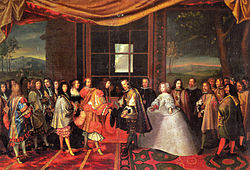
After France and Spain made peace with the 1659 Treaty of the Pyrenees, James considered taking a Spanish offer to be an admiral in their navy but declined the position, awaiting changing fortunes at home.
Image source: Treaty of the Pyrenees
Oct 1660
% complete
In October 1660, Charles II appointed his brother Governor of the Royal Adventurers into Africa, later reformed as the Royal African Company in 1672. By 1665, the slave trade to the Americas represented 25 per cent of its income.
Image source: Royal African Company
1664
% complete
In 1664, Charles II granted American territory between the Delaware and Connecticut rivers to James, territory that became New York, named in his honour after the city of York.
Image source: Province of New York
1665 - 1667
% complete
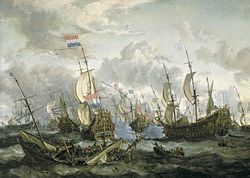
Rivalry with the Dutch, including company raids supported in 1664 by the Royal Navy frigate Jersey under Robert Holmes, was a major cause of the Second Anglo-Dutch War (1665–1667), in which James commanded naval forces.
Image source: Second Anglo-Dutch War
Sep 1666
% complete
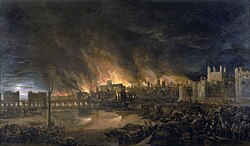
In September 1666, Charles II put James in charge of firefighting operations during the Great Fire of London, in the absence of action by Lord Mayor Thomas Bloodworth, winning him public credit for his efforts.
Image source: Great Fire of London
1667
% complete
Following the humiliating Dutch raid on the Medway in 1667, which devastated the English fleet, James oversaw the survey and re-fortification of the southern coast of England against further attack.
Image source: Raid on the Medway
May 6, 1682
% complete
On 6 May 1682, James narrowly escaped the sinking of HMS Gloucester, in which between 130 and 250 people perished. The wreck was only rediscovered centuries later off the Norfolk coast.
Image source: English ship Gloucester (1654)
1683
% complete
In 1683, James became the Governor of the Hudson's Bay Company, though he did not take an active role in its governance, adding another commercial governorship to his portfolio.
Image source: Hudson's Bay Company
1660
% complete
After the collapse of the Commonwealth in 1660, the Stuart Restoration returned Charles II to the thrones of England, Ireland and Scotland. James returned home from exile as heir presumptive to the throne.
Image source: Stuart Restoration
Sep 3, 1660
% complete
Although nearly everyone, including Anne Hyde's father, urged the couple not to marry, James and Anne married secretly, then went through an official marriage ceremony on 3 September 1660 in London, scandalising the court.
Image source: Anne Hyde
Dec 31, 1660
% complete
On 31 December 1660, following his brother's restoration, James was created Duke of Albany in Scotland, complementing his English title of Duke of York. On the same date, he was also created Duke of Normandy by King Louis XIV of France.
Image source: Duke of Albany
Apr 30, 1662
% complete
Only two of James and Anne Hyde's children survived: Mary, born 30 April 1662, and Anne, born 6 February 1665. Both would later reign as queens of England and Scotland, Mary jointly with her husband William III.
Image source: Mary II of England
1668
% complete
James took Catholic Eucharist in 1668 or 1669, although his conversion was kept secret for almost a decade as he continued to attend Anglican services until 1676. This conversion caused growing concern about Catholic influence.
1671
% complete
Anne Hyde, James's first wife and mother of Mary and Anne, died in 1671. Her death paved the way for James's second marriage to a Catholic princess two years later.
1673
% complete
Growing fears of Roman Catholic influence at court led the English Parliament to introduce a new Test Act in 1673, requiring office-holders to take oaths against Catholicism and forcing James to resign key positions.
Image source: Test Acts 1673 & 1678
Sep 20, 1673
% complete
James and Mary of Modena were married by proxy in a Roman Catholic ceremony on 20 September 1673, reinforcing concerns about his Catholicism and deepening opposition among Protestant elites.
Image source: Mary of Modena
1677
% complete
In 1677, King Charles II arranged for James's daughter Mary to marry the Protestant Prince William III of Orange, son of Charles's and James's sister Mary, a match that would prove fateful in 1688.
Image source: William III of England
1679 - 1681
% complete
His conversion to Catholicism caused growing concern, particularly during the Exclusion Crisis of 1679–81, when Whigs attempted to exclude him from the succession. In 1679, with the Exclusion Bill in danger of passing, Charles II dissolved Parliament; two further Parliaments elected in 1680 and 1681 were dissolved for the same reason.
Image source: Exclusion Crisis
1680
% complete
In 1680, James was appointed Lord High Commissioner of Scotland and took up residence at Holyrood Palace in Edinburgh to suppress an uprising and oversee the royal government there.
Image source: Holyrood Palace
1683
% complete
In 1683, a plot was uncovered to assassinate Charles II and his brother and spark a republican revolution to re-establish a government of the Cromwellian style, boosting royalist sympathy for the Stuarts.
Image source: Rye House Plot
1684
% complete
Taking advantage of James's rebounding popularity following the exposure of the Rye House Plot, Charles invited him back onto the Privy Council in 1684, restoring him closer to the centre of power.
1685
% complete
James sent a letter to the Scottish Parliament at its opening in 1685 declaring his wish for new penal laws against refractory Presbyterians, lamenting that he was not present in person to promote such a law.
Image source: Church of Scotland
Feb 6, 1685
% complete
Charles II died on 6 February 1685 from apoplexy, after supposedly converting to Catholicism on his deathbed. James succeeded peacefully as King of England and Ireland as James II and King of Scotland as James VII.
Image source: Charles II of England
Apr 23, 1685
% complete
Wishing to proceed quickly to the coronation, James and Mary were crowned at Westminster Abbey on 23 April 1685, cementing his accession despite lingering anxieties about his Catholic faith.
Image source: Coronation of James II and VII and Mary
May 1685
% complete
The new Parliament that assembled in May 1685 gained the name of 'Loyal Parliament' and was initially favourable to James, who had stated that most former exclusionists would be forgiven if they acquiesced to his rule.
Image source: Loyal Parliament
Jun 18, 1685
% complete
Rebellions against James were quickly crushed: Argyll was captured at Inchinnan on 18 June 1685, and the Monmouth Rebellion was defeated shortly afterwards, leaving James seemingly secure on his throne.
Image source: Monmouth Rebellion
Nov 1685
% complete
When even the previously supportive Parliament objected to James's measures, he ordered Parliament prorogued in November 1685, never to meet again in his reign — a decisive step towards absolutist rule.
Jan 1686
% complete
At the beginning of 1686, two papers were found in Charles II's strong box and closet, in his own hand, stating arguments for Catholicism over Protestantism, which encouraged James in his religious policy.
Mar 1686
% complete
In March 1686, James sent a letter to the Scottish Privy Council advocating toleration for Roman Catholics but not for rebellious Presbyterian Covenanters, revealing the selective nature of his tolerance policy.
Image source: Privy Council of Scotland
May 1686
% complete
In May 1686, James sought to obtain a ruling from the English common-law courts that showed he had the power to dispense with Acts of Parliament, challenging constitutional constraints on royal authority.
1687
% complete
In the summer of 1687, James attempted to increase support for his tolerationist policy through a speaking tour of the western counties of England, directly appealing to local elites and communities.
1687
% complete
In 1687, James prepared to pack Parliament with his supporters so that it would repeal the Test Act and the Penal Laws, engineering the composition of Parliament to achieve his religious goals.
1687
% complete
In 1687, James issued the Declaration of Indulgence, using his dispensing power to negate laws punishing both Roman Catholics and Protestant Dissenters, seeking broad support for religious toleration.
Image source: Declaration of Indulgence (1687)
1688
% complete
In 1688, James ordered the Declaration read from the pulpits of every Anglican church, further alienating the Anglican bishops against their Supreme Governor and provoking clerical resistance.
Jan 1688 - Mar 1688
% complete
During the first three months of 1688, hundreds of officials who gave negative replies when asked whether they would accept the Declaration of Indulgence were dismissed from their posts.
Apr 1688
% complete
In April 1688, James re-issued the Declaration of Indulgence and subsequently ordered Anglican clergy to read it in their churches, intensifying confrontation with the Church of England.
Jun 30, 1688
% complete
On 30 June 1688, a group of seven Protestant nobles invited William, Prince of Orange, to come to England with an army, setting in motion the Glorious Revolution that would depose James.
Image source: Invitation to William
Aug 24, 1688
% complete
Finally, on 24 August 1688, James ordered the issue of writs for a general election, hoping a new Parliament would be more amenable to his policies as dissent turned into crisis.
Image source: 1689 English general election
Nov 5, 1688
% complete
When William landed in Brixham on 5 November 1688, many Protestant officers, including Churchill, defected to William, as did James's own daughter Anne, and James's army deserted him.
Image source: Glorious Revolution
Dec 23, 1688
% complete
After his army deserted, James went into exile in France on 23 December 1688, effectively ending his reign and opening the way for William and Mary to take the throne.
Feb 1689
% complete
In February 1689, a special Convention Parliament held James had 'vacated' the English throne and installed William and Mary as joint monarchs, establishing that sovereignty derived from Parliament, not birth. It convened on 22 January 1689, and the Declaration was the basis for the later Bill of Rights enacted in 1689.
Mar 14, 1689
% complete
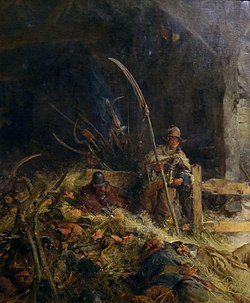
With the assistance of French troops, James landed in Ireland on 14 March 1689 in an attempt to recover his kingdoms, supported by a simultaneous rising in Scotland. He worked to build an army in Ireland.
Image source: Williamite War in Ireland
Apr 11, 1689
% complete
On 11 April 1689, the Parliament of Scotland declared James to have forfeited the throne of Scotland as well, following England's lead, and offered it to William and Mary.
Image source: Convention of Estates (1689)
Jul 1, 1690
% complete
James was ultimately defeated at the Battle of the Boyne on 1 July 1690 O.S. After this defeat he returned to France, where he spent the rest of his life in exile at Saint-Germain, protected by Louis XIV.
1692
% complete
In 1692, James's last child, Louisa Maria Teresa, was born at Saint-Germain-en-Laye, giving hope to Jacobites who looked to his descendants for a restoration of the Stuart line.
Image source: Louisa Maria Stuart
1696
% complete
Some supporters in England attempted to assassinate William III to restore James to the throne in 1696, but the plot failed and the backlash made James's cause less popular than ever.
Image source: 1696 Jacobite assassination plot
1697
% complete
After Louis concluded peace with William in 1697, he ceased to offer much assistance to James, leaving the exiled king increasingly isolated at Saint-Germain.
Image source: Peace of Ryswick
Sep 16, 1701
% complete
James died on 16 September 1701 of a brain haemorrhage at Saint-Germain-en-Laye, aged 67. He was the last Catholic monarch of England, Scotland, and Ireland.
1702
% complete
The Italian composer Angelo Olivieri was commissioned to write a Requiem mass in honour of James in 1702, reflecting continuing devotion among his followers after his death.
Image source: Andrew Olivieri
1702
% complete
James's younger daughter Anne succeeded when William died in 1702, continuing the Protestant succession established by the Glorious Revolution and sidelining the Jacobite claim.
Image source: Anne, Queen of Great Britain
1714
% complete
When Anne died in 1714, less than two months after the death of Sophia, she was succeeded by George I, Sophia's son, the Elector of Hanover and Anne's second cousin, firmly excluding the Stuarts.
Image source: George I of Great Britain
1715 - 1716
% complete
James Francis Edward Stuart led a rising in Scotland shortly after George I's accession in 1715, attempting to restore the Stuart line, but the rebellion was defeated.
Image source: Jacobite rising of 1715
1734
% complete
In 1734, the Archbishop of Paris heard evidence to support James's canonisation, titling him a Servant of God, but nothing came of the cause for beatification.
Image source: Beatification
1745 - 1746
% complete
James's son Charles Edward Stuart led a final major Jacobite rising in 1745, but it was again defeated, ending serious hopes of a Stuart restoration.
Image source: Jacobite rising of 1745
Or browse the full history timeline directory, with more than 2,000 topics.
This James II of England timeline was generated with the help of AI, using information found on the internet.
We work hard to keep these timelines accurate, but mistakes do get through. If you spot one, email us at [email protected] and we'll fix it for future visitors.
Generate yours with AI or build it from scratch, for free.
Export your timeline, add your own events, edit or remove AI-generated events, and much more
No credit card required.
Cancel anytime.
Cancel anytime.
You can create an unlimited number of timelines with up to 10 events on each one, customize how they look, export them to PDF, PNG, PowerPoint, CSV, and Excel, and share them with a link. Paid plans raise the event limit and add features like spreadsheet imports and collaborators.
Yes. You can cancel your subscription from your account page at any time, and you will not be charged again. Your subscription stays active for the rest of the period you already paid for.
Yes. We will email you a reminder before the annual renewal, and we will also email you a receipt.
Yes. You can email us within 15 days of any payment, and we will issue you a full refund.
Check out our pricing docs or send us an email anytime: [email protected].