
-
Use Cases
-
Resources
-
Pricing
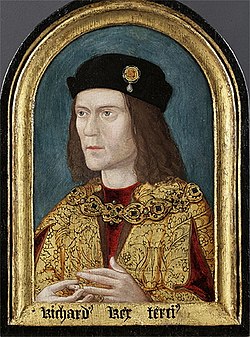
Richard III was King of England from 1483 until his death in 1485, the last king of the Plantagenet dynasty and the last English king to die in battle. His brief reign, marked by the disappearance of the Princes in the Tower and his defeat by Henry Tudor at the Battle of Bosworth Field, ended the Wars of the Roses. Shakespeare's famous play portrayed him as a villainous hunchback, though modern historians debate his true character. In 2012, his lost grave was discovered beneath a car park in Leicester. More Less
Oct 2, 1452
% complete
Richard was born at Fotheringhay Castle in Northamptonshire, the eleventh child and fourth surviving son of Richard, Duke of York, and Cecily Neville. His birth came during a turbulent period that would soon erupt into the Wars of the Roses.
Image source: Richard III of England
May 22, 1455
% complete
The Wars of the Roses began when Richard, Duke of York's forces defeated those of King Henry VI. This conflict would dominate Richard III's childhood and shape his family's fortunes dramatically.
Image source: First Battle of St Albans
Oct 2, 1459
% complete
After the Yorkist defeat at Ludford Bridge, young Richard fled with his mother and brother George to the Low Countries. They returned to England in 1460 following their father's victory at Northampton.
Dec 30, 1460
% complete
Richard's father was killed at the Battle of Wakefield, along with his older brother Edmund. The seven-year-old Richard lost his father and heir to the throne claim, leaving his eldest brother Edward as the Yorkist leader.
Image source: Battle of Wakefield
Jun 28, 1461
% complete
Richard's eldest brother was crowned King Edward IV after the Yorkist victory at Towton. Richard spent much of his youth in his brother's household, receiving noble training.
Image source: Edward IV of England
Nov 1, 1461 - Apr 1, 1465
% complete
Richard spent formative years at the court of Philip the Good, Duke of Burgundy, where he gained exposure to continental chivalric culture and courtly refinement before returning to England.
Nov 1, 1461
% complete
Richard was formally created Duke of Gloucester by his brother Edward IV, establishing his status among the great nobles of England and beginning his path to prominence.
Image source: Prince Richard, Duke of Gloucester
Apr 14, 1471
% complete
Richard commanded part of Edward IV's army in a decisive Yorkist victory over Warwick the Kingmaker, helping restore his brother to the throne after Henry VI's brief Readeption.
Image source: Battle of Barnet
May 4, 1471
% complete
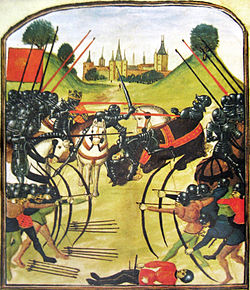
Richard again distinguished himself in battle, helping crush Lancastrian forces and kill Edward of Westminster, Prince of Wales. This victory secured Edward IV's second reign.
Image source: Battle of Tewkesbury
May 18, 1471
% complete
Following the restoration of Edward IV, Richard was appointed Lord High Admiral, one of several high offices he accumulated as his brother trusted him with growing power.
Image source: Lord High Admiral of the United Kingdom
Jul 12, 1472
% complete
Richard married Anne Neville, widow of the Lancastrian prince Edward of Westminster and daughter of Warwick the Kingmaker. The marriage brought him significant lands and influence in northern England.
Image source: Anne Neville
1475 - 1483
% complete
Richard administered vast estates across northern England, becoming beloved there for his justice and good governance. His administration from Middleham Castle earned lasting loyalty in the region.
Image source: Council of the North
Jun 1, 1482 - Aug 1, 1482
% complete
Richard led a large English army into Scotland, capturing Berwick-upon-Tweed for the crown and briefly occupying Edinburgh before returning south. It was his greatest military achievement as duke.
Apr 9, 1483
% complete
King Edward IV died unexpectedly at Westminster at age 40. His twelve-year-old son Edward V succeeded him, naming Richard as Lord Protector during the young king's minority.
Apr 30, 1483
% complete
Richard intercepted the young Edward V en route to London, taking custody of him and asserting control over the government, clashing with the Woodville faction loyal to the queen mother Elizabeth Woodville.
Image source: Lord Protector
Jun 16, 1483
% complete
Edward V and his younger brother Richard of Shrewsbury were lodged in the Tower of London, ostensibly in preparation for Edward's coronation. Neither boy was seen in public again, fueling centuries of speculation about their fate.
Image source: Princes in the Tower
Jun 25, 1483
% complete
Parliament passed Titulus Regius, declaring Edward IV's children illegitimate based on claims of a prior marriage contract, thereby legally justifying Richard's claim to the throne.
Image source: Titulus Regius
Jul 6, 1483
% complete
Richard was formally crowned King of England at Westminster Abbey alongside his wife Anne Neville, following the deposition of Edward V on grounds of illegitimacy declared by Parliament through Titulus Regius.
Aug 24, 1483
% complete
Richard's only legitimate son was invested as Prince of Wales at York Minster in a grand ceremony, securing the succession — though tragically the boy would die within months.
Image source: Edward of Middleham, Prince of Wales
Oct 10, 1483 - Oct 25, 1483
% complete
A revolt against Richard's rule broke out, involving former allies including Henry Stafford, Duke of Buckingham. The rebellion collapsed quickly; Buckingham was captured and executed, while Henry Tudor's first invasion attempt failed.
1484
% complete
Richard formalized a governing council for northern England, an administrative innovation praised for its efficiency that endured long after his death under later Tudor monarchs.
Jan 23, 1484
% complete
Richard convened his first Parliament, which passed reforms promoting justice, prohibiting unfair sales practices like forced credit sales, and standardizing measures. His reign is noted for progressive legislation despite its brevity.
Image source: Richard III Society
Apr 9, 1484
% complete
Richard's son and heir died suddenly at Middleham Castle, leaving the king without a direct successor and deepening the succession crisis facing his reign.
Mar 16, 1485
% complete
Anne Neville died at Westminster, possibly of tuberculosis. Her death devastated Richard and removed his heir prospects, while rumors spread that he had poisoned her to marry his niece Elizabeth of York.
Aug 7, 1485
% complete
Henry Tudor landed with French mercenaries in Wales after years of exile in Brittany, gathering Welsh supporters as he marched toward confrontation with Richard's royal army.
Image source: Henry VII of England
Aug 22, 1485
% complete
Richard led a charge aimed directly at Henry Tudor but was deserted by allies including Thomas Stanley. He was killed in combat — the last English king to die in battle, ending both his reign and the Wars of the Roses.
Image source: Battle of Bosworth Field
Aug 22, 1485
% complete
Henry Tudor was proclaimed king on the battlefield, founding the Tudor dynasty. He married Elizabeth of York, uniting the warring houses of Lancaster and York symbolized by the Tudor rose.
Aug 25, 1485
% complete
Richard's body was displayed publicly and then buried without ceremony in the church of the Greyfriars friary in Leicester, where it remained lost for over five centuries beneath urban development.
Image source: Exhumation and reburial of Richard III of England
1592
% complete
William Shakespeare's tragedy immortalized Richard as a hunchbacked, scheming villain whose reputation shaped popular perception for centuries, largely drawing on hostile Tudor-era chronicles.
Image source: Richard III (play)
Or browse the full history timeline directory, with more than 2,000 topics.
This Richard III of England timeline was generated with the help of AI, using information found on the internet.
We work hard to keep these timelines accurate, but mistakes do get through. If you spot one, email us at [email protected] and we'll fix it for future visitors.
Generate yours with AI or build it from scratch, for free.
Export your timeline, add your own events, edit or remove AI-generated events, and much more
No credit card required.
Cancel anytime.
Cancel anytime.
You can create an unlimited number of timelines with up to 10 events on each one, customize how they look, export them to PDF, PNG, PowerPoint, CSV, and Excel, and share them with a link. Paid plans raise the event limit and add features like spreadsheet imports and collaborators.
Yes. You can cancel your subscription from your account page at any time, and you will not be charged again. Your subscription stays active for the rest of the period you already paid for.
Yes. We will email you a reminder before the annual renewal, and we will also email you a receipt.
Yes. You can email us within 15 days of any payment, and we will issue you a full refund.
Check out our pricing docs or send us an email anytime: [email protected].