-
Use Cases
-
Resources
-
Pricing
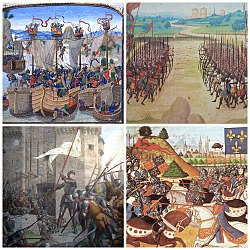
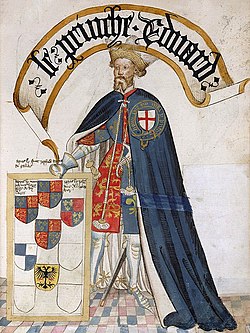
Edward III was King of England from 1327 to 1377. He became king at the age of 14 after his father Edward II was deposed, and he later asserted control by overthrowing his mother Isabella of France and her lover Roger Mortimer in 1330. His reign saw the start of the Hundred Years' War with France, major English military victories at Crécy and Poitiers, and the establishment of the Order of the Garter. More Less
Nov 13, 1312
% complete
Edward III was born at Windsor Castle, the eldest son of Edward II of England and Isabella of France. His birth strengthened the position of his father's reign and secured the succession of the Plantagenet dynasty.
Image source: Edward III of England
Nov 12, 1320
% complete
The young Edward was invested as Earl of Chester, a title traditionally held by the heir apparent to the English throne. This formal recognition marked him as the future king from an early age.
Image source: Earl of Chester
Aug 27, 1326
% complete
As part of his mother Isabella's alliance against Edward II, a betrothal was arranged between Edward and Philippa of Hainaut. The alliance provided crucial military support for the invasion that would topple his father.
Image source: Philippa of Hainault
Sep 24, 1326
% complete
Queen Isabella and Roger Mortimer landed in Suffolk with a small force of mercenaries, launching a successful invasion that quickly gained support and led to the collapse of Edward II's regime.
Image source: Invasion of England (1326)
Jan 16, 1327
% complete
Parliament forced Edward II to abdicate in favor of his fourteen-year-old son. The deposition was unprecedented in English history, ending Edward II's troubled reign and paving the way for Edward III's accession.
Image source: Edward II of England
Feb 1, 1327
% complete
Edward III was crowned King of England at Westminster Abbey at the age of fourteen. Real power, however, remained with his mother Queen Isabella and her lover Roger Mortimer, who ruled as regents.
Image source: Coronation Chair
Mar 17, 1328
% complete
Mortimer and Isabella concluded a treaty recognizing Robert Bruce as king of an independent Scotland. The humiliating terms were deeply unpopular in England and damaged the regency's standing.
Oct 29, 1330
% complete
At seventeen, Edward seized power by staging a coup at Nottingham Castle, arresting Mortimer, who was then tried and executed as a traitor. Isabella was retired to honorable confinement, and Edward began his personal rule.
Image source: Roger Mortimer, 1st Earl of March
Jan 24, 1328
% complete
Edward married Philippa of Hainaut at York Minster. Their long marriage produced twelve or thirteen children, including Edward the Black Prince and John of Gaunt, whose descendants shaped English history for generations.
Apr 23, 1348
% complete
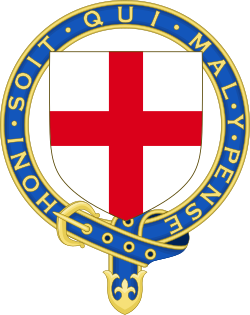
Edward founded the Order of the Garter, England's most prestigious chivalric order, traditionally associated with the motto 'Honi soit qui mal y pense'. It bound the realm's leading knights to the king's cause.
Image source: Order of the Garter
Aug 15, 1369
% complete
Philippa of Hainaut died at Windsor Castle after a long illness. Her death profoundly affected Edward, who thereafter increasingly fell under the influence of his mistress Alice Perrers.
Jun 8, 1376
% complete
Edward III's eldest son and heir died of illness, plunging the succession into uncertainty. The king's grandson Richard of Bordeaux, the Black Prince's son, became the new heir apparent.
Image source: Edward the Black Prince
Jun 21, 1377
% complete
Edward III died at Sheen Palace after a stroke, aged sixty-four, after fifty years on the throne. He was succeeded by his ten-year-old grandson Richard II, beginning a turbulent new chapter for England.
Aug 11, 1332
% complete
Edward Balliol, backed by English 'disinherited' lords, defeated the Scots at Dupplin Moor and briefly claimed the Scottish crown. The battle demonstrated devastating English longbow tactics used later in France.
Jul 19, 1333
% complete
Edward III personally led an army to relieve Berwick, inflicting a crushing defeat on the Scots using dismounted men-at-arms supported by longbowmen. The victory installed Balliol as a puppet king of Scotland.
Image source: Battle of Halidon Hill
May 24, 1337
% complete
After Philip VI of France confiscated Aquitaine, Edward formally claimed the French throne through his mother Isabella, daughter of Philip IV. The dynastic dispute ignited a conflict that would span more than a century.
Image source: Hundred Years' War
Jun 24, 1340
% complete
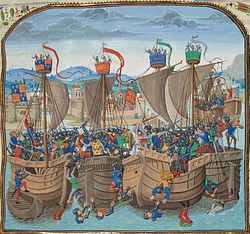
Edward III commanded the English fleet to a decisive naval victory over the French off Sluys in Flanders, destroying French sea power and securing English control of the Channel for years to come.
Image source: Battle of Sluys
Sep 1340
% complete
Edward's campaign in Flanders stalled before Tournai amid mounting debts, forcing him to accept a truce brokered under papal pressure. The failure strained his finances and relationships with allies.
1341 - 1364
% complete
Edward backed John de Montfort's claim to the Duchy of Brittany against Charles of Blois, supported by France. The prolonged proxy war kept French resources divided throughout the 1340s.
Image source: War of the Breton Succession
Sep 30, 1342
% complete
An English force under William de Bohun defeated a much larger French army using entrenched defensive positions and longbows, showcasing tactics that would become hallmarks of English warfare in France.
Image source: Battle of Morlaix
Aug 26, 1346
% complete
Edward III's army routed a far larger French force at Crécy in Normandy. The combination of longbowmen and dismounted men-at-arms proved devastatingly effective, and the Black Prince won his spurs in battle.
Image source: Battle of Crécy
Sep 4, 1346 - Aug 3, 1347
% complete
After nearly a year-long siege, Calais surrendered to Edward III and became an English stronghold for over two centuries. The famous episode of the six burghers symbolized the town's suffering.
Image source: Siege of Calais (1346–1347)
Aug 29, 1350
% complete
Edward III personally commanded the English fleet against Castilian raiders near Winchelsea, winning a bloody naval engagement fought with boarding actions rather than missile exchanges.
Image source: Battle of Winchelsea
Mar 23, 1351
% complete
A brief truce between England and France was agreed, allowing both exhausted kingdoms to regroup after years of campaigning, though hostilities resumed within a few years.
Image source: 1350s in England
Sep 19, 1356
% complete
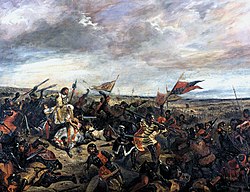
Edward, the Black Prince, captured the French king John II at Poitiers in a stunning English victory. With France leaderless and riven by internal chaos, England gained enormous diplomatic leverage.
Image source: Battle of Poitiers
Oct 24, 1360
% complete
The peace agreement gave Edward III vast territories in France in full sovereignty, including Aquitaine expanded greatly, in exchange for renouncing his claim to the French throne. It marked the high point of English fortunes.
Image source: Treaty of Brétigny
1369 - 1375
% complete
Charles V of France renewed the war, and under the brilliant constable Bertrand du Guesclin, French forces reconquered most of the lands ceded at Brétigny, reversing decades of English gains.
Image source: Hundred Years' War, 1369–1389
1373 - 1374
% complete
John of Gaunt led a destructive raid from Calais to Bordeaux across France, burning territory but achieving no lasting conquest, illustrating the diminishing returns of English strategy.
Jun 1348 - 1350
% complete
The bubonic plague swept through England, killing perhaps a third to half of the population. The demographic catastrophe disrupted warfare, transformed labor relations, and prompted royal attempts to control wages.
Image source: Black Death in England
1351
% complete
In response to post-plague labor shortages and rising wages, Parliament passed the Statute of Labourers attempting to fix wages at pre-plague levels, provoking resentment among workers and peasants.
Image source: Statute of Labourers 1351
Apr 28, 1376 - Jul 10, 1376
% complete
The Good Parliament criticized corrupt royal officials and the influence of Alice Perrers, reflecting growing discontent with the aging king's government and marking rising parliamentary assertiveness.
Image source: Good Parliament
Or browse the full history timeline directory, with more than 2,000 topics.
This Edward III of England timeline was generated with the help of AI, using information found on the internet.
We work hard to keep these timelines accurate, but mistakes do get through. If you spot one, email us at [email protected] and we'll fix it for future visitors.
Generate yours with AI or build it from scratch, for free.
Export your timeline, add your own events, edit or remove AI-generated events, and much more
No credit card required.
Cancel anytime.
Cancel anytime.
You can create an unlimited number of timelines with up to 10 events on each one, customize how they look, export them to PDF, PNG, PowerPoint, CSV, and Excel, and share them with a link. Paid plans raise the event limit and add features like spreadsheet imports and collaborators.
Yes. You can cancel your subscription from your account page at any time, and you will not be charged again. Your subscription stays active for the rest of the period you already paid for.
Yes. We will email you a reminder before the annual renewal, and we will also email you a receipt.
Yes. You can email us within 15 days of any payment, and we will issue you a full refund.
Check out our pricing docs or send us an email anytime: [email protected].