-
Use Cases
-
Resources
-
Pricing
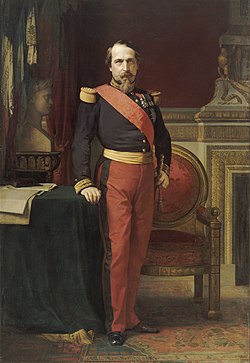
Napoleon III, born Charles-Louis Napoléon Bonaparte, was the first President of France (1848–1852) and the last monarch of France as Emperor of the Second Empire (1852–1870). A nephew of Napoleon I, he modernized Paris under Baron Haussmann, expanded French influence abroad, and was captured and deposed after France's defeat in the Franco-Prussian War. More Less
Apr 20, 1808
% complete
Charles-Louis Napoléon Bonaparte was born in Paris, the third son of Louis Bonaparte, King of Holland, and Hortense de Beauharnais. As a nephew of Napoleon I, he grew up with a strong sense of dynastic destiny that would drive his lifelong ambition to restore Bonapartist rule in France.
Image source: Napoleon III
1815
% complete
After Napoleon I's final defeat at Waterloo, the Bonaparte family was forced into exile. Young Louis-Napoléon spent his youth in Switzerland and Italy, absorbing liberal and nationalist ideas while nursing dreams of restoring the imperial legacy.
Image source: Hundred Days
1830 - 1831
% complete
Louis-Napoléon joined the Carbonari revolutionaries in Italy, participating in an uprising against papal authority. The revolt's failure, followed by his mother's death and the death of his brother, deepened his political resolve and pushed him toward a career focused on France.
Image source: Carbonari
Oct 30, 1836
% complete
Louis-Napoléon staged a failed coup attempt in Strasbourg, trying to rally troops to his cause. He was quickly arrested and exiled to the United States, but the episode marked him as a serious claimant to the Bonapartist mantle.
Aug 6, 1840
% complete
He landed at Boulogne-sur-Mer with a small band of conspirators in another bid to seize power. The attempt collapsed, and he was imprisoned at the fortress of Ham, where he wrote political works that spread his ideas and built his reputation.
May 25, 1846
% complete
Disguised as a laborer, Louis-Napoléon escaped from his six-year imprisonment at Ham and fled to England. His daring escape enhanced his romantic legend among supporters in France.
Image source: Napoleon III
Dec 10, 1848
% complete
Following the February Revolution of 1848, Louis-Napoléon returned to France and won a landslide victory in the first-ever French presidential election, capturing nearly 75% of the vote on a platform of order, national glory, and support for the working classes.
Image source: 1848 French presidential election
Dec 20, 1848 - 1850
% complete
As president, Louis-Napoléon aligned with the conservative Party of Order, supporting measures like the Falloux Law on education and restricting universal male suffrage in 1850, while quietly cultivating popular support for his own ambitions.
Image source: French Second Republic
Dec 2, 1851
% complete
Facing a constitutional ban on reelection, Louis-Napoléon dissolved the National Assembly and seized power in a coup. Resistance was crushed, thousands were arrested, and a plebiscite overwhelmingly approved his assumption of dictatorial powers.
Image source: 1851 French coup d'état
Dec 2, 1852
% complete
Exactly one year after his coup, following another referendum, Louis-Napoléon became Emperor of the French as Napoleon III, restoring the hereditary empire and beginning nearly two decades of personal rule.
Image source: Second French Empire
Jan 29, 1853
% complete
Napoleon III married Spanish countess Eugénie de Montijo, who became Empress of the French. She would exert significant influence over court life, fashion, and later foreign policy during his reign.
Image source: Eugénie de Montijo
Mar 16, 1856
% complete
The birth of Napoleon III's only legitimate son secured the dynasty's succession and was celebrated throughout the empire with festivities and amnesty for political prisoners.
Image source: Louis-Napoléon, Prince Imperial
1853 - 1870
% complete
Under Baron Haussmann, Paris was transformed with broad boulevards, parks, sewers, and aqueducts, creating the modern capital. The project provided employment, improved public health, and facilitated troop movements, though it displaced many poor residents.
Image source: Haussmann's renovation of Paris
Jan 2, 1860 - 1870
% complete
Responding to growing opposition, Napoleon III granted amnesties, allowed greater parliamentary debate, and loosened censorship, gradually transforming his authoritarian regime into the 'Liberal Empire' in a decade-long process.
Image source: Liberalism
Jan 23, 1860
% complete
Napoleon III signed a landmark free-trade agreement with Britain, lowering tariffs dramatically despite protectionist opposition at home and promoting a new era of European economic liberalism.
Image source: Cobden–Chevalier Treaty
Apr 1, 1867 - Nov 3, 1867
% complete
The 1867 World's Fair in Paris showcased industrial and artistic achievement from around the world, cementing the city's reputation as the cultural capital of Europe and celebrating the empire's prosperity.
Image source: Exposition Universelle (1867)
Nov 17, 1869
% complete
The Suez Canal, built largely with French capital under diplomat Ferdinand de Lesseps, opened linking the Mediterranean and Red Seas, a triumph of French engineering and imperial commerce celebrated by Empress Eugénie at the ceremony.
Image source: Suez Canal
May 8, 1870
% complete
A referendum overwhelmingly approved the new liberal constitution returning power to the parliament, appearing to consolidate the empire just months before its sudden collapse.
Oct 4, 1853 - Mar 30, 1856
% complete
Napoleon III allied France with Britain and the Ottoman Empire against Russia, seeking to reverse the defeat of 1815 and reassert French influence. The costly war ended with Russian defeat and made France again a leading European power.
Image source: Crimean War
Mar 30, 1856
% complete
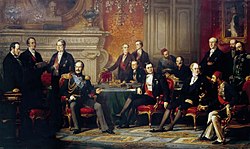
The Congress of Paris neutralized the Black Sea and checked Russian expansion, marking a diplomatic triumph for Napoleon III, who hosted the peace congress in the French capital.
Image source: Treaty of Paris (1856)
Sep 1, 1858 - 1867
% complete
French forces intervened in Vietnam, gradually conquering the southern provinces and establishing the colony of Cochinchina, laying the foundation for French Indochina.
Image source: French Cochinchina
Apr 29, 1859 - Jul 11, 1859
% complete
France allied with Piedmont-Sardinia against Austria to help unify Italy. French victories at Magenta and Solferino were decisive, though the high casualties shocked Europe and inspired the founding of the Red Cross.
Image source: Second Italian War of Independence
Mar 24, 1860
% complete
In exchange for supporting Italian unification, France annexed Savoy and Nice following plebiscites, expanding its southeastern frontier — its last major territorial gain in Europe.
Image source: Treaty of Turin (1860)
Dec 14, 1861 - 1867
% complete
Seeking to establish a Catholic client state in the Americas, Napoleon III sent troops to Mexico and installed Archduke Maximilian of Austria as emperor. The venture drained resources and ended disastrously when Mexican republicans executed Maximilian in 1867.
Image source: Second French intervention in Mexico
Apr 1867 - May 1867
% complete
A diplomatic confrontation arose when France sought to buy Luxembourg from the Netherlands while Prussia threatened war. The crisis was defused by international agreement making Luxembourg neutral, but it exposed rising Franco-Prussian tensions.
Image source: Luxembourg Crisis
Jun 19, 1867
% complete
The execution of the French-installed Emperor Maximilian by Benito Juárez's republican forces was a humiliating blow to Napoleon III, forcing the withdrawal of French troops and damaging his prestige.
Image source: Maximilian I of Mexico
Jul 2, 1870 - Jul 12, 1870
% complete
Prussia backed a Hohenzollern prince for the Spanish throne, alarming France. Though the candidacy was withdrawn, French demands for guarantees set the stage for further escalation between the two nations.
Image source: Karl Anton, Prince of Hohenzollern (born 1811)
Jul 13, 1870
% complete
Otto von Bismarck edited and published King Wilhelm I's telegram to make it appear insulting to France, provoking French public outrage and pushing Napoleon III into declaring war.
Image source: Ems Dispatch
Jul 19, 1870 - May 10, 1871
% complete
France declared war on Prussia, but the poorly prepared French army suffered repeated defeats. German states united behind Prussia, and the war ended in catastrophic French defeat with the loss of Alsace and part of Lorraine.
Image source: Franco-Prussian War
Sep 1, 1870 - Sep 2, 1870
% complete
Encircled at Sedan, Napoleon III surrendered along with his entire army of over 80,000 men to the Prussians. The decisive defeat sealed the fate of his regime.
Image source: Battle of Sedan
Sep 4, 1870
% complete
News of Sedan triggered revolution in Paris, where crowds stormed the legislature and proclaimed the Third Republic, ending eighteen years of Napoleonic rule.
Jan 9, 1873
% complete
After two years of captivity in Germany and exile at Chislehurst, England, Napoleon III died following surgery for bladder stones. He was survived by Empress Eugénie and the Prince Imperial, keeping Bonapartist hopes alive briefly.
Or browse the full history timeline directory, with more than 2,000 topics.
This Napoleon III timeline was generated with the help of AI, using information found on the internet.
We work hard to keep these timelines accurate, but mistakes do get through. If you spot one, email us at [email protected] and we'll fix it for future visitors.
Generate yours with AI or build it from scratch, for free.
Export your timeline, add your own events, edit or remove AI-generated events, and much more
No credit card required.
Cancel anytime.
Cancel anytime.
You can create an unlimited number of timelines with up to 10 events on each one, customize how they look, export them to PDF, PNG, PowerPoint, CSV, and Excel, and share them with a link. Paid plans raise the event limit and add features like spreadsheet imports and collaborators.
Yes. You can cancel your subscription from your account page at any time, and you will not be charged again. Your subscription stays active for the rest of the period you already paid for.
Yes. We will email you a reminder before the annual renewal, and we will also email you a receipt.
Yes. You can email us within 15 days of any payment, and we will issue you a full refund.
Check out our pricing docs or send us an email anytime: [email protected].