
-
Use Cases
-
Resources
-
Pricing
The Code Napoleon, also known as the Napoleonic Code or the French Civil Code, was a comprehensive set of civil laws established under Napoleon Bonaparte in 1804. It standardized legal principles such as equality before the law, property rights, and secular authority, replacing the fragmented feudal and regional laws of pre-revolutionary France. Its clear structure influenced civil law systems across Europe, Latin America, and beyond, making it one of the most enduring legal documents in history. More Less
Jan 1, 1756
% complete
The Codex Maximilianeus bavaricus civilis was a civil law code established in Bavaria in 1756, preceding the Napoleonic Code as one of the first legal codes in a European country with a civil-law legal system.
Image source: Codex Maximilianeus bavaricus civilis
Jan 1, 1794
% complete
The Allgemeines Landrecht was a comprehensive legal code for Prussia issued in 1794, another important predecessor to the Napoleonic Code among European civil-law codes.
Jan 1, 1797
% complete
The West Galician Code was adopted in 1797 in Galicia, then part of Austria, making it one of the earliest civil codes in Europe and a precursor to the Napoleonic Code.
Feb 10, 1763
% complete
Following the 1763 Treaty of Paris, the British continued to use the Coutume de Paris in Canada, which later formed the basis of the Civil Code of Lower Canada, itself influenced by the French Code Napoléon.
Image source: Treaty of Paris (1763)
Oct 1, 1800
% complete
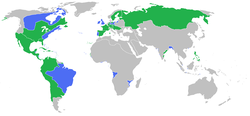
Spanish and French colonial forces had quarreled over Louisiana during most of the 1700s; Spain ultimately ceded the territory to France in 1800 under the Third Treaty of San Ildefonso.
Image source: Louisiana Purchase
Apr 30, 1803
% complete
Having reacquired Louisiana from Spain in 1800, France sold the territory to the United States in 1803; French civil law traditions there later shaped Louisiana's unique legal system.
Apr 21, 1808
% complete
The French Civil Code was extended to Mauritius under the title Code Napoléon by decree of Charles Mathieu Isidore Decaen, Capitaine-General, on 21 April 1808.
Image source: Napoleonic Code
Jan 1, 1836
% complete
For comparison with continental procedure, it was only in 1836 that prisoners charged with a felony were given a formal right to counsel in England, long after similar reforms under the French codes.
Image source: Right to counsel
Jan 1, 1864 - Jan 1, 2011
% complete
A civil code with Napoleonic code influences was adopted in 1864 in Romania and remained in force until 2011, demonstrating the enduring international reach of the French model.
Jan 1, 1900
% complete
In German regions such as the Rhenish Palatinate, the Prussian Rhine Province, the former Duchy of Berg, and the Grand Duchy of Baden, the Napoleonic Code remained influential until the introduction of the Bürgerliches Gesetzbuch in 1900, the first common civil code for the entire German Empire.
Jan 1, 1920
% complete
For over a century, all of the codes in force in France have been documented in the annually revised editions published by Dalloz in Paris, keeping the Napoleonic legacy accessible to jurists.
Jan 1, 1945
% complete
In Mauritius, the Code was modified and embodied in Chapter 179 of the Revised Laws of Mauritius 1945, edited by Sir Charlton Lane, former Chief Justice of Mauritius.
Jan 1, 1994
% complete
The term 'Napoleonic Code' is also used to refer to legal codes influenced by the French Code Napoléon, especially the Civil Code of Lower Canada, which was replaced in 1994 by the Civil Code of Quebec.
Image source: Civil Code of Quebec
Mar 1, 2013
% complete
In March 2013, the French government responded encouragingly regarding plans for codification efforts, including a proposed public service code (code général de la fonction publique).
Image source: Napoleonic Code
Jan 1, 2014
% complete
In 2014, the Commission complained that the government's encouraging response had not been followed through, noting in particular that the government had abandoned its plan for a public service code.
Oct 5, 1790
% complete
On 5 October 1790, the Constituent Assembly voted for a codification of French laws, an early step toward creating a unified civil code for France.
Image source: Napoleon
Sep 3, 1791
% complete
The Constitution of 1791 promised the establishment of a code of laws common to the entire realm, advancing the goal of legal unification in revolutionary France.
Image source: French Constitution of 1791
Sep 4, 1791
% complete
On 4 September 1791, the National Assembly adopted a unanimous resolution providing that 'there shall be a code of civil laws common for the entire realm.'
Jan 1, 1793
% complete
In 1793, the National Convention established a special commission headed by Jean-Jacques-Régis de Cambacérès to oversee the drafting of the civil code, giving him a one-month deadline.
Image source: Jean-Jacques-Régis de Cambacérès
Jan 1, 1793
% complete
Cambacérès' first draft of the civil code, completed in 1793 under a one-month deadline, was rejected by the National Convention amid revolutionary turmoil.
Jan 1, 1794
% complete
A second draft of the civil code prepared by Cambacérès in 1794 was likewise rejected by the National Convention.
Jan 1, 1796
% complete
Cambacérès' third draft, presented in 1796, was rejected as well; the French Directory was more preoccupied with wars and strife with other European powers than with codification.
Dec 1, 1799
% complete
Another commission, established in December 1799 following Napoleon's rise to power, produced a fourth outline drafted in part by Jean-Ignace Jacqueminot (1754–1813).
Aug 12, 1800
% complete
Returning to Paris, Napoleon appointed on 12 August 1800 a commission of distinguished jurists — Jacques de Maleville, François Denis Tronchet, Félix-Julien-Jean Bigot de Préameneu, and Jean-Étienne-Marie Portalis — to draft a civil code.
Dec 1, 1801
% complete
After the drafting process finished, the Code was sent to the Legislative Body as a preliminary bill in December 1801, where it was narrowly rejected by a vote of 142 to 139.
Jan 2, 1802
% complete
In response to the rejection, Napoleon announced on 2 January 1802 that he was suspending all projects, effectively closing the assemblies' sessions, while simultaneously berating members of the Sénat conservateur.
Jan 1, 1791
% complete
In 1791, Louis Michel le Peletier de Saint-Fargeau presented a new criminal code to the National Constituent Assembly, which did not contain provisions for religious crimes, incest, or homosexuality.
Image source: French Penal Code of 1810
Jan 1, 1804
% complete
The Napoleonic Code abolished divorce by mutual consent in 1804, reflecting its more restrictive provisions regarding marriage and family law compared to earlier revolutionary legislation.
Mar 21, 1804
% complete
The Napoleonic Code, officially the Civil Code of the French, finally came into effect on 21 March 1804 during the French Consulate, establishing a unified civil law for France that remains in force today despite frequent amendments.
Jun 1, 1805
% complete
The draft Military Code was presented to Napoleon in June 1805 by a special commission headed by Pierre Daru; however, as the War of the Third Coalition progressed, the code was set aside and never implemented.
Jan 1, 1806
% complete
After an overhaul of the entire legal system, the new code of civil procedure was adopted in 1806; civil procedure had previously been part of the civil code before being moved into this separate code.
Jan 1, 1807
% complete
The commercial code (code de commerce) was adopted in 1807, extending the Napoleonic codification project into commercial law and regulating merchants, trade, and bankruptcy.
Image source: French company law
Jan 1, 1808
% complete
In 1808, the code d'instruction criminelle was published, laying out criminal procedure as part of Napoleon's broader program of codifying French law.
Jan 1, 1810
% complete
In 1810, a new criminal code was issued under Napoleon. As with the Penal Code of 1791, it contained no provisions for religious crimes, incest, or homosexuality.
Or browse the full history timeline directory, with more than 2,000 topics.
This Code Napoleon timeline was generated with the help of AI, using information found on the internet.
We work hard to keep these timelines accurate, but mistakes do get through. If you spot one, email us at [email protected] and we'll fix it for future visitors.
Generate yours with AI or build it from scratch, for free.
Export your timeline, add your own events, edit or remove AI-generated events, and much more
No credit card required.
Cancel anytime.
Cancel anytime.
You can create an unlimited number of timelines with up to 10 events on each one, customize how they look, export them to PDF, PNG, PowerPoint, CSV, and Excel, and share them with a link. Paid plans raise the event limit and add features like spreadsheet imports and collaborators.
Yes. You can cancel your subscription from your account page at any time, and you will not be charged again. Your subscription stays active for the rest of the period you already paid for.
Yes. We will email you a reminder before the annual renewal, and we will also email you a receipt.
Yes. You can email us within 15 days of any payment, and we will issue you a full refund.
Check out our pricing docs or send us an email anytime: [email protected].