
-
Use Cases
-
Resources
-
Pricing
The Code of Hammurabi is one of the oldest and best-preserved written legal codes in human history. Issued by King Hammurabi of Babylon around 1754 BCE, it consists of 282 laws carved on a diorite stele covering topics such as trade, property, family, labor, and criminal justice. Famous for the principle of retributive justice—'an eye for an eye'—the code offers invaluable insight into Mesopotamian society and the early development of rule of law. More Less
1792 BC - 1750 BC
The epilogue contains much legal imagery, and the phrase 'to prevent the strong from oppressing the weak' (dannum enšam ana lā ḫabālim, lines 3202'–3203') is reused from the prologue, unifying the composition.
Image source: Code of Hammurabi
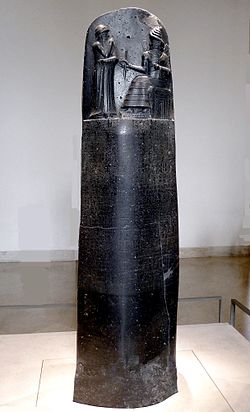
1792 BC - 1750 BC
Hammurabi invokes the wrath of the gods on any man who disobeys or erases his pronouncements (lines 3360'–3641', the end of the text). Curses include depriving him of rain from heaven and flood from the springs, and decreeing him 'a life that is no better than death.'
1792 BC - 1750 BC
Hammurabi wishes for good fortune for any future ruler who heeds his pronouncements and respects his stele (lines 3296'–3359').
1792 BC - 1750 BC
Having the laws read aloud would bring Hammurabi praise (lines 3257'–3275') and divine favour upon the listener (lines 3276'–3295'), according to the epilogue.
1792 BC - 1750 BC
Hammurabi expresses a hope that 'any wronged man who has a lawsuit' may have the laws of the stele read aloud to him and know his rights (lines 3240'–3256'). This concrete measure addressed the inaccessibility of scribal education in the Old Babylonian period.
1792 BC - 1750 BC
In lines 3152'–3239' of the epilogue, Hammurabi exalts his laws and his magnanimity, presenting himself as a shepherd of justice for his people.
1792 BC - 1750 BC
The epilogue begins (lines 3144'–3151') with the declaration: 'These are the just decisions which Hammurabi...' framing the laws as divinely sanctioned judgments of the king.
1792 BC
Hammurabi (or Hammurapi), the sixth king of the Amorite First Dynasty of Babylon, began his rule around 1792 BC according to the middle chronology. He would go on to expand Babylonian power and commission the famous law code that bears his name.
Image source: Hammurabi
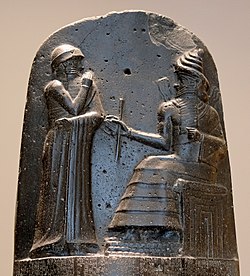
1792 BC - 1750 BC
Hammurabi ruled from around 1792 to around 1750 BC (middle chronology). During his reign, the Code of Hammurabi was created, one of the best-preserved and most complete legal collections from ancient Mesopotamia.
1754 BC
The Code of Hammurabi was inscribed on a diorite stele during Hammurabi's reign, containing laws written in Akkadian cuneiform. The prologue and epilogue frame the laws with legal imagery, including the phrase 'to prevent the strong from oppressing the weak.'
This Code of Hammurabi timeline was generated with the help of AI, using information found on the internet.
We work hard to keep these timelines accurate, but mistakes do get through. If you spot one, email us at [email protected] and we'll fix it for future visitors.
Generate yours with AI or build it from scratch, for free.


