-
Use Cases
-
Resources
-
Pricing
Hammurabi was the sixth king of the First Babylonian Dynasty who ruled Mesopotamia from approximately 1792 to 1750 BCE. He is best known for creating one of the world's earliest and most complete written legal codes, the Code of Hammurabi, which established standards for justice, commerce, and daily life in ancient Babylon. More Less
1894 BC
% complete
The kings who came before Hammurabi founded a relatively minor Amorite city-state around 1894 BC, which controlled little territory outside of the city of Babylon itself. For roughly a century after its founding, Babylon was overshadowed by older, larger, and more powerful kingdoms such as Elam, Assyria, Isin, Eshnunna, and Larsa.
Image source: Babylon
1810 BC
% complete
Hammurabi was born around 1810 BC into the Amorite First Dynasty of Babylon. His name in Old Babylonian Akkadian was Ḫammu-rāpi, and he would go on to become one of the most famous rulers of ancient Mesopotamia.
Image source: Hammurabi
1800 BC
% complete
In northern Mesopotamia, the Amorite king Shamshi-Adad I, who had already inherited centuries-old Assyrian colonies in Anatolia, expanded his territory into the Levant and central Mesopotamia. His untimely death would somewhat fragment his kingdom, altering the balance of power during Hammurabi's era.
Image source: Shamshi-Adad I
1792 BC
% complete
Hammurabi was an Amorite First Dynasty king of the city-state of Babylon who inherited power from his father, Sin-Muballit, around 1792 BC. He became the sixth king of his dynasty and began a reign that would last over four decades.
1792 BC - 1765 BC
% complete
In the early years of his reign, Hammurabi ruled a relatively minor city-state that controlled little territory outside of Babylon itself. He spent these decades consolidating his position while larger kingdoms like Larsa, Eshnunna, and Assyria dominated Mesopotamian politics.
1792 BC - 1750 BC
% complete
Hammurabi reigned as the sixth Amorite king of Babylon from around 1792 BC to around 1750 BC. Over more than forty years he transformed Babylon from a minor city-state into the capital of an empire encompassing much of Mesopotamia.
1780 BC - 1765 BC
% complete
During the middle portion of his reign, Hammurabi skillfully played rival powers against one another, forming alliances when convenient and breaking them when advantageous. This diplomatic maneuvering allowed him to preserve Babylon's independence while preparing for future expansion.
1765 BC - 1755 BC
% complete
In the later part of his reign, Hammurabi launched a series of military campaigns against neighboring states, conquering rivals across Mesopotamia. His victories brought cities such as Isin, Eshnunna, and Mari under Babylonian control.
1764 BC
% complete
Angered by Larsa's failure to come to his aid during a military campaign, Hammurabi turned against his southern neighbor. This betrayal set the stage for his invasion and annexation of the powerful kingdom of Larsa.
1763 BC
% complete
Angered by Larsa's failure to come to his aid, Hammurabi invaded and then annexed Larsa, thus gaining control of the entirety of the lower Mesopotamian plain around 1763 BC. This conquest made Babylon the dominant power in southern Mesopotamia.
1763 BC - 1750 BC
% complete
With the annexation of Larsa, Hammurabi gained control of the entirety of the lower Mesopotamian plain around 1763 BC. Babylon now stood at the center of a unified kingdom stretching across southern Mesopotamia.
1755 BC - 1750 BC
% complete
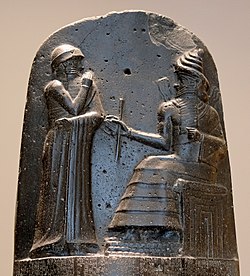
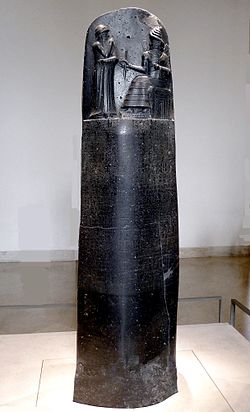
Near the end of his reign, Hammurabi issued his famous law code, one of the earliest and best-preserved written legal codes in history. The laws were inscribed on a stele addressed to 'any future king' with the wish 'May he be given life forever!'
Image source: Code of Hammurabi
1754 BC
% complete
The Code of Hammurabi was inscribed on a massive stele of polished diorite, depicting Hammurabi receiving the laws from the sun god Shamash. The text contained hundreds of laws governing commerce, property, family life, and justice.
1158 BC
% complete
The stele bearing the Code of Hammurabi was later plundered by the Elamites and removed to their capital, Susa. There it remained for centuries until its rediscovery by archaeologists in the twentieth century.
1750 BC
% complete
Hammurabi died around 1750 BC and was succeeded by his son Samsu-iluna. Although Samsu-iluna inherited a vast empire, it began to unravel within decades of his father's death.
Image source: Samsu-iluna
1740 BC
% complete
In northern Mesopotamia, both the Amorites and Babylonians were driven from Assyria by Puzur-Sin, a native Akkadian-speaking ruler, around 1740 BC. This marked the beginning of the fragmentation of Hammurabi's empire.
1595 BC
% complete
The coup de grace for Hammurabi's Amorite Dynasty occurred in 1595 BC, when Babylon was sacked and conquered by the powerful Hittite Empire, thereby ending all Amorite political presence in Mesopotamia.
Image source: Babylonia
1158 BC
% complete
When the Elamite king Shutruk-Nakhunte raided Babylon in 1158 BC and carried off many stone monuments, he had most of the inscriptions on these monuments erased and new inscriptions carved into them, erasing much of the record of earlier kings including Hammurabi.
Image source: Shutruk-Nakhunte
1749 BC - 1600 BC
% complete
For centuries after his death, Hammurabi's laws continued to be copied by scribes as part of their writing exercises, and they were even partially translated into Sumerian. The code remained a foundational legal and educational text long after the fall of his dynasty.
2010
% complete
Since his rediscovery by archaeologists in the late nineteenth century, Hammurabi has been seen as an important figure in the history of law. His code influenced legal traditions across the ancient Near East, as shown by finds like the Hazor tablet, and continues to be studied worldwide today.
1880 - 1900
% complete
Hammurabi was rediscovered by archaeologists in the late 19th century and has since been seen as an important figure in the history of law. Excavations and decipherment of cuneiform texts brought his reign and achievements back to light.
1900 - 1920
% complete
In the early twentieth century, many scholars believed that Hammurabi was Amraphel, the King of Shinar mentioned in Genesis 14:1. This identification fueled intense scholarly debate about connections between the Bible and ancient Mesopotamia.
Image source: Amraphel
1900 - 1905
% complete
In the late nineteenth century, the Code of Hammurabi became a major center of debate in the heated Babel und Bibel ('Babylon and Bible') controversy in Germany over the relationship between the Bible and ancient Babylonian texts.
Image source: Panbabylonism
1901
% complete
The stele of the Code of Hammurabi was rediscovered in 1901 at Susa in Iran, where it had been taken by Elamite plunderers centuries earlier. Its excavation revealed one of the most important legal documents of the ancient world.
1901
% complete
After its rediscovery at Susa in 1901, the stele of the Code of Hammurabi was transported to France and placed in the Louvre Museum in Paris, where it remains one of the museum's most celebrated artifacts.
Image source: Louvre
Jan 1902
% complete
In January 1902, the German Assyriologist Friedrich Delitzsch gave a lecture at the Sing-Akademie zu Berlin in front of Kaiser Wilhelm II and his wife in which he argued that the Mosaic Laws of the Old Testament were directly copied off the Code of Hammurabi.
Image source: Friedrich Delitzsch
Sep 1903
% complete
Delitzsch's lecture was so controversial that, by September 1903, he had managed to collect 1,350 short articles from newspapers and journals, over 300 longer ones, and twenty-eight pamphlets written in response to this lecture, as well as a preceding one about the Flood story in the Epic of Gilgamesh.
1904
% complete
The Kaiser distanced himself from Delitzsch and his radical views, and in fall of 1904 Delitzsch was forced to give his third lecture in Cologne and Frankfurt am Main rather than in Berlin, signaling official disapproval of his claims.
Image source: Wilhelm II
1920 - 1921
% complete
The putative relationship between the Mosaic Law and the Code of Hammurabi became a major part of Delitzsch's argument in his 1920–21 book Die große Täuschung (The Great Deception), which claimed the Hebrew Bible was irredeemably contaminated by Babylonian influence and that only by eliminating the human Old Testament entirely could Christians believe in the true message of the New Testament.
Image source: Gilgamesh
2010
% complete
In 2010, a team of archaeologists from Hebrew University discovered a cuneiform tablet dating to the eighteenth or seventeenth century BC at Hazor in Israel containing laws clearly derived from the Code of Hammurabi, demonstrating the far-reaching influence of Hammurabi's legal tradition.
Image source: Tel Hazor
Or browse the full history timeline directory, with more than 2,000 topics.
This Hammurabi timeline was generated with the help of AI, using information found on the internet.
We work hard to keep these timelines accurate, but mistakes do get through. If you spot one, email us at [email protected] and we'll fix it for future visitors.
Generate yours with AI or build it from scratch, for free.
Export your timeline, add your own events, edit or remove AI-generated events, and much more
No credit card required.
Cancel anytime.
Cancel anytime.
You can create an unlimited number of timelines with up to 10 events on each one, customize how they look, export them to PDF, PNG, PowerPoint, CSV, and Excel, and share them with a link. Paid plans raise the event limit and add features like spreadsheet imports and collaborators.
Yes. You can cancel your subscription from your account page at any time, and you will not be charged again. Your subscription stays active for the rest of the period you already paid for.
Yes. We will email you a reminder before the annual renewal, and we will also email you a receipt.
Yes. You can email us within 15 days of any payment, and we will issue you a full refund.
Check out our pricing docs or send us an email anytime: [email protected].