-
Use Cases
-
Resources
-
Pricing
The Phoenician Civilization was an ancient maritime culture centered on the coastal cities of Tyre, Sidon, and Byblos in modern-day Lebanon. Renowned as master seafarers and traders of the Mediterranean, the Phoenicians developed the first widely used alphabetic writing system, established colonies across the Mediterranean including Carthage, and spread their commercial networks and cultural influence throughout the ancient world. More Less
2750 BC
% completado
The fifth-century BC Greek historian Herodotus claimed that the Phoenicians had migrated from the Erythraean Sea around 2750 BC. The first-century AD geographer Strabo similarly reported a claim that they came from Tylos and Arad (Bahrain and Muharraq).
Image source: Phoenicia
1750 BC
% completado
Some archaeologists working on the Persian Gulf have accepted the ancient migration traditions and suggest a migration connected with the collapse of the Dilmun civilization around 1750 BC.
Image source: Dilmun
2686 BC - 2134 BC
% completado
Vines grew readily in the coastal Levant, and wine was exported to Egypt as early as the Old Kingdom period (2686–2134 BC), marking an early chapter of Phoenician commerce.
1950 BC - 1450 BC
% completado
The earliest verified relationship appears to have begun with the Minoan civilization on Crete (1950–1450 BC), which together with the Mycenaean civilization (1600–1100 BC) is considered the progenitor of classical Greece.
Image source: Minoan civilization
1200 BC
% completado
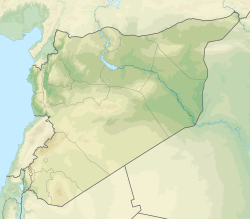
As early as 1200 BC, texts from Ugarit suggest that Canaanite merchant ships were capable of carrying cargoes weighing up to 450 tons, demonstrating advanced maritime capability.
Image source: Ugarit
1000 BC
% completado
The recovery of the Mediterranean economy can be credited to Phoenician mariners and merchants, who re-established long-distance trade between Egypt and Mesopotamia in the 10th century BC.
1000 BC
% completado
During the 10th century BC, the Phoenician cities engineered irrigation systems to grow crops on the fertile coastal strip and built cisterns to supply the urban centers with drinking water.
900 BC
% completado
From the late tenth century BC, the Phoenicians established commercial outposts throughout the Mediterranean, with Tyre founding colonies in Cyprus, Sardinia, Iberia, the Balearic Islands, Sicily, Malta, Morocco, and Tunisia.
700 BC
% completado
An excavation of a small Phoenician town south of Sidon uncovered a wine factory used from at least the seventh century BC, believed to have been aimed for an overseas market.
700 BC
% completado
In the seventh century BC the western colonies came under the control of Carthage, which was exercised directly through appointed magistrates.
Image source: Carthage
700 BC
% completado
The Phoenicians founded colonies and trading posts throughout the Mediterranean; among these, Carthage in the Mediterranean Maghreb developed into a major power by the 7th century BC.
1997
% completado
The wine trade with Egypt is vividly documented by shipwrecks discovered in 1997 in the open sea 50 kilometres (30 mi) west of Ascalon.
Image source: Ashkelon
2014
% completado
In 2014, a 12 metres (39 ft) long Phoenician trading ship was found near Gozo island in Malta, providing valuable insight into Phoenician maritime technology.
Image source: Gozo
1750 BC
% completado
Phoenicians may have discovered the famous dye, produced from murex sea snails, as early as 1750 BC. The dye became one of the most prized commodities of the ancient Mediterranean world.
Image source: Tyrian purple
1050 BC
% completado
Around 1050 BC, the Phoenicians developed a script for writing their own language. The name Phoenician is by convention given to inscriptions beginning around this time, because Phoenician, Hebrew, and other Canaanite dialects were largely indistinguishable before then.
Image source: Phoenician alphabet
950 BC
% completado
In the Old Testament, a craftsman from Tyre is commissioned to build and decorate the legendary Solomon's Temple in Jerusalem, which presupposes a well-developed and highly respected craft industry in Phoenicia by the mid-tenth century BC.
Image source: Solomon's Temple
800 BC
% completado
The Phoenician alphabet was adopted and modified by the Greeks probably in the eighth century BC, forming the basis of the Greek alphabet and ultimately most modern Western scripts.
200 BC
% completado
According to Krahmalkov, Poenulus, a Latin comedic play written in the early 2nd century BC, appears to preserve a Punic term for the Phoenician/Punic language which may be reconstructed as Pōnnīm, a point disputed by Joseph Naveh of the Hebrew University.
500 AD
% completado
Punic was still spoken in the fifth century AD and known to St. Augustine, showing the remarkable endurance of the Phoenician language long after the fall of Carthage.
Image source: Punic language
1479 BC - 1425 BC
% completado
The first known account of the Phoenicians relates the conquests of Pharaoh Thutmose III (1479–1425 BC), including the subjugation of those the Egyptians called Fenekhu ('carpenters').
Image source: Thutmose III
1400 BC
% completado
By the mid-14th century BC, the Phoenician city-states were considered 'favored cities' by the Egyptians, enjoying a privileged status within the Egyptian imperial system.
1350 BC - 1300 BC
% completado
The Amarna letters report that from 1350 to 1300 BC, neighboring Amorites and Hittites were capturing Phoenician cities, especially in the north.
Image source: Amarna letters
1230 BC
% completado
The Phoenicians survived the Bronze Age crisis, and by 1230 BC city-states such as Tyre, Sidon, and Byblos maintained political independence, asserted their maritime interests, and enjoyed economic prosperity.
1200 BC - 1150 BC
% completado
Sometime between 1200 and 1150 BC, the Late Bronze Age collapse severely weakened or destroyed most civilizations in the region, including those of the Egyptians and the Hittites.
Image source: Late Bronze Age collapse
1200 BC - 1000 BC
% completado
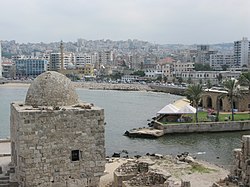
Sidon was dominant between the 12th and 11th centuries BC and influenced its neighbors, before Tyre later rose to become the most powerful city-state.
Image source: Sidon
1100 BC
% completado
A period sometimes described as a 'Phoenician renaissance' had begun, and by the end of the 11th century BC, an alliance formed between Tyre and Israel had created a new geopolitical status quo in the Levant.
969 BC - 936 BC
% completado
By the tenth century BC, Tyre rose to become the richest and most powerful Phoenician city-state, particularly during the reign of Hiram I (c. 969–936 BC).
Image source: Hiram I
700 BC - 600 BC
% completado
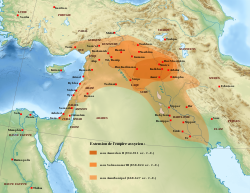
Esarhaddon's mass purges of Assyrian state officials by execution greatly weakened the functioning of the Assyrian administrative state, and by the end of the seventh century BC, the Assyrian empire had been weakened by successive revolts.
Image source: Neo-Assyrian Empire
700 BC
% completado
During the seventh century BC, Sidon rebelled and was destroyed by Esarhaddon, who enslaved its inhabitants and built a new city on its ruins.
Image source: Esarhaddon
600 BC
% completado
Among the writings of ancient historians, the detail about the length of Nebuchadnezzar's supposed thirteen-year siege of Tyre in the early sixth century BC can be found only in Josephus' first century writings, recorded almost 700 years after the purported event.
Image source: List of sieges
600 BC
% completado
In the sixth century BC, during the period of Babylonian rule, Tyre briefly adopted a system of government consisting of a pair of judges known as sufetes (shophets), chosen from the most powerful noble families and serving short terms.
600 BC
% completado
At least one woman, Amoashtart, or Ummiashtart, is recorded to have ruled Sidon in the sixth century BC.
500 BC
% completado
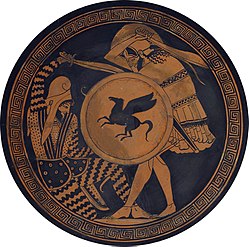
The Phoenicians remained a core asset to the Achaemenid Empire, particularly for their prowess in maritime technology and navigation; they furnished the bulk of the Persian fleet during the Greco-Persian Wars of the late fifth century BC.
Image source: Greco-Persian Wars
400 BC
% completado
In the fourth century BC, when the armies of Alexander the Great approached Tyre, they were met not by its King but by representatives of the commonwealth of the city.
Image source: Siege of Tyre (332 BC)
350 BC
% completado
In the mid-fourth century BC, King Tennes of Sidon led a failed rebellion against Artaxerxes III, enlisting the help of the Egyptians, who were subsequently drawn into a war with the Persians.
Image source: Artaxerxes III
332 BC
% completado
The scholarly consensus is that the Phoenicians' period of greatest prominence was 1200 BC to the end of the Persian period (332 BC).
300 BC
% completado
The Phoenician homeland was repeatedly contested by the Ptolemaic Kingdom of Egypt during the forty-year Syrian Wars, coming under Ptolemaic rule in the third century BC.
Image source: Syrian Wars
200 BC - 150 BC
% completado
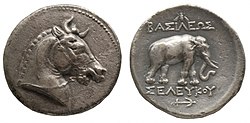
The Seleucids reclaimed the area the following century, holding it until the mid-first 2nd century BC.
Image source: Seleucid Empire
150 BC
% completado
Phoenician influence endured in the western Mediterranean until the Roman destruction of Carthage in the mid-2nd century BC, marking the effective end of Punic power.
Image source: Third Punic War
1600 - 1800
% completado
Long regarded as a 'lost' civilization due to the absence of native historical accounts, the Phoenicians became better understood only after the discovery of inscriptions in the 17th and 18th centuries.
2006
% completado
A study in 2006 found evidence for the genetic persistence of Phoenicians in the Spanish island of Ibiza.
Image source: Ibiza
2008
% completado
A 2008 study led by Pierre Zalloua found that six subclades of Haplogroup J-M172 (J2)—thought to have originated between the Caucasus Mountains, Mesopotamia and the Levant—were of a 'Phoenician signature', present amongst male populations of coastal Lebanon and areas of historic Phoenician settlement from Cyprus to Morocco.
Image source: Haplogroup J-M172
2016
% completado
In 2016, the rare U5b2c1 maternal haplogroup was identified in the DNA of a 2,500-year-old male skeleton excavated from a Punic tomb in Tunisia.
Image source: Haplogroup U
2017
% completado
According to a 2017 study published by the American Journal of Human Genetics, present-day Lebanese derive most of their ancestry from a Canaanite-related population, implying substantial genetic continuity in the Levant since at least the Bronze Age.
Image source: Lebanese people
2018
% completado
One 2018 study of mitochondrial lineages in Sardinia concluded that the Phoenicians were 'inclusive, multicultural and featured significant female mobility', with evidence of indigenous Sardinians integrating peacefully and permanently with Semitic Phoenician settlers.
Image source: History of Sardinia
2020
% completado
In a 2020 study published in the American Journal of Human Genetics, researchers showed there is substantial genetic continuity in Lebanon since the Bronze Age interrupted by three significant admixture events during the Iron Age, Hellenistic, and Ottoman periods.
2022
% completado
A 2022 analysis of maternal haplogroups from ancient samples from Punic sites of Motya and Lilibeo in Sicily indicates that the Sicilian Phoenicians shared genetic similarities with Bronze Age samples from the Iberian Peninsula, Sardinia and Italy, and are not particularly close to other Phoenicians from Sardinia and the Iberian islands.
Image source: Motya
Apr 2025
% completado
A genetic study published in Nature Communications in April 2025 examined the remains of 196 individuals from 14 sites traditionally identified as Phoenician and Punic in the central and western Mediterranean.
Image source: Nature Communications
Or browse the full history timeline directory, with more than 2,000 topics.
This Phoenician Civilization timeline was generated with the help of AI, using information found on the internet.
We work hard to keep these timelines accurate, but mistakes do get through. If you spot one, email us at [email protected] and we'll fix it for future visitors.
Generate yours with AI or build it from scratch, for free.
Export your timeline, add your own events, edit or remove AI-generated events, and much more
No credit card required.
Cancel anytime.
Cancel anytime.
You can create an unlimited number of timelines with up to 10 events on each one, customize how they look, export them to PDF, PNG, PowerPoint, CSV, and Excel, and share them with a link. Paid plans raise the event limit and add features like spreadsheet imports and collaborators.
Yes. You can cancel your subscription from your account page at any time, and you will not be charged again. Your subscription stays active for the rest of the period you already paid for.
Yes. We will email you a reminder before the annual renewal, and we will also email you a receipt.
Yes. You can email us within 15 days of any payment, and we will issue you a full refund.
Check out our pricing docs or send us an email anytime: [email protected].