-
Use Cases
-
Resources
-
Pricing
The Etruscan Civilization was an advanced pre-Roman society that flourished in Etruria (modern Tuscany, Umbria, and northern Lazio) on the Italian Peninsula. Known for their sophisticated art, metallurgy, urban planning, and religious practices, the Etruscans heavily influenced early Roman culture before being gradually absorbed into the expanding Roman Republic. More Less
1300 BC - 800 BC
% complete
A 2012 survey of the previous 30 years' archaeological findings based on excavations of the major Etruscan cities showed a continuity of culture from the last phase of the Bronze Age (13th–11th century BC) to the Iron Age (10th–9th century BC), supporting local development.
1200 BC
% complete
The most marked and radical archaeologically attested change in the area was the adoption, starting around the 12th century BC, of the funeral rite of incineration in terracotta urns, a Continental European practice derived from the Urnfield culture. Nothing about this practice suggests an ethnic contribution from Asia Minor or the Near East.
Image source: Etruscan civilization
1200 BC - 1100 BC
% complete
It is possible that there were contacts between northern-central Italy and the Mycenaean world at the end of the Bronze Age, but contacts between the inhabitants of Etruria and inhabitants of Greece, the Aegean islands, Asia Minor, and the Near East are attested only centuries later.
Image source: Mycenaean Greece
1000 BC
% complete
The Etruscans themselves dated their nation's origin to a date corresponding to the 11th or 10th century BC, providing an ancient internal tradition about the beginnings of their civilization in central Italy.
750 BC - 700 BC
% complete
The first Greek author to mention the Etruscans, whom the Ancient Greeks called Tyrrhenians, was the 8th-century BC poet Hesiod in his work the Theogony, providing the earliest literary reference to the people of Etruria.
Image source: Theogony
700 BC - 600 BC
% complete
The 7th-century BC Homeric Hymn to Dionysus referred to the Tyrrhenians as pirates, reflecting the Greek view of Etruscan seafarers who dominated much of the Mediterranean during this period.
Image source: Homeric Hymns
500 BC - 400 BC
% complete
In the 5th century BC, some Greek writers began to associate the Tyrrhenians and Pelasgians, with some using these terms merely as generic labels for non-Greeks and for the supposed indigenous ancestors of the Greeks.
Image source: Pelasgians
100 BC - 1 BC
% complete
The 1st-century BC historian Dionysius of Halicarnassus, a Greek living in Rome, dismissed many ancient theories of other Greek historians and postulated that the Etruscans were indigenous people who had always lived in Etruria, different from both the Pelasgians and the Lydians. He noted that Xanthus of Lydia, an important authority on Lydia's history, never suggested a Lydian origin of the Etruscans.
Image source: Dionysius of Halicarnassus
100 BC - 1 BC
% complete
Similarly, the 1st-century BC historian Livy, in his Ab Urbe Condita Libri, said that the Rhaetians were Etruscans who had been driven into the mountains by the invading Gauls, and he asserted that the inhabitants of Raetia were of Etruscan origin.
Image source: Livy
900 BC - 100 BC
% complete
Etruscan art was produced by the Etruscan civilization between the 9th and 2nd centuries BC, encompassing sculpture, pottery, frescoes, and metalwork that reveal both indigenous traditions and Greek influence.
Image source: Etruscan art
800 BC - 700 BC
% complete
Through contact with the Greek colonies at Pithecusae and Cumae in Campania in the course of the Greek colonization, the Etruscans came under the influence of Greek culture in the 8th century BC, shaping their art, religion, and writing.
800 BC - 700 BC
% complete
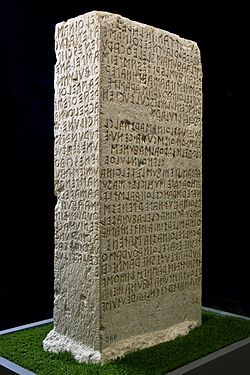
Etruscan texts, written over a space of seven centuries, use a form of the Greek alphabet due to close contact between the Etruscans and the Greek colonies at Pithecusae and Cumae in the 8th century BC, until the script was no longer used at the beginning of the 1st century AD.
Image source: Etruscan alphabet
700 BC - 600 BC
% complete
All four key early artifacts bearing Etruscan inscriptions date from the 7th century BC, marking the earliest surviving evidence of the Etruscan writing system in use.
Image source: Etruscan language
700 BC - 400 BC
% complete
One can distinguish an archaic Etruscan script from the 7th to 5th centuries BC from a more recent script of the 4th to 1st centuries BC. In the later script, some characters were no longer used, including the X for a sh sound. The consistent use of the letters means deciphering Etruscan inscriptions is not a problem.
650 BC
% complete
In the middle of the 7th century BC, the Romans adopted the Etruscan writing system and letters, which formed the basis for the Latin alphabet and, ultimately, the alphabets of much of the modern world.
Image source: Old Latin
600 BC - 500 BC
% complete
It is assumed that the formation of the Oscan script, probably in the 6th century BC, was fundamentally influenced by the Etruscan alphabet, demonstrating the wide cultural reach of Etruscan writing in ancient Italy.
400 BC - 300 BC
% complete
It was only from the end of the 4th century BC that evidence of physiognomic portraits began to be found in Etruscan art, and Etruscan portraiture became more realistic, reflecting individual features of the deceased.
100 BC - 50 BC
% complete
In the 1st century BC, Diodorus Siculus wrote that literary culture was one of the great achievements of the Etruscans, although only a few fragments of their texts, religious and especially funerary, survive today.
Image source: Diodorus Siculus
1 AD
% complete
No further Etruscan literature has survived, and from the early 1st century AD, inscriptions with Etruscan characters have ceased to exist, marking the effective end of the Etruscan written tradition.
600 BC - 500 BC
% complete
Etruscan interests collided with those of the Greeks, especially in the sixth century BC, when Phocaeans of Italy founded colonies along the coasts of Sardinia, Spain and Corsica, intensifying competition for trade and territory in the western Mediterranean.
600 BC - 500 BC
% complete
It is believed that the Etruscan government style changed from total monarchy to oligarchic republic in the 6th century BC, in a manner similar to the transformation that produced the Roman Republic.
500 BC - 400 BC
% complete
The earliest Etruscan coinage, struck mainly at Populonia, dates from around the fifth century BC, but it remained a limited phenomenon, and exchange long relied on bronze by weight, including the so-called ramo secco ingots.
Image source: Populonia
500 BC - 200 BC
% complete
Roman authors repeatedly praised the fertility of Etruria and its abundant grain, in particular spelt (farro), as well as its vineyards, olive groves and figs. Cities such as Cerveteri, Roselle, Volterra, Chiusi, Perugia and Arezzo supplied large quantities of grain to Rome, both during the famines of the fifth century BC and to the army of Scipio during the Punic Wars.
Image source: Etruria
475 BC - 400 BC
% complete
From the first half of the 5th century BC, the new political situation meant the beginning of the Etruscan decline after losing their southern provinces, marking the start of the gradual erosion of Etruscan power in Italy.
400 BC - 200 BC
% complete
Roman annexation of Etruscan city states occurred in the 4th and 3rd centuries BC, and saw the adoption of many Etruscan religious-political practices by Rome.
400 BC - 300 BC
% complete
In the 4th century BC, Etruria saw a Gallic invasion end its influence over the Po Valley and the Adriatic coast, further shrinking the sphere of Etruscan power in northern Italy.
Image source: Gauls
300 BC - 200 BC
% complete
Beginning in the late 4th century BC, Etruria succumbed to the expanding Roman Republic during the Roman–Etruscan Wars, with Etruria fully conquered by Rome in the 3rd century BC.
90 BC
% complete
The Etruscans were granted Roman citizenship in 90 BC, formally integrating the former Etruscan population into the Roman state as Roman expansion absorbed their territory.
27 BC
% complete
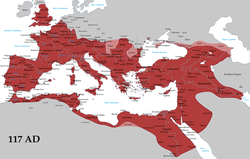
By 27 BC the whole Etruscan territory was incorporated into the newly established Roman Empire, completing the absorption of Etruscan civilization into the Roman world.
Image source: Roman Empire
1934
% complete
Paul Kretschmer's 1934 article in Glotta proposed that the Greek word for the Etruscans was a loanword from a Mediterranean language, a hypothesis later revived by Robert Beekes in his Etymological Dictionary of Greek.
Image source: Tyrrhenians
1947
% complete
Modern Etruscologists and archeologists, such as Massimo Pallottino (1947), have shown that early historians' assumptions and assertions on the subject of Etruscan origins were groundless, reshaping the scholarly debate.
Image source: Massimo Pallottino
1998
% complete
Since Rix (1998), it is widely accepted that the Tyrsenian family groups Raetic and Lemnian together with Etruscan, providing a linguistic framework for understanding Etruscan's relatives.
Image source: Tyrsenian languages
2000
% complete
In 2000, the Etruscologist Dominique Briquel explained in detail why he believes that ancient Greek narratives on Etruscan origins should not even count as historical documents, further undermining the traditional migration theories.
2004
% complete
An mtDNA study published in 2004, based on about 28 samples of individuals who lived from 600 to 100 BC in Veneto, Etruria and Campania, found that the Etruscans had no significant heterogeneity and that all mitochondrial lineages observed appear typically European or West Asian, though only a few haplotypes were shared with modern populations.
2013
% complete
A couple of mitochondrial DNA studies published in 2013 in PLOS One and the American Journal of Physical Anthropology, based on Etruscan samples from Tuscany and Latium, concluded the Etruscans were indigenous. Etruscan mtDNA appeared very close to a Neolithic population from Central Europe and other Tuscan populations, suggesting the civilization developed locally from the Villanovan culture, with genetic links between Tuscany and western Anatolia dating to the Neolithic.
2017
% complete
In the collective volume Etruscology published in 2017, British archeologist Phil Perkins provided an analysis of the state of DNA studies, writing that none of the DNA studies to date conclusively prove that the Etruscans were an intrusive population originating in the Eastern Mediterranean or Anatolia, and that DNA evidence can support the theory that the Etruscan people are autochthonous in central Italy.
2018
% complete
A 2018 mtDNA study in the American Journal of Physical Anthropology compared ancient and modern samples from Tuscany across Prehistory, the Etruscan age, Roman age, Renaissance and the present day, concluding that the Etruscans appear to be a local population, intermediate between the prehistoric and the other samples.
2019
% complete
A 2019 study published in the journal Science analyzed the remains of eleven Iron Age individuals from the areas around Rome, of whom four were Etruscan: one buried in Veio Grotta Gramiccia from the Villanovan era (900-800 BC) and three buried in the La Mattonara Necropolis near Civitavecchia from the Orientalizing period (700-600 BC).
Image source: Science (journal)
2021
% complete
In his 2021 book A Short History of Humanity, German geneticist Johannes Krause, codirector of the Max Planck Institute for Evolutionary Anthropology, concludes that it is likely the Etruscan language, as well as Basque, Paleo-Sardinian and Minoan, developed on the continent in the course of the Neolithic Revolution.
Image source: Johannes Krause
Sep 2021
% complete
An archeogenetic study published in September 2021 in Science Advances analyzed the autosomal DNA and uniparental markers of 48 Iron Age individuals from Tuscany and Lazio, spanning from 800 to 1 BC, and concluded that the Etruscans were autochthonous and had a genetic profile similar to their Latin neighbors.
Image source: Science Advances
Or browse the full history timeline directory, with more than 2,000 topics.
This Etruscan Civilization timeline was generated with the help of AI, using information found on the internet.
We work hard to keep these timelines accurate, but mistakes do get through. If you spot one, email us at [email protected] and we'll fix it for future visitors.
Generate yours with AI or build it from scratch, for free.
Export your timeline, add your own events, edit or remove AI-generated events, and much more
No credit card required.
Cancel anytime.
Cancel anytime.
You can create an unlimited number of timelines with up to 10 events on each one, customize how they look, export them to PDF, PNG, PowerPoint, CSV, and Excel, and share them with a link. Paid plans raise the event limit and add features like spreadsheet imports and collaborators.
Yes. You can cancel your subscription from your account page at any time, and you will not be charged again. Your subscription stays active for the rest of the period you already paid for.
Yes. We will email you a reminder before the annual renewal, and we will also email you a receipt.
Yes. You can email us within 15 days of any payment, and we will issue you a full refund.
Check out our pricing docs or send us an email anytime: [email protected].