-
Use Cases
-
Resources
-
Pricing
The Toltec Civilization was a powerful Mesoamerican empire that flourished in central Mexico from roughly 900 to 1168 CE. Centered at its capital of Tula (Tollan), the Toltecs were renowned for their militaristic society, impressive pyramids and colossal warrior statues, and their profound cultural and political influence on later civilizations, especially the Aztecs, who revered them as a golden age of civilization. More Less
550 - 650
% complete
The great metropolis of Teotihuacan began to decline and was eventually sacked around 550-650 CE. Its collapse left a power vacuum in central Mexico that allowed new groups, including the ancestors of the Toltecs, to migrate into the region and establish new centers of power.
Image source: Teotihuacan
600 - 800
% complete
Semi-nomadic Chichimeca peoples speaking Nahuatl languages migrated southward from northern Mexico into the Valley of Mexico and surrounding highlands during the Epiclassic period, mixing with sedentary agricultural peoples and laying the demographic foundations for Toltec society.
Image source: Toltec
650 - 900
% complete
The fortified hilltop city of Xochicalco flourished after Teotihuacan's fall, blending Maya and central Mexican traditions. Its prominence helped shape the political and artistic environment from which the Toltec state would later emerge.
Image source: Xochicalco
900
% complete
Around 900 CE, the Toltecs established their capital at Tollan-Xicocotitlan, known today as Tula, in the present-day Mexican state of Hidalgo. The city grew to cover several square kilometers and became one of the largest and most influential cities in Mesoamerica.
Image source: Tula (Mesoamerican site)
1050 - 1100
% complete
At its zenith, Tollan may have housed tens of thousands of inhabitants within its urban core, supported by intensive agriculture, irrigation, and tribute from subject regions, making it one of the greatest cities of postclassic Mesoamerica.
950
% complete
According to later Aztec historical traditions, Ce Tlalpitzin Mixcoatl, a Chichimec war leader, founded the Toltec ruling dynasty at Tollan, establishing the lineage of kings that would rule the Toltec state for generations.
Image source: Mixcoatl
968 - 987
% complete
Topiltzin Ce Acatl Quetzalcoatl, the most famous Toltec ruler, reigned over Tollan. Associated with the feathered serpent deity Quetzalcoatl, he was remembered as a wise priest-king who promoted learning, agriculture, and peaceful worship before his legendary exile.
Image source: Cē Ācatl Topiltzin
987
% complete
Later legends describe a struggle between followers of Quetzalcoatl, associated with peace and refined arts, and adherents of Tezcatlipoca, linked to warfare and human sacrifice. The conflict allegedly ended with Quetzalcoatl's banishment from Tollan and his journey east toward the Gulf of Mexico.
Image source: Quetzalcōātl
987 - 1027
% complete
Following Quetzalcoatl's exile, Huemac assumed leadership of the Toltecs. His reign is remembered in legend as a time of growing moral decay, famine, and internal strife that foreshadowed the eventual collapse of Tollan.
1000 - 1150
% complete
Tollan controlled access to the rich obsidian deposits of Pachuca, distributing blades and cores across vast distances. This lucrative trade underpinned Toltec economic power and connected distant regions of Mesoamerica.
Image source: Obsidian use in Mesoamerica
1000 - 1100
% complete
Strong Toltec influences appeared at the Maya city of Chichen Itza, whose architecture, including warrior temples, chacmool sculptures, and feathered serpent imagery, closely parallels Tula. Scholars debate whether this reflects conquest, migration, or shared elite culture.
Image source: Chichen Itza
1000 - 1150
% complete
Through trade, conquest, and cultural prestige, Toltec influence extended across much of Mesoamerica, reaching the Maya region of Yucatan, western Mexico, and beyond. The term 'Toltec' became synonymous with civilization itself for later peoples.
Image source: Toltec Empire
987
% complete
After his fall from power, Quetzalcoatl was said to have traveled to the Gulf coast and departed across the eastern sea on a raft of serpents, vowing to return. This prophecy later influenced how Mexica rulers interpreted the arrival of Spanish conquistadors.
1000 - 1150
% complete
Archaeological evidence, including tzompantli skull racks and sacrificial remains at Tula, indicates that large-scale human sacrifice became central to Toltec state religion, tied to warfare and the cults of Tezcatlipoca and other deities.
Image source: Human sacrifice in Aztec culture
1000 - 1150
% complete
Toltec society elevated militarism, with elite orders of eagle and jaguar warriors depicted on Atlantean columns and friezes. These warrior ideals were later adopted by the Aztecs, who claimed descent from Toltec military traditions.
Image source: Eagle warrior
1000 - 1150
% complete
Toltec craftsmen became renowned for working turquoise, shell, and obsidian, producing elaborate mosaics and ritual objects. Their metalworking knowledge, likely acquired through contacts with South America, spread through their trade networks.
Image source: Turquoise
1000 - 1150
% complete
The Mesoamerican ballgame held deep ritual significance in Toltec society. Ballcourts at Tula and sites under Toltec influence hosted ceremonial games often associated with fertility, cosmology, and sometimes human sacrifice.
Image source: Mesoamerican ballgame
1000 - 1100
% complete
At its height, Tula saw the construction of its most famous monuments, including Pyramid B with its five colossal basalt Atlantean warrior columns, colonnaded halls, and friezes depicting jaguars, eagles, and feathered serpents consuming human hearts.
Image source: Atlantean figures
1050 - 1150
% complete
Paleoclimate evidence suggests prolonged droughts affected central Mexico during the late Postclassic transition, reducing harvests and undermining the agricultural base that sustained Tollan's large population and contributed to social unrest.
Image source: Drought
1100 - 1150
% complete
Aztec chronicles describe civil wars, famine, and divine displeasure during the final years of Tollan, with conflicts between rival factions eroding centralized authority and prompting waves of emigration from the capital.
1150 - 1250
% complete
After Tollan's fall, Toltec-descended groups dispersed widely, settling in areas such as Culhuacan in the Valley of Mexico, the Puebla-Tlaxcala highlands, and beyond, carrying Toltec culture and prestige with them.
1150 - 1168
% complete
Around the mid-twelfth century, Tula's major civic and ceremonial buildings were burned and abandoned, marking the dramatic end of Toltec political dominance in central Mexico.
1168
% complete
Tradition holds that the last Toltec king Huemac fled the doomed Tollan and hanged himself in a cave at Chapultepec, symbolizing the definitive end of the Toltec dynasty in Aztec historical memory.
1200 - 1300
% complete
The city-state of Culhuacan, founded by Toltec exiles, claimed direct descent from Tollan's royal line. Its dynastic prestige made it the arbiter of legitimacy in the Valley of Mexico, sought after by rising powers including the Mexica.
Image source: Colhuacan (altepetl)
1300
% complete
The Mexica, future Aztecs, began their legendary migration from Aztlán, consciously modeling themselves on Toltec traditions and seeking marriage alliances with Toltec-descended nobility to legitimize their own rule.
Image source: Mexica
1376 - 1395
% complete
Tenochtitlan's leaders chose Acamapichtli, son of a Culhuacan princess of Toltec lineage, as their first huey tlatoani, deliberately linking the young Aztec state to the prestigious Toltec royal bloodline.
Image source: Acamapichtli
1400 - 1519
% complete
The Mexica embraced 'toltecayotl' — the essence of Toltec civilization — claiming Toltec ancestry, imitating Toltec art styles, excavating relics at Tula, and presenting themselves as heirs of the Toltecs to bolster imperial legitimacy.
1519 - 1521
% complete
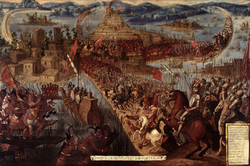
The Spanish conquest of the Aztec Empire ended the indigenous states that had preserved and invoked Toltec heritage, though Nahua scribes continued recording Toltec history and legends in colonial-era codices and annals.
Image source: Fall of Tenochtitlan
1550 - 1600
% complete
Post-conquest works such as the Florentine Codex, Durán's histories, and Ixtlilxochitl's writings preserved detailed accounts of Tollan, Quetzalcoatl, and the Toltec kings, though filtered through Aztec ideology and Christian interpretation.
Image source: Florentine Codex
1880 - 1950
% complete
Beginning with explorations by antiquarians and culminating in major mid-twentieth-century excavations led by Mexican archaeologists such as Jorge Acosta, systematic work at Tula revealed the scale and splendor of the ancient Toltec capital.
1981
% complete
Mexico formally protected Tula as an archaeological zone, and its Atlantean figures became national symbols. Today the site draws visitors worldwide and stands as the principal archaeological witness to Toltec civilization.
Or browse the full history timeline directory, with more than 2,000 topics.
This Toltec Civilization timeline was generated with the help of AI, using information found on the internet.
We work hard to keep these timelines accurate, but mistakes do get through. If you spot one, email us at [email protected] and we'll fix it for future visitors.
Generate yours with AI or build it from scratch, for free.
Export your timeline, add your own events, edit or remove AI-generated events, and much more
No credit card required.
Cancel anytime.
Cancel anytime.
You can create an unlimited number of timelines with up to 10 events on each one, customize how they look, export them to PDF, PNG, PowerPoint, CSV, and Excel, and share them with a link. Paid plans raise the event limit and add features like spreadsheet imports and collaborators.
Yes. You can cancel your subscription from your account page at any time, and you will not be charged again. Your subscription stays active for the rest of the period you already paid for.
Yes. We will email you a reminder before the annual renewal, and we will also email you a receipt.
Yes. You can email us within 15 days of any payment, and we will issue you a full refund.
Check out our pricing docs or send us an email anytime: [email protected].