-
Use Cases
-
Resources
-
Pricing
The Minoan Civilization was a Bronze Age culture centered on the island of Crete, flourishing from approximately 3000 to 1100 BCE. Named after the legendary King Minos by archaeologist Arthur Evans, it is considered Europe's first advanced civilization, renowned for its elaborate palace complexes such as Knossos, sophisticated art and frescoes, maritime trade networks across the Aegean, and the undeciphered Linear A writing system. The civilization declined following natural disasters and the rise of Mycenaean Greek influence. More Less
7000 BC
% complete
The oldest evidence of modern human habitation on Crete consists of pre-ceramic Neolithic farming-community remains dating to about 7000 BC, marking the earliest known settlement of the island.
3100 BC
% complete
The Minoan civilization developed from the local Neolithic culture around 3100 BC, laying the foundations for one of the earliest complex societies in Europe.
3100 BC - 2650 BC
% complete
The period from 3100 to 2650 BC is marked by the appearance of the first painted ceramics, an early hallmark of Minoan material culture.
Image source: Minoan pottery
2650 BC - 2200 BC
% complete
The period from 2650 to 2200 BC has been termed an international era, reflecting extensive Minoan connections across the Aegean and eastern Mediterranean.
Image source: Minoan civilization
2500 BC
% complete
By 2500 BC, during the Prepalatial period, Knossos had an estimated population of 1,300 to 2,000 people, making it a significant early settlement on Crete.
Image source: Knossos
2200 BC - 2100 BC
% complete
The period from 2200 to 2100 BC saw the continuation of the international trends established in the preceding era.
2100 BC - 1875 BC
% complete
The period from 2100 to 1875 BC saw the emergence of Protopalatial society, a formative stage in Minoan political and social organization.
2100 BC - 1925 BC
% complete
From 2100 to 1925 BC, populations increased dramatically at sites such as Knossos, Phaistos, and Malia, accompanied by major construction projects.
2000 BC
% complete
Around 2000 BC, with complex urban settlements flourishing, Knossos had grown to an estimated population of 18,000 inhabitants.
1925 BC - 1875 BC
% complete
Between 1925 and 1875 BC, the first palaces were built at Knossos, Phaistos, and Malia, in areas that had been used for communal ceremonies since the Neolithic.
1750 BC
% complete
The period from 1750 to 1700 BC marks the beginning of the Neopalatial period, the height of Minoan cultural achievement.
1700 BC
% complete
After 1700 BC, Minoan culture indicates a high degree of organization, reflected in architecture, administration, and craft production.
1700 BC - 1470 BC
% complete
The period from 1700 to 1470 BC was a continuation of the prosperous Neopalatial culture, marked by artistic and architectural achievements.
1650 BC - 1600 BC
% complete
In north-central Crete, blue-greenschist was used to pave floors of streets and courtyards between 1650 and 1600 BC, demonstrating sophisticated urban design.
1625 BC - 1470 BC
% complete
The post-eruption LM IB period saw ambitious new building projects, booming international trade, and artistic developments such as the distinctive marine style of pottery.
1600 BC
% complete
A notable event of this era was the eruption of the Thera volcano around 1600 BC towards the end of the LM IA subperiod. Carbon dating places it around 1600 BC, while synchronism with Egyptian records would place it roughly a century later.
Image source: Minoan eruption
1600 BC
% complete
Around 1600 BC, Knossos reached an estimated population of 20,000 to 100,000, making it one of the largest urban centers in the Aegean world.
1875 BC - 1700 BC
% complete
The period from 1875 to 1700 BC saw the development of the Minoan writing systems, Cretan hieroglyphic and Linear A, among the earliest scripts in Europe.
Image source: Linear A
1450 BC
% complete
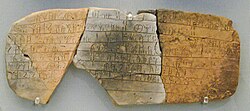
After 1450 BC, a modified version of Linear A known as Linear B was used to write Mycenaean Greek, which had become the language of administration on Crete.
Image source: Linear B
1470 BC - 1420 BC
% complete
The period from 1470 to 1420 BC is sparsely represented in the archaeological record but appears to have been a time of decline for Minoan society.
1470 BC
% complete
The period ending in 1470 BC concluded with severe destructions throughout the island, marking the end of Neopalatial society.
1450 BC
% complete
Around 1450 BC, the Minoans came under the cultural and perhaps political domination of the mainland Mycenaean Greeks. A Mycenaean elite clearly ruled Knossos from this point, forming a hybrid culture which lasted until around 1100 BC.
Image source: Mycenaean Greece
1420 BC - 1075 BC
% complete
The period from 1420 to 1075 BC shows profound social and political changes as Mycenaean influence reshaped Cretan society.
1360 BC
% complete
By 1360 BC, Knossos had an estimated population of 30,000, remaining a major center even under Mycenaean rule.
1200 BC - 1075 BC
% complete
From 1200 to 1075 BC, coinciding with the wider Late Bronze Age collapse, coastal settlements were abandoned in favor of defensible locations on higher ground.
Image source: Late Bronze Age collapse
1100 BC
% complete
The hybrid culture formed after the Mycenaean takeover lasted until around 1100 BC, after which the Minoan civilization faded into obscurity following the Late Bronze Age collapse.
1900
% complete
Largely forgotten after the Late Bronze Age collapse, the Minoan civilization was rediscovered in the early twentieth century through archaeological excavation, notably by Arthur Evans at Knossos.
1952
% complete
Linear B was deciphered in 1952, unlocking a major source of textual evidence about the economics and social organization of the final years at the palace of Knossos.
1989
% complete
A 1989 study published in The Angle Orthodontist showed remarkable similarity in craniofacial morphology between Minoans and modern Greeks, suggesting close affinity and stability over 4,000 years.
1998
% complete
In 1998, Minoan archaeologists met in a Belgian conference to discuss whether the Pax Minoica — the idea of a peaceful Minoan society — was outdated; evidence of Minoan warfare remained scanty.
Image source: Minoan civilization
2013
% complete
A 2013 archaeogenetics study by Hughey et al. examined ancient DNA to investigate the origins and genetic affinities of the Minoans.
2014
% complete
A 2014 study published in Anthropologischer Anzeiger indicated craniological similarities between modern Greeks and Minoans, indicating continuity of populations.
2017
% complete
A 2017 study found that Minoans and Mycenaean Greeks were genetically highly similar — but not identical — and that modern Greeks descend from these populations.
2023
% complete
In 2023, whole genome-wide data of 102 individuals from Crete, the Greek mainland, and Aegean Islands were sequenced, spanning from the Neolithic to Iron Age.
2024
% complete
In 2024, archaeologists discovered a Minoan bronze dagger with silver rivets in an ancient shipwreck at Kumluca in Antalya Province, Turkey.
2024
% complete
A report in 2024 also included a bioarchaeological investigation conducted on remains found in Armenoi, Crete, adding new insights into Minoan health and demography.
Or browse the full history timeline directory, with more than 2,000 topics.
This Minoan Civilization timeline was generated with the help of AI, using information found on the internet.
We work hard to keep these timelines accurate, but mistakes do get through. If you spot one, email us at [email protected] and we'll fix it for future visitors.
Generate yours with AI or build it from scratch, for free.
Export your timeline, add your own events, edit or remove AI-generated events, and much more
No credit card required.
Cancel anytime.
Cancel anytime.
You can create an unlimited number of timelines with up to 10 events on each one, customize how they look, export them to PDF, PNG, PowerPoint, CSV, and Excel, and share them with a link. Paid plans raise the event limit and add features like spreadsheet imports and collaborators.
Yes. You can cancel your subscription from your account page at any time, and you will not be charged again. Your subscription stays active for the rest of the period you already paid for.
Yes. We will email you a reminder before the annual renewal, and we will also email you a receipt.
Yes. You can email us within 15 days of any payment, and we will issue you a full refund.
Check out our pricing docs or send us an email anytime: [email protected].