-
Use Cases
-
Resources
-
Pricing
The Hittite Empire was a powerful Bronze Age civilization centered in Anatolia (modern-day Turkey), known for its capital Hattusa, its mastery of ironworking and chariot warfare, its adoption of Indo-European language and cuneiform writing, and its famous Battle of Kadesh against Egypt. It rivaled Egypt and Babylon as one of the great powers of the ancient Near East before collapsing around 1180 BCE during the Bronze Age collapse. More Less
5000 BC - 3000 BC
% complete
Recent genetic and archaeological research has indicated that Proto-Anatolian speakers arrived in Anatolia sometime between 5000 and 3000 BC.
Image source: Hittites
4400 BC - 4100 BC
% complete
The ancestors of the Hittites came into Anatolia between 4400 and 4100 BC, when the Anatolian language family split from (Proto)-Indo-European.
4200 BC - 4000 BC
% complete
Anthony in 2007 concluded that steppe herders who were archaic Indo-European speakers spread into the lower Danube valley about 4200–4000 BC, either causing or taking advantage of the collapse of Old Europe. He thought their languages probably included archaic Proto-Indo-European dialects, and that their descendants later moved into Anatolia, perhaps as early as 3000 BC.
2800 BC
% complete
2800 BC fit with the customary assumption that the Anatolian Indo-European language was introduced into Anatolia sometime in the third millennium BC.
2100 BC
% complete
The Proto-Hittite language developed around 2100 BC, and the Hittite language itself is believed to have been in use in Central Anatolia between the 20th and 12th centuries BC.
Image source: Hittite language
2025 BC - 1750 BC
% complete
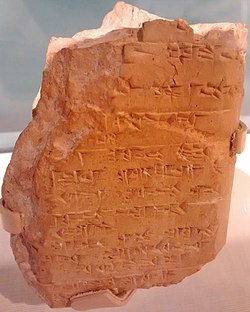
There were also Assyrian colonies in the region during the Old Assyrian Empire (2025–1750 BC); it was from the Assyrian speakers of Upper Mesopotamia that the Hittites adopted the cuneiform script.
Image source: Old Assyrian period
2000 BC
% complete
Isolated Hittite loanwords and numerous personal names appear in an Old Assyrian context from as early as the 20th century BC, making Hittite the Indo-European language with the earliest surviving written attestation.
1900 BC
% complete
The Hittite language is recorded fragmentarily from about the 19th century BC in the Kültepe texts, and remained in use until about 1100 BC.
1833 BC
% complete
1800 BC - 1700 BC
% complete
The early history of the Hittite kingdom is known through four cushion-shaped tablets, probably created in Kussara, Nēša, or another site in Anatolia, that may first have been written in the 18th century BC in Old Hittite language; most survived only as Akkadian copies made in the 14th and 13th centuries BC.
1790 BC - 1750 BC
% complete
During the kārum period, when the merchant colony of the Old Assyrian Empire was flourishing at the site and before the conquest of Pithana, the local kings of Kaneš included Ḫurmili (prior to 1790 BC), Paḫanu (a short time in 1790 BC), Inar (c. 1790–1775 BC), and Waršama (c. 1775–1750 BC).
1750 BC
% complete
It took some time before the Hittites established themselves following the collapse of the Old Assyrian Empire in the mid-18th century BC. For several centuries there were separate Hittite groups, usually centered on various cities, including the kingdom of Kussara and Kanesh or Neša.
1750 BC
% complete
The Anitta text begins by telling how Pithana, king of Kussara, conquered neighbouring Neša (Kanesh); this conquest took place around 1750 BC. The Hittites are also first associated with the kingdom of Kussara prior to this time.
Image source: Anitta (singer)
1745 BC - 1720 BC
% complete
Pithana's son Anitta continued where his father left off and conquered several northern cities, including Hattusa, which he cursed, and also Zalpuwa.
1710 BC - 1705 BC
% complete
Anitta was succeeded by Zuzzu (r. 1720–1710 BC), but sometime between 1710 and 1705 BC Kanesh was destroyed, taking the long-established Assyrian merchant trading system with it.
1650 BC
% complete
A king named Labarna renamed himself Hattusili I (meaning 'the man of Hattusa') around 1650 BC and established his capital city at Hattusa, forming an empire centered there.
Image source: Hattusa
1600 BC - 1500 BC
% complete
This excerpt from The Edict of Telepinu, dating to the 16th century BC, is supposed to illustrate the unification, growth, and prosperity of the Hittites under his rule. Throughout the remainder of the 16th century BC, the Hittite kings were held to their homelands by dynastic quarrels and warfare with the Hurrians.
1600 BC - 1400 BC
% complete
At some point in the 16th or 15th century BC, Hittite law codes moved away from torture and capital punishment toward more humanitarian forms of punishment, such as fines.
Image source: Hittite laws
1595 BC
% complete
In 1595 BC (middle chronology) Mursili I conducted a great raid down the Euphrates River, bypassing Assyria and sacking Aleppo and Babylon, ejecting the Amorite rulers of the Old Babylonian Empire. Rather than incorporate Babylonia, he turned control over to his Kassite allies, who ruled it for the next four centuries.
1525 BC - 1500 BC
% complete
King Telipinu is considered to be the last king of the Old Kingdom of the Hittites. He won a few victories to the southwest, apparently by allying himself with one Hurrian state (Kizzuwatna) against another.
1500 BC - 1400 BC
% complete
The period of the 15th century BC is largely unknown with few surviving records. During the Old Hittite Kingdom prior to 1400 BC, the king was viewed not as a living god like Egyptian pharaohs but rather as a first among equals; only from 1400 until 1200 BC did kingship become more centralized and powerful.
1430 BC - 1400 BC
% complete
The 'Hittite Empire period' proper dates from the reign of Tudhaliya I from c. 1430 BC. Around 1400 BC, Tudhaliya I, again allied with Kizzuwatna, vanquished the Hurrian states of Aleppo and Mitanni, and expanded westward at the expense of Arzawa, a Luwian state.
Image source: Tudḫaliya I
1365 BC - 1050 BC
% complete
The Middle Assyrian Empire once more began to grow in power with the ascension of Ashur-uballit I in 1365 BC. Between the 15th and 13th centuries BC, the Hittites were among the most dominant powers of the Near East, coming into conflict with Egypt, Assyria, and Mitanni.
Image source: Middle Assyrian Empire
1350 BC - 1322 BC
% complete
The kingdom recovered its former glory under Šuppiluliuma I (c. 1350 BC), who again conquered Aleppo. The empire reached its peak under him, encompassing most of Anatolia and parts of northern Syria and Upper Mesopotamia, bordering the rival empires of the Hurri-Mitanni and Assyrians.
1330 BC - 1295 BC
% complete
After Šuppiluliuma I's rule and the brief reign of his eldest son Arnuwanda II, another son, Mursili II, became king around 1330 BC.
Image source: Muršili II
1274 BC
% complete
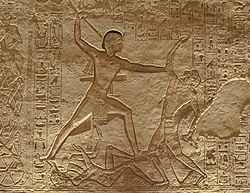
This battle between the Hittites and the New Kingdom of Egypt took place in the 5th year of Ramesses II, c. 1274 BC by the most commonly used chronology, in what is today Syria.
Image source: Battle of Kadesh
1200 BC - 800 BC
% complete
From the late 12th century BC, during the Late Bronze Age collapse, the Hittites splintered into several small independent states, some of which survived until the 8th century BC before succumbing to the Neo-Assyrian Empire; their descendants scattered and ultimately merged into the modern populations of the Levant and Mesopotamia.
Image source: Neo-Hittite states
1198 BC - 1196 BC
% complete
A study of tree rings of juniper trees growing in the region showed a change to drier conditions from the 13th century BC into the 12th century BC, including drought for three consecutive years in 1198, 1197 and 1196 BC.
Image source: Late Bronze Age collapse
1190 BC - 900 BC
% complete
Although the capital of Hattuša was abandoned around 1190 BC, this abandonment was not absolute. The evacuation concerned mainly the officialdom, with a modest native population remaining until the 10th century BC. Two decades after abandonment, changes near Gordion saw the end of Wheel-made ceramics (Hittite) at the end of the 10th century.
1180 BC
% complete
This left the Hittite homelands vulnerable to attack from all directions, and Hattusa was burnt to the ground sometime around 1180 BC following a combined onslaught from new waves of invaders: the Kaskians, Phrygians and Bryges.
1160 BC
% complete
By 1160 BC, the political situation in Asia Minor looked vastly different from that of only 25 years earlier. Much of the Hittite Empire had been annexed by the Middle Assyrian Empire, with the remainder sacked by Phrygian newcomers to the region.
800 BC - 700 BC
% complete
The Niğde Stele from the end of the 8th century BC is a Luwian monument from the Post-Hittite period, found in the modern Turkish city of Niğde.
Image source: Niğde Stele
1801 - 1850
% complete
English classicist Francis William Newman expressed a critical view common in the early 19th century that no Hittite king could have compared in power to the King of Judah, illustrating prevailing skepticism about the Hittites' historical significance among many scholars of his era.
1834
% complete
French scholar Charles Texier found the first Hittite ruins in 1834 but did not identify them as such.
Image source: Charles Texier
1851 - 1900
% complete
As discoveries in the second half of the 19th century revealed the scale of the Anatolian Hittite kingdom, Archibald Sayce asserted that rather than being compared to Judah, the Anatolian civilization was worthy of comparison to the divided Kingdom of Egypt and infinitely more powerful than that of Judah. The modern name 'Hittites' stems from initial identification of the people of Hattusa with the Biblical Hittites.
Image source: Archibald Sayce
1884
% complete
The script on a monument at Boğazkale by a 'People of Hattusas' discovered by William Wright in 1884 was found to match peculiar hieroglyphic scripts from Aleppo and Hama in Northern Syria.
Image source: William Wright (orientalist)
1887
% complete
In 1887, excavations at Amarna in Egypt uncovered the diplomatic correspondence of Pharaoh Amenhotep III and his son Akhenaten.
Image source: Amarna letters
1901 - 1930
% complete
Sayce's identification came to be widely accepted over the course of the early 20th century, and the name 'Hittite' became attached to the civilization uncovered at Boğazköy. Modern interest in the Hittites increased further with the founding of the Republic of Turkey in 1923.
1906
% complete
During sporadic excavations at Boğazköy (Hattusa) that began in 1906, archaeologist Hugo Winckler found a royal archive with 10,000 tablets inscribed in cuneiform Akkadian and an unknown language matching the Egyptian letters from Kheta, confirming the identity of the two names.
Image source: Hugo Winckler
1907
% complete
Under the direction of the German Archaeological Institute, excavations at Hattusa have been under way since 1907, with interruptions during the world wars.
Nov 24, 1915
% complete
Czech linguist Bedřich Hrozný announced his decipherment results in a lecture at the Near Eastern Society of Berlin on 24 November 1915. His book The Language of the Hittites was printed in Leipzig in 1917.
Image source: Bedřich Hrozný
1948 - 2005
% complete
Kültepe was successfully excavated by Professor Tahsin Özgüç from 1948 until his death in 2005.
Image source: Tahsin Özgüç
2001
% complete
This theory has been increasingly contested in the 21st century, with the Late Bronze Age collapse, and subsequent Iron Age, seeing the slow, comparatively continuous spread of ironworking technology across the region.
Or browse the full history timeline directory, with more than 2,000 topics.
This Hittite Empire timeline was generated with the help of AI, using information found on the internet.
We work hard to keep these timelines accurate, but mistakes do get through. If you spot one, email us at [email protected] and we'll fix it for future visitors.
Generate yours with AI or build it from scratch, for free.
Export your timeline, add your own events, edit or remove AI-generated events, and much more
No credit card required.
Cancel anytime.
Cancel anytime.
You can create an unlimited number of timelines with up to 10 events on each one, customize how they look, export them to PDF, PNG, PowerPoint, CSV, and Excel, and share them with a link. Paid plans raise the event limit and add features like spreadsheet imports and collaborators.
Yes. You can cancel your subscription from your account page at any time, and you will not be charged again. Your subscription stays active for the rest of the period you already paid for.
Yes. We will email you a reminder before the annual renewal, and we will also email you a receipt.
Yes. You can email us within 15 days of any payment, and we will issue you a full refund.
Check out our pricing docs or send us an email anytime: [email protected].