-
Use Cases
-
Resources
-
Pricing
2600 BC
% complete
The name "Assur" is first attested for the site in documents of the Akkadian period in the 24th century BC, marking the earliest known reference to the city that would become the heart of the Assyrian civilization.
Image source: Assyria
2600 BC - 2025 BC
% complete
During the early period of Assur's history (c. 2600–2025 BC), the city was dominated by states and polities from southern Mesopotamia, with no evidence that it was independent during this time.
2025 BC
% complete
Due to the collapse of the Third Dynasty of Ur, Assur became an independent city-state in c. 2025 BC, beginning a line of independent kings starting with Puzur-Ashur I.
1974 BC - 1934 BC
% complete
Under Ilushuma (r. 1974–1934 BC), Assur experimented with free trade, the earliest known such experiment in world history, leaving trade initiative entirely to the populace rather than the state.
Image source: Old Assyrian period
1950 BC - 1836 BC
% complete
Between c. 1950–1836 BC, twenty-five tons of Anatolian silver was transported to Assur, while approximately one hundred tons of tin and 100,000 textiles were transported to Anatolia in return.
1808 BC
% complete
In 1808 BC, the Amorite ruler of Ekallatum, Shamshi-Adad I, conquered the city of Assur. He equated Ashur with the southern god Enlil during his rule over northern Mesopotamia.
Image source: Shamshi-Adad I
1595 BC
% complete
The destruction of the dominant Old Babylonian Empire in 1595 BC allowed the smaller kingdoms of Mitanni and Kassite Babylonia to rise in the north and south, respectively.
1430 BC - 1360 BC
% complete
Around 1430 BC, Assur was subjugated by Mitanni, an arrangement that lasted for about 70 years until c. 1360 BC, when Assyrian independence was reasserted.
Image source: Mitanni
1363 BC
% complete
From its rise as a territorial state in the 14th century BC onward, Assyria was referred to in official documents as māt Aššur ("land of Ashur"), marking its shift to being a regional polity.
1363 BC - 1328 BC
% complete
Ashur-uballit I (r. 1363–1328 BC), whose rise to power, independence, and conquests of neighboring territory traditionally marks the rise of the Middle Assyrian Empire (c. 1363–912 BC). He introduced the royal style šarru dannu ("strong king").
Image source: Ashur-uballit I
1350 BC
% complete
A Hittite invasion by Šuppiluliuma I in the 14th century BC effectively crippled the Mitanni kingdom, opening the way for Assyrian expansion into northern Mesopotamia.
Image source: Šuppiluliuma I
1305 BC - 1207 BC
% complete
During the reigns of Adad-nirari I (1305–1274 BC), Shalmaneser I (1273–1244 BC) and Tukulti-Ninurta I (1243–1207 BC), Assyria began to realize its aspirations of becoming a significant regional power.
Image source: Shalmaneser I
1237 BC
% complete
Tukulti-Ninurta I won the Battle of Nihriya in 1237 BC, which marked the beginning of the end of Hittite influence in northern Mesopotamia, and temporarily conquered Babylonia, an Assyrian vassal from c. 1235 BC.
1233 BC
% complete
In 1233 BC, Tukulti-Ninurta I inaugurated Kar-Tukulti-Ninurta as a new capital city of the Assyrian Empire.
Image source: Tukulti-Ninurta I
1207 BC - 1115 BC
% complete
The death of Tukulti-Ninurta I in 1207 BC was followed by inter-dynastic conflict and a significant drop in Assyrian power, though later rulers worked to reverse the decline.
1200 BC - 1000 BC
% complete
Chariots first entered extensive military use under Tiglath-Pileser I in the 12th–11th centuries BC, and were later gradually phased out in favor of cavalry in the Neo-Assyrian period.
Image source: Tiglath-Pileser I
1100 BC
% complete
An entirely new type of monument introduced in the 11th century BC were obelisks: four-sided stone stelae decorated all around with both images and text, which saw continued use until at least the 9th century BC.
Image source: White Obelisk
1074 BC - 1056 BC
% complete
An unusual limestone statue of a nude woman is known from Nineveh from the time of Ashur-bel-kala (r. 1074–1056 BC), a rare artistic work from this era.
Image source: Ashur-bel-kala
1056 BC - 935 BC
% complete
From the time of Eriba-Adad II (r. 1056–1054 BC) onward, Assyrian decline intensified, though the surrounding lands were also fragmented, easing later reconquest by the reinvigorated Assyrian army.
911 BC
% complete
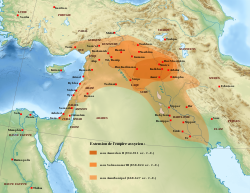
The Neo-Assyrian Empire was established in 911 BC, becoming a major ancient Mesopotamian empire that would conquer and administer most of West Asia from the Assyrian heartland in Upper Mesopotamia.
Image source: Neo-Assyrian Empire
900 BC
% complete
From the 9th century BC onward, Aramaic became the de facto lingua franca of the Neo-Assyrian Empire, with Akkadian relegated to a language of the political elite; from Shalmaneser III's time, Aramaic was used alongside Akkadian in state contexts.
Image source: Aramaic
800 BC - 609 BC
% complete
The Neo-Assyrian Empire maintained a communication speed unprecedented before its rise, not surpassed in the Middle East until the telegraph was introduced by the Ottoman Empire in 1865, nearly two and a half thousand years later.
627 BC - 609 BC
% complete
The Neo-Assyrian Empire fell in the late 7th century BC: civil war weakened Assyria, after which it was conquered by a coalition of Babylonians, Medes and Scythians in the Medo-Babylonian conquest of the Assyrian Empire.
550 BC
% complete
Toward the end of the 6th century BC, the Assyrian dialect of the Akkadian language went extinct, having already largely been replaced by Aramaic as a vernacular language toward the end of the Neo-Assyrian Empire.
Image source: Akkadian language
539 BC
% complete
Under the empires succeeding the Neo-Babylonians, from the late 6th century BC onward, Assyria began to experience a recovery, though ancient Assyrian culture and traditions continued to survive for centuries throughout the post-imperial period.
500 BC
% complete
The term "Syria" first appears during the time of the ancient Greek historian Herodotus in the 5th century BC; because it is so similar to "Assyria", scholars have debated their connection since the 17th century.
Image source: Syria (region)
312 BC
% complete
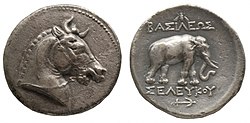
Under the Seleucid Empire, which controlled Mesopotamia from the late 4th to mid-2nd century BC, Assyrian sites such as Assur, Nimrud and Nineveh were resettled, and many villages were rebuilt and expanded.
Image source: Seleucid Empire
141 BC
% complete
After the Parthian Empire conquered the region in the 2nd century BC, the recovery of Assyria continued, culminating in an unprecedented return to prosperity and revival in the 1st to 3rd centuries AD.
Image source: Parthian Empire
100 BC
% complete
From around or shortly after the end of the 2nd century BC, Assur may have become the capital of its own small semi-autonomous Assyrian realm, either under the suzerainty of Hatra or under direct Parthian suzerainty.
Image source: Assur
1 AD
% complete
There was some influence of Judaism on Assyria, given that the kings of Adiabene, a vassal kingdom covering much of the old Assyrian heartland, converted to Judaism in the 1st century AD.
Image source: Adiabene
50 AD
% complete
According to some traditions, Christianity took hold in Assyria when Saint Thaddeus of Edessa converted King Abgar V of Osroene in the mid-1st century AD.
Image source: Addai of Edessa
150 AD
% complete
The ancient Ashur temple was restored in the 2nd century AD, reflecting the persistence of the old Mesopotamian religion even as Christianity spread through the region.
170 AD
% complete
In the 2nd century AD, the Christian Assyrian writer Tatian composed the influential Diatessaron, a synoptic rendition of the gospels, showing Assyrians had intellectually contributed to Christian thought.
Image source: Diatessaron
200 AD
% complete
From the 3rd century AD onward, it is clear that Christianity was becoming the major religion of the region, with Christ replacing the old Mesopotamian deities, though holdouts survived for centuries.
Image source: Christianity in Iraq
240 AD
% complete
Assur was sacked for the last time in AD 240 by the Sasanian Empire, which sacked numerous cities and semi-independent Assyrian territories in the region, ending ancient Mesopotamian religion at Assur.
Image source: Sasanian Empire
Or browse the full history timeline directory, with more than 2,000 topics.
This Assyrian Empire timeline was generated with the help of AI, using information found on the internet.
We work hard to keep these timelines accurate, but mistakes do get through. If you spot one, email us at [email protected] and we'll fix it for future visitors.
Generate yours with AI or build it from scratch, for free.
Export your timeline, add your own events, edit or remove AI-generated events, and much more
No credit card required.
Cancel anytime.
Cancel anytime.
You can create an unlimited number of timelines with up to 10 events on each one, customize how they look, export them to PDF, PNG, PowerPoint, CSV, and Excel, and share them with a link. Paid plans raise the event limit and add features like spreadsheet imports and collaborators.
Yes. You can cancel your subscription from your account page at any time, and you will not be charged again. Your subscription stays active for the rest of the period you already paid for.
Yes. We will email you a reminder before the annual renewal, and we will also email you a receipt.
Yes. You can email us within 15 days of any payment, and we will issue you a full refund.
Check out our pricing docs or send us an email anytime: [email protected].