-
Use Cases
-
Resources
-
Pricing
The Babylonian Empire was a powerful ancient Mesopotamian state centered on the city of Babylon. It reached its first height under King Hammurabi, famous for his legal code, and later flourished as the Neo-Babylonian Empire under rulers like Nebuchadnezzar II, who built the legendary Hanging Gardens and expanded the empire before its conquest by Persia. More Less
1894 BC
% complete
Babylonia was founded as an independent state c. 1894 BC by an Amorite chieftain named Sumu-abum, who established Babylon as the center of a new kingdom in southern Mesopotamia.
1894 BC - 1792 BC
% complete
For over a century after its founding, Babylonia was a minor and relatively weak state, overshadowed by older and more powerful neighbors such as Isin, Larsa, Assyria and Elam.
Image source: Babylonia
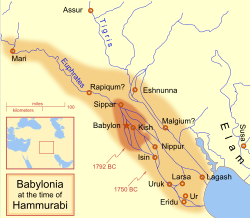
1792 BC - 1750 BC
% complete
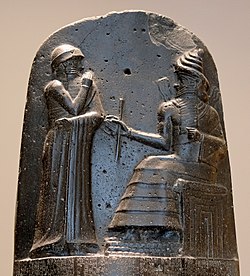
Hammurabi (r. c. 1792–1750 BC) turned Babylon into a major power, transforming it from a small kingdom into one of the dominant states of Mesopotamia through diplomacy and warfare.
Image source: Hammurabi
1763 BC - 1750 BC
% complete
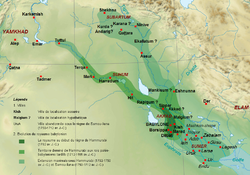
Hammurabi eventually conquered Mesopotamia and lands beyond it, founding the Old or First Babylonian Empire and making Babylon the preeminent political power of the region.
Image source: Old Babylonian Empire
1750 BC
% complete
Marduk held the position of patron deity of the city of Babylon since the reign of Hammurabi (18th century BC) in Babylon's first dynasty, remaining central to Babylonian religion for centuries afterward.
Image source: Marduk
1750 BC
% complete
After Hammurabi's death in c. 1750 BC, his dynasty lasted another century and a half, but the Babylonian Empire he built quickly collapsed and Babylon once more became a small state.
1750 BC - 1595 BC
% complete
Following Hammurabi's death, the empire rapidly shrank, with territories lost to rivals, though his dynasty continued to rule a reduced Babylonian state for another 150 years.
1595 BC
% complete
Babylonia fell to the Hittite king Mursili I c. 1595 BC, who raided and sacked Babylon, ending the rule of Hammurabi's dynasty and opening the way for Kassite domination.
1595 BC - 1155 BC
% complete
After the Hittite raid, the Kassites took control of Babylonia and ruled for almost five centuries, one of the longest-lasting dynasties in ancient Mesopotamian history.
Image source: Kassite dynasty
1155 BC
% complete
The Kassites were eventually deposed by native Babylonian rulers, who continued to rule the Babylonian rump state, maintaining a diminished but persistent Babylonian kingdom.
900 BC - 700 BC
% complete
The 9th and 8th centuries BC were catastrophic for the independent Babylonian kingdom, with many weak kings either failing to control all the constituent groups, to defeat rivals, or to maintain important trade routes.
800 BC - 700 BC
% complete
By the 8th century BC, the constituent groups of the native Babylonians, the main population in the large cities, had lost their old identities and had assimilated into a unified 'Babylonian' culture.
729 BC
% complete
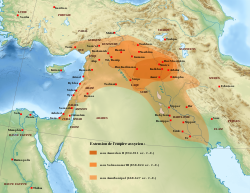
The Assyrians conquered Babylonia, beginning a century-long struggle for Babylonian independence against unstable Assyrian rule, including several unsuccessful Babylonian revolts.
Image source: Assyria
729 BC - 626 BC
% complete
Under Assyrian domination, Babylonians launched several unsuccessful revolts seeking independence during more than a century of often unstable and contested Assyrian rule.
626 BC - 539 BC
% complete
Over the course of the Neo-Babylonian century, cylinder seals increasingly fell into disuse, eventually being entirely replaced by stamp seals in administrative practice.
Image source: Cylinder seal
626 BC - 539 BC
% complete
The Chaldean dynasty founded by Nabopolassar ruled Babylon for less than a century, presiding over the height of Neo-Babylonian power before its conquest by Persia.
Image source: Neo-Babylonian Empire
626 BC - 609 BC
% complete
Beginning with Nabopolassar's coronation in 626 BC, the Neo-Babylonian Empire grew in strength and became firmly established as the Assyrian Empire weakened.
Nov 626 BC
% complete
In November 626 BC, Nabopolassar was crowned King of Babylon, restoring Babylonia as an independent kingdom after more than a century of direct Assyrian rule.
Image source: Nabopolassar
612 BC - 609 BC
% complete
The Neo-Babylonian Empire became firmly established through the fall of the Assyrian Empire between 612 and 609 BC, with Babylon inheriting much of Assyria's former territory.
Image source: Neo-Assyrian Empire
539 BC
% complete
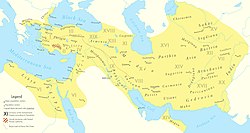
The Neo-Babylonian Empire was conquered by the Achaemenid Persian Empire in 539 BC, ending less than a century after the founding of the Chaldean dynasty under Nabopolassar.
Image source: Fall of Babylon
539 BC
% complete
Despite Achaemenid attention and the recognition of the Achaemenid rulers as kings of Babylon, Babylonia resented the Achaemenids, just as the Assyrians had been resented a century earlier.
Image source: Achaemenid Empire
539 BC - 330 BC
% complete
Babylonian culture endured for centuries under Achaemenid Persian rule and survived under the later Hellenic Macedonian and Seleucid Empires, whose rulers were also listed as kings of Babylon in Babylonian civil documents.
330 BC
% complete
The Hellenic Macedonian Empire took control of Babylon after defeating the Achaemenids, and Macedonian rulers continued to be listed as kings of Babylon in Babylonian civil documents.
Image source: Macedonia (ancient kingdom)
330 BC
% complete
During the centuries of Macedonian and Seleucid rule, Greeks settled in Babylon. By Parthian times two major recognized groups lived in the city: the Babylonians and the Greeks.
Image source: Babylon
305 BC - 141 BC
% complete
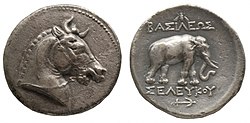
The Seleucid Empire ruled Babylon for centuries, and Seleucid rulers, like their Macedonian predecessors, were listed as kings of Babylon in local civil documents while Babylonian culture persisted.
Image source: Seleucid Empire
141 BC
% complete
The Parthian Empire took control of Babylon and Mesopotamia, ushering in a new era of foreign rule under which Babylonian culture continued to survive for some time.
Image source: Parthian Empire
127 BC
% complete
In the first century or so of Parthian rule, Babylonian culture was still alive: people in the city bore traditional Babylonian names such as Bel-aḫḫe-uṣur and Nabu-mušetiq-uddi, mentioned as receivers of silver in a 127 BC legal document.
100 BC
% complete
After the Persian conquest, Babylon remained culturally distinct for centuries, with references to people with Babylonian names and to the Babylonian religion known from as late as the Parthian Empire in the 1st century BC.
50 BC
% complete
The astronomical diaries kept since the days of ancient Babylon survived through Persian and Hellenic rule but stopped being written in the mid-1st century BC, marking the fading of an ancient scholarly tradition.
Image source: Babylonian astronomical diaries
95 AD
% complete
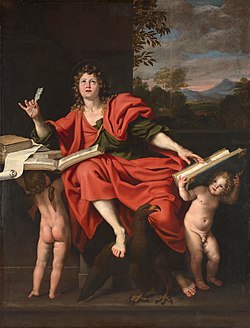
The Book of Revelation in the Christian Bible refers to Babylon many centuries after it ceased to be a major political center, using it as a powerful symbol long after the city's decline.
Image source: Book of Revelation
Or browse the full history timeline directory, with more than 2,000 topics.
This Babylonian Empire timeline was generated with the help of AI, using information found on the internet.
We work hard to keep these timelines accurate, but mistakes do get through. If you spot one, email us at [email protected] and we'll fix it for future visitors.
Generate yours with AI or build it from scratch, for free.
Export your timeline, add your own events, edit or remove AI-generated events, and much more
No credit card required.
Cancel anytime.
Cancel anytime.
You can create an unlimited number of timelines with up to 10 events on each one, customize how they look, export them to PDF, PNG, PowerPoint, CSV, and Excel, and share them with a link. Paid plans raise the event limit and add features like spreadsheet imports and collaborators.
Yes. You can cancel your subscription from your account page at any time, and you will not be charged again. Your subscription stays active for the rest of the period you already paid for.
Yes. We will email you a reminder before the annual renewal, and we will also email you a receipt.
Yes. You can email us within 15 days of any payment, and we will issue you a full refund.
Check out our pricing docs or send us an email anytime: [email protected].