-
Use Cases
-
Resources
-
Pricing
George III (1738–1820) was King of Great Britain and later the United Kingdom from 1760 to 1820, making his reign the third longest in British history. His rule encompassed major events including the American Revolution, the French Revolutionary and Napoleonic Wars, the Act of Union with Ireland, and significant agricultural and industrial changes at home. He suffered recurring bouts of mental illness late in life, leading to his son serving as Prince Regent from 1811. More Less
Jun 4, 1738
% complete
George William Frederick was born at Norfolk House, St James's Square, London. He was the eldest son of Frederick, Prince of Wales, and Princess Augusta of Saxe-Gotha, and became heir apparent after his father's death in 1751.
Image source: George III
Mar 20, 1751
% complete
George's father died suddenly of a lung injury, making the twelve-year-old George the new Prince of Wales and heir to the British throne under his grandfather George II.
Image source: Frederick, Prince of Wales
Oct 25, 1760
% complete
George succeeded his grandfather George II as King of Great Britain and Ireland at age 22, becoming the first Hanoverian monarch born in Britain who spoke English natively.
Sep 22, 1761
% complete
George was crowned with great ceremony at Westminster Abbey, though the event was overshadowed by widespread measles among attendees.
Image source: Coronation of George III and Charlotte
Sep 8, 1761
% complete
George married Princess Charlotte just weeks after meeting her for the first time. Their marriage proved happy and produced fifteen children, thirteen of whom survived to adulthood.
Image source: Charlotte of Mecklenburg-Strelitz
Oct 26, 1788 - Feb 27, 1789
% complete
George suffered a severe bout of what was likely bipolar disorder or porphyria, prompting talk of a regency led by the Prince of Wales before he recovered.
Feb 27, 1789
% complete
George's timely recovery prevented the Prince of Wales from assuming power as regent, preserving the king's authority and disappointing opposition Whigs.
Image source: Charles James Fox
Oct 25, 1809
% complete
Celebrations marked fifty years of George III's reign, one of the first such jubilees in English history, with festivities across the country despite the ongoing war.
Nov 2, 1810
% complete
The death of George's beloved youngest daughter plunged him into permanent mental decline, ending any hope of his return to active rule.
Image source: Princess Amelia of the United Kingdom
Feb 5, 1811 - Jan 29, 1820
% complete
Parliament passed the Regency Act, transferring royal duties to George's son, inaugurating the Regency era while George lived in seclusion at Windsor Castle.
Image source: Regency era
Jan 29, 1820
% complete
George died blind, deaf, and insane at Windsor Castle after a reign of nearly sixty years, the longest of any British monarch up to that time. He was succeeded by his son as George IV.
Image source: Death and state funeral of George VI
Feb 10, 1763
% complete
The treaty ended the Seven Years' War, ceding Canada and lands east of the Mississippi to Britain but leaving the nation with a massive war debt that shaped subsequent colonial policy.
Image source: Treaty of Paris (1763)
Apr 16, 1763
% complete
John Stuart, Earl of Bute, resigned amid unpopularity, and George Grenville took office, pursuing taxation policies toward the American colonies that would prove fateful.
Image source: Grenville ministry
Feb 6, 1778
% complete
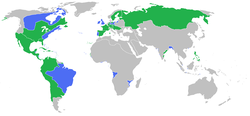
The Treaty of Alliance brought France into the American Revolutionary War against Britain, transforming the conflict into a global struggle.
Image source: France–United States relations
Apr 12, 1779
% complete
Spain joined France as a co-belligerent against Britain through the Bourbon Compact, opening new fronts including the siege of Gibraltar.
Image source: Spain–United States relations
Jun 24, 1779 - Feb 7, 1783
% complete
Spanish and French forces besieged British-held Gibraltar for over three years, but the garrison held out in one of the longest sieges in British military history.
Image source: Great Siege of Gibraltar
Dec 19, 1783
% complete
William Pitt became Britain's youngest prime minister and would dominate government for nearly two decades, becoming George III's most trusted minister.
Image source: William Pitt the Younger
Jul 14, 1789
% complete
The storming of the Bastille began the French Revolution, which would dominate European politics and eventually draw Britain into prolonged war with France.
Image source: French Revolution
Feb 1, 1793 - Mar 25, 1802
% complete
After France declared war on Britain, George supported Pitt's prosecution of the conflict, beginning two decades of near-continuous warfare against France.
Image source: French Revolutionary Wars
Jan 1, 1801
% complete
The Act of Union created the United Kingdom of Great Britain and Ireland, and George dropped the ancient title 'King of France,' becoming simply King of the United Kingdom.
Image source: Acts of Union 1800
May 18, 1803 - Jun 18, 1815
% complete
War resumed with Napoleonic France, culminating during George's reign in British victories including Trafalgar in 1805 and, shortly after his incapacity, Waterloo in 1815.
Image source: Napoleonic Wars
Oct 7, 1763
% complete
The proclamation forbade colonists from settling west of the Appalachian Mountains, intended to stabilize relations with Native Americans but angering land-hungry colonists.
Image source: Royal Proclamation of 1763
Mar 22, 1765 - Mar 18, 1766
% complete
Parliament passed the Stamp Act requiring printed materials in the colonies to bear a tax stamp, provoking furious protests and the slogan 'no taxation without representation.'
Jun 29, 1767
% complete
A series of measures imposing duties on imported goods like glass, paint, paper, and tea deepened colonial resentment and prompted boycotts of British goods.
Image source: Townshend Acts
Mar 5, 1770
% complete
British soldiers fired into a crowd in Boston, killing five civilians. The incident was exploited by propagandists like Paul Revere to inflame anti-British sentiment.
Image source: Boston Massacre
Dec 16, 1773
% complete
Colonists disguised as Mohawk Indians dumped 342 chests of tea into Boston Harbor in protest of the Tea Act, provoking George III's firm support for punitive measures.
Image source: Boston Tea Party
Mar 31, 1774 - Jun 22, 1774
% complete
Parliament closed Boston Harbor, revoked Massachusetts' charter, and imposed other punishments for the Tea Party, uniting the colonies in resistance.
Image source: Intolerable Acts
Sep 5, 1774 - Oct 26, 1774
% complete
Delegates from twelve colonies met in Philadelphia to coordinate a response to the Coercive Acts, adopting a boycott of British trade and petitioning the king.
Image source: First Continental Congress
Apr 19, 1775
% complete
The first military engagements of the American Revolutionary War occurred when British troops marched to seize colonial arms, igniting open rebellion.
Image source: Battles of Lexington and Concord
Jul 4, 1776
% complete
The thirteen American colonies formally declared independence from Britain, listing grievances against George III himself and rejecting his authority entirely.
Image source: United States Declaration of Independence
Oct 17, 1777
% complete
General John Burgoyne's army surrendered after defeat at Saratoga, a decisive turning point that convinced France to enter the war as an American ally.
Image source: Battles of Saratoga
Oct 19, 1781
% complete
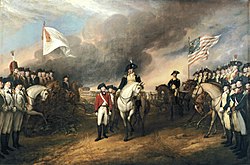
General Cornwallis surrendered to combined Franco-American forces under Washington, effectively ending major combat in North America and forcing Lord North's government to fall.
Image source: Siege of Yorktown
Sep 3, 1783
% complete
Britain recognized American independence and ceded territory east of the Mississippi River, marking the loss of its most valuable colonies during George III's reign.
Image source: Treaty of Paris (1783)
Or browse the full history timeline directory, with more than 2,000 topics.
This George III timeline was generated with the help of AI, using information found on the internet.
We work hard to keep these timelines accurate, but mistakes do get through. If you spot one, email us at [email protected] and we'll fix it for future visitors.
Generate yours with AI or build it from scratch, for free.
Export your timeline, add your own events, edit or remove AI-generated events, and much more
No credit card required.
Cancel anytime.
Cancel anytime.
You can create an unlimited number of timelines with up to 10 events on each one, customize how they look, export them to PDF, PNG, PowerPoint, CSV, and Excel, and share them with a link. Paid plans raise the event limit and add features like spreadsheet imports and collaborators.
Yes. You can cancel your subscription from your account page at any time, and you will not be charged again. Your subscription stays active for the rest of the period you already paid for.
Yes. We will email you a reminder before the annual renewal, and we will also email you a receipt.
Yes. You can email us within 15 days of any payment, and we will issue you a full refund.
Check out our pricing docs or send us an email anytime: [email protected].