-
Use Cases
-
Resources
-
Pricing
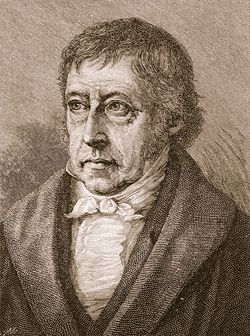
Georg Wilhelm Friedrich Hegel (1770–1831) was a German philosopher and one of the leading figures of German Idealism. He developed the concept of the dialectic and argued that history and reality unfold through a rational process of development toward self-consciousness and freedom. His works, including The Phenomenology of Spirit and Elements of the Philosophy of Right, profoundly influenced later thinkers in philosophy, theology, politics, and social theory. More Less
1733 - 1799
% complete
Hegel's father, Georg Ludwig Hegel (1733–1799), served as secretary to the revenue office at the court of Karl Eugen, Duke of Württemberg.
Image source: Georg Wilhelm Friedrich Hegel
1741 - 1783
% complete
Hegel's mother, Maria Magdalena Louisa Hegel, née Fromm (1741–1783), was the daughter of a lawyer at the High Court of Justice at the Württemberg court, Ludwig Albrecht Fromm (1696–1758).
Aug 27, 1770
% complete
Hegel was born on 27 August 1770 in Stuttgart, capital of the Duchy of Württemberg in the Holy Roman Empire (now southwestern Germany). He would become a German philosopher and a major figure in the tradition of German idealism.
1773 - 1812
% complete
Hegel had a sister, Christiane Luise (1773–1832), and a brother, Georg Ludwig (1776–1812), who perished as an officer during Napoleon's 1812 Russian campaign.
1776
% complete
In 1776, Hegel entered Stuttgart's Eberhard-Ludwigs-Gymnasium and during his adolescence read voraciously, copying lengthy extracts in his diary.
1783
% complete
Hegel's earliest writings on Christianity date between 1783 and 1800, reflecting the deep religious interests that would shape much of his later philosophical work.
1788
% complete
When Hegel entered the Tübingen seminary in 1788, he was a typical product of the German Enlightenment – an enthusiastic reader of Rousseau and Lessing, acquainted with Kant (at least at second hand), but perhaps more deeply devoted to the classics than to anything modern. During this early period 'the Greeks – especially Plato – came first.'
1793
% complete
Although the violence of the 1793 Reign of Terror dampened Hegel's hopes, he continued to identify with the moderate Girondin faction and never lost his commitment to the principles of 1789, expressing this by drinking a toast to the storming of the Bastille every fourteenth of July.
1800
% complete
At this time, Hegel envisaged his future as that of a Popularphilosoph (a 'man of letters') who serves to make the abstruse ideas of philosophers accessible to a wider public; his own felt need to engage critically with the central ideas of Kantianism would not come until 1800.
Feb 1807
% complete
The following February marked the birth of Hegel's illegitimate son, Georg Ludwig Friedrich Fischer (1807–1831), as the result of an affair with his landlady Christiana Burkhardt née Fischer.
1811
% complete
In 1811, Hegel married Marie Helena Susanna von Tucher (1791–1855), the eldest daughter of a Nuremberg senator.
Image source: Georg Wilhelm Friedrich Hegel
1813 - 1814
% complete
During the Nuremberg years came the birth of two sons, Karl Friedrich Wilhelm (1813–1901) and Immanuel Thomas Christian (1814–1891).
Apr 1817
% complete
Soon after moving to Heidelberg, his illegitimate son Ludwig Fischer (now ten years old) joined the Hegel household in April 1817, having spent time in an orphanage after the death of his mother Christiana Burkhardt.
1793 - 1796
% complete
Having received his theological certificate from the Tübingen Seminary, Hegel became Hofmeister (house tutor) from 1793 to 1796 to the family of Captain Karl Friedrich von Steiger, a member of the Bernese patriciate.
1797
% complete
His relations with his Bern employers becoming strained, Hegel accepted an offer mediated by Hölderlin to take up a similar position with a wine merchant's family in Frankfurt in 1797.
1801
% complete
In 1801, Hegel came to Jena at the encouragement of Schelling, who held the position of Extraordinary Professor at the University of Jena. There he lectured on 'Logic and Metaphysics' and gave lectures with Schelling on an 'Introduction to the Idea and Limits of True Philosophy' and facilitated a 'philosophical disputorium.'
Image source: University of Jena
1802 - 1803
% complete
In 1802, Schelling and Hegel founded the journal Kritische Journal der Philosophie (Critical Journal of Philosophy), to which they contributed until the collaboration ended when Schelling left for Würzburg in 1803.
Image source: Friedrich Wilhelm Joseph Schelling
1805
% complete
In 1805, the university promoted Hegel to the unsalaried position of extraordinary professor after he wrote a letter to Goethe protesting the promotion of his philosophical adversary Jakob Friedrich Fries ahead of him.
Oct 14, 1806
% complete
Hegel was putting the finishing touches to The Phenomenology of Spirit as Napoleon engaged Prussian troops on 14 October 1806 in the Battle of Jena on a plateau outside the city.
Image source: Battle of Jena–Auerstedt
1807
% complete
In 1807, Hegel had to move to Bamberg since his savings and the payment from the Phenomenology were exhausted and he needed money to support his illegitimate son Ludwig.
Image source: Bamberg
Sep 1808
% complete
After being investigated in September 1808 by the Bavarian state for potentially violating security measures by publishing French troop movements, Hegel wrote to Niethammer, now a high official in Munich, pleading for help in securing a teaching position.
Nov 1808 - 1816
% complete
With the help of Niethammer, Hegel was appointed headmaster of a gymnasium in Nuremberg in November 1808, a post he held until 1816.
Image source: Nuremberg
1816
% complete
Having received offers of a post from the Universities of Erlangen, Berlin and Heidelberg, Hegel chose Heidelberg, where he moved in 1816.
Image source: Heidelberg University
1816 - 1818
% complete
Written by Hegel's student Friedrich Wilhelm Carové between 1816 and 1818, and preserved in the estate of theologian Friedrich Windischmann, notes include a long-sought transcript of Hegel's Heidelberg lectures on aesthetics. In 2022, scholar Klaus Vieweg discovered more than 4,000 pages of these previously undocumented transcripts in the library of the Archdiocese of Munich and Freising.
1818
% complete
In the Phenomenology, and even in the 1817 edition of the Encyclopedia, Hegel discusses art only as it figures in the 'Art-Religion' of the ancient Greeks. In 1818, however, Hegel begins lecturing on the philosophy of art as an explicitly autonomous domain.
Image source: Lectures on Aesthetics
1818
% complete
In 1818, Hegel accepted the renewed offer of the chair of philosophy at the University of Berlin, which had remained vacant since Johann Gottlieb Fichte's death in 1814.
Image source: Humboldt University of Berlin
Oct 1829 - Sep 1830
% complete
Hegel was appointed University Rector of the university in October 1829, but his term ended in September 1830.
1831
% complete
In 1831 Frederick William III decorated Hegel with the Order of the Red Eagle, 3rd Class for his service to the Prussian state.
Image source: Order of the Red Eagle
Aug 1831
% complete
In August 1831, a cholera epidemic reached Berlin and Hegel left the city, taking up lodgings in Kreuzberg.
1795 - 1796
% complete
During his time in Bern, Hegel composed the text known as the Life of Jesus and a book-length manuscript titled 'The Positivity of the Christian Religion.'
1797
% complete
While in Frankfurt, Hegel composed the essay 'Fragments on Religion and Love.'
1797
% complete
Also in 1797, the unpublished and unsigned manuscript of 'The Oldest Systematic Program of German Idealism' was written.
1798
% complete
In 1798, Hegel published Confidential Letters on the Prior Constitutional Relations of the Wadtlandes (Pays de Vaud) to the City of Bern, an early political writing.
1799
% complete
In 1799, Hegel wrote another essay titled 'The Spirit of Christianity and Its Fate', which remained unpublished during his lifetime.
1802
% complete
In 1802, Hegel published 'How Commonsense takes Philosophy, Illustrated by the Works of Mr.', an essay engaging with popular objections to philosophy.
1802
% complete
In 1802, Hegel also published 'The Relation of Scepticism to Philosophy', examining ancient skepticism's significance for modern philosophical inquiry.
1807
% complete
Phenomenology of Spirit was published in 1807. This major work details Hegel's systematic vision and remains one of his most influential texts. Religion is a major theme throughout the work, well before it emerges as the explicit topic of the penultimate Religion chapter.
Image source: The Phenomenology of Spirit
1812 - 1816
% complete
This period saw the publication of Hegel's second major work, the Science of Logic (Wissenschaft der Logik; 3 vols., 1812, 1813 and 1816; Book I revised 1831). Sometimes called the 'Greater Logic', it provides a metaphysical logic of truth rather than a mere logic of formal validity. A revised Book I appeared in 1831.
1817
% complete
In 1817, Hegel published Encyclopaedia of the Philosophical Sciences in Basic Outline as a summary of his philosophy for students attending his lectures at Heidelberg. With this edition, his triadic system — adopted from Proclus's Neoplatonic triad of 'remaining-procession-return' and the Christian Trinity — was completed in published form.
1821
% complete
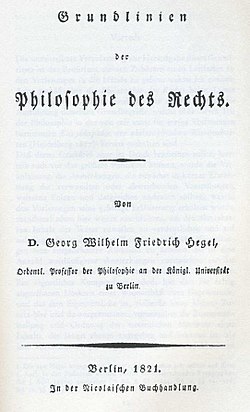
At Berlin, Hegel published his Elements of the Philosophy of Right (1821), or Natural Law and Political Science in Outline, a textbook for his lectures on political philosophy.
Image source: Elements of the Philosophy of Right
1827
% complete
During the last ten years of his life, Hegel did not publish another book but thoroughly revised the Encyclopedia, issuing a second edition in 1827.
1830
% complete
Hegel issued a third edition of the Encyclopaedia of Philosophical Sciences in 1830, completing his thorough revisions of that summary of his system.
Image source: Encyclopedia of the Philosophical Sciences
Nov 14, 1831
% complete
Georg Wilhelm Friedrich Hegel died on 14 November 1831, closing a life that spanned the era of the French Revolution, Napoleonic upheaval, and the rise of German idealism.
1840
% complete
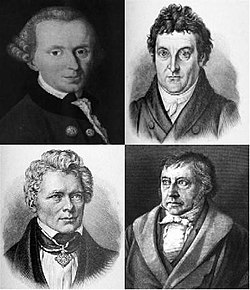
Among the first followers to take an expressly critical view of Hegel's system were those in the 19th-century German group known as the Young Hegelians, which included Feuerbach, Marx, Engels, and their followers.
1867
% complete
According to Bernstein, the influence of Hegel on American pragmatism can be divided into three moments: the late nineteenth century, the mid-twentieth, and the present. The first is found in early issues of The Journal of Speculative Philosophy (founded 1867).
Image source: Pragmatism
1870 - 1920
% complete
In late nineteenth- and early twentieth-century England, a school known as British idealism propounded a version of absolute idealism through direct engagement with Hegel's texts.
Image source: British idealism
1907
% complete
Some critics – most canonically Benedetto Croce, in 1907 – have attributed to Hegel some form of the thesis that art is 'dead.' Hegel, however, never said any such thing, nor can such a view be plausibly attributed to him.
Image source: Benedetto Croce
1923
% complete
György Lukács' History and Class Consciousness (1923) helped reintroduce Hegel into the Marxist canon, renewing engagement between Hegelian dialectics and Marxism.
Image source: History and Class Consciousness
1930 - 1980
% complete
In the twentieth century, Hegel's thought was further developed in traditions such as French Hegelianism and critical theory, and became a major point of reference for existentialism.
Image source: German idealism
1990
% complete
Discussing the 'Hegel Renaissance' in late 20th-century Anglo-American philosophy, Beiser expresses surprise – given today's highly secular academic culture – at such a surge of interest in Hegel.
1993
% complete
Philosophy is only possible 'if it is historical, only if the philosopher is aware of the origins, context, and development of his doctrines.' In his 1993 essay 'Hegel's Historicism', Beiser declared this 'nothing less than a revolution in the history of philosophy.' In a 2011 monograph, however, Beiser excluded Hegel from the German historicist tradition, noting Hegel's greater interest in the philosophy of history than in epistemology.
Or browse the full history timeline directory, with more than 2,000 topics.
This Georg Wilhelm Friedrich Hegel timeline was generated with the help of AI, using information found on the internet.
We work hard to keep these timelines accurate, but mistakes do get through. If you spot one, email us at [email protected] and we'll fix it for future visitors.
Generate yours with AI or build it from scratch, for free.
Export your timeline, add your own events, edit or remove AI-generated events, and much more
No credit card required.
Cancel anytime.
Cancel anytime.
You can create an unlimited number of timelines with up to 10 events on each one, customize how they look, export them to PDF, PNG, PowerPoint, CSV, and Excel, and share them with a link. Paid plans raise the event limit and add features like spreadsheet imports and collaborators.
Yes. You can cancel your subscription from your account page at any time, and you will not be charged again. Your subscription stays active for the rest of the period you already paid for.
Yes. We will email you a reminder before the annual renewal, and we will also email you a receipt.
Yes. You can email us within 15 days of any payment, and we will issue you a full refund.
Check out our pricing docs or send us an email anytime: [email protected].