-
Use Cases
-
Resources
-
Pricing
Gottfried Wilhelm Leibniz (1646–1716) was a German polymath renowned for his contributions to mathematics, philosophy, logic, and engineering. He independently co-invented calculus, developed the binary number system foundational to modern computing, and made lasting contributions to metaphysics with his theory of monads. More Less
Jul 1, 1646
Gottfried Wilhelm Leibniz was born in Leipzig, Saxony, to Friedrich Leibniz, a professor of moral philosophy, and Catharina Schmuck. His father died when he was six, leaving him access to an extensive library that fueled his early intellectual development.
1661
At age fifteen, Leibniz entered the University of Leipzig, where he studied philosophy, law, and mathematics, immersing himself in the works of Aristotle, scholastic philosophers, and emerging modern thinkers like Descartes.
Dec 1662
Leibniz completed his bachelor's degree in philosophy at the University of Leipzig, defending a thesis on the principle of individual things, which drew on scholastic metaphysics.
Image source: Leipzig University

Feb 1664
Leibniz earned his master's degree in philosophy from Leipzig with a dissertation on a combinatorial approach to legal questions, foreshadowing his lifelong interest in symbolic reasoning.
1666
The University of Leipzig refused to grant Leibniz a doctorate in law, reportedly due to his youth. He instead submitted his dissertation 'De Casibus Perplexis' to the University of Altdorf, which awarded him the degree.
Image source: University of Altdorf

1667
After receiving his doctorate at Altdorf, Leibniz was offered a professorship, which he declined, choosing instead to pursue a career in service to noble patrons and courts rather than academia.
Image source: Gottfried Wilhelm Leibniz

Mar 1666
Leibniz published his early work on combinatorics, envisioning a universal characteristic in which all concepts could be reduced to combinations of basic elements — an early dream of formal logic and symbolic computation.
Image source: De Arte Combinatoria

1672
In Paris, Leibniz met the Dutch mathematician and physicist Christiaan Huygens, who mentored him in advanced mathematics and inspired his serious engagement with infinitesimal calculus.
Image source: Christiaan Huygens

1673
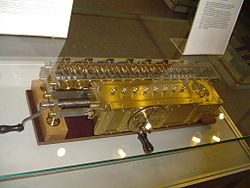
Leibniz designed the stepped reckoner, a mechanical calculator capable of performing multiplication and division using his stepped drum mechanism, presenting it to the Royal Society in London.
Image source: Stepped reckoner
Apr 1673
During a diplomatic visit to London, Leibniz demonstrated his calculating machine and was elected a Fellow of the Royal Society, gaining recognition among leading European scientists.
Image source: Royal Society

This Gottfried Wilhelm Leibniz timeline was generated with the help of AI, using information found on the internet.
We work hard to keep these timelines accurate, but mistakes do get through. If you spot one, email us at [email protected] and we'll fix it for future visitors.
Generate yours with AI or build it from scratch, for free.