-
Use Cases
-
Resources
-
Pricing
Friedrich Engels (1820–1895) was a German philosopher, historian, and social scientist best known for co-developing Marxist theory alongside Karl Marx. Born into a wealthy textile family in Barmen, Prussia, he became a critic of industrial capitalism through works like The Condition of the Working Class in England. His lifelong partnership with Marx produced foundational texts such as The Communist Manifesto (1848) and Das Kapital, which he completed after Marx's death. More Less
Nov 28, 1820
% complete
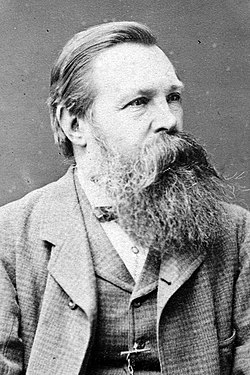
Friedrich Engels was born on November 28, 1820, in Barmen (now part of Wuppertal), Prussia. He was the eldest son of a wealthy textile manufacturer, and his upbringing in a devoutly religious and conservative household would later contrast sharply with his radical political views.
Image source: Friedrich Engels
1834 - 1837
% complete
Engels attended the gymnasium in nearby Elberfeld, where he excelled in languages, literature, and history. His father, however, wanted him to pursue a commercial career and forced him to leave school at age 17 before completing his studies.
1838 - 1841
% complete
Engels was sent to Bremen to work as a commercial apprentice in his father's business connections. During this period, he began writing under the pseudonym 'Friedrich Oswald' for liberal publications, developing his literary skills and questioning his religious upbringing.
1840 - 1841
% complete
While in Bremen, Engels published letters and essays critiquing social conditions and religion under the pseudonym Friedrich Oswald, marking his emergence as a young writer with critical and progressive views.
1841 - 1842
% complete
Engels served a year of compulsory military service in the Prussian artillery in Berlin. While there, he attended philosophy lectures at the University of Berlin and became involved with the Young Hegelians, embracing radical philosophical ideas that shaped his intellectual development.
1843
% complete
In Manchester, Engels met Mary Burns, an Irish working-class woman who became his lifelong companion. Through her, he gained deep insight into the lives of Irish workers and the urban poor of industrial England, informing his later writings.
Jan 1863
% complete
Mary Burns died suddenly at age 41, devastating Engels. Her death briefly strained his friendship with Marx, who responded coolly to the news, though the two quickly reconciled and remained close collaborators.
Dec 1842
% complete
Engels was sent by his father to Manchester, England, to work at Ermen & Engels, a cotton mill partly owned by his family. There he witnessed firsthand the brutal conditions of the Industrial Revolution, which profoundly influenced his thinking about capitalism.
Jun 1847
% complete
Engels joined the League of the Just, which soon reorganized as the Communist League. He helped draft its principles, contributing an early version of what would become the Communist Manifesto, titled 'Principles of Communism.'
Image source: Communist League
May 1848 - Jul 1849
% complete
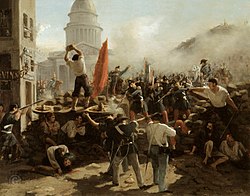
During the wave of European revolutions, Engels returned to Germany and worked as editor of the Rheinische Zeitung alongside Marx. When revolution broke out, he took part in armed uprisings in Baden and the Palatinate as an aide-de-camp to August Willich.
Jul 1849
% complete
After the suppression of revolutionary forces in Baden, Engels escaped across the border into Switzerland, joining many other defeated radicals who fled repression following the collapse of the 1848 revolutions.
Image source: Revolutions of 1848
Sep 28, 1864
% complete
Engels supported the founding of the International Workingmen's Association (the First International) in London, an organization uniting socialist and labor groups across Europe, which became a vehicle for spreading Marxist ideas.
Image source: International Workingmen's Association
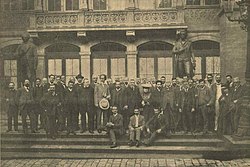
Jul 1889 - 1895
% complete
Engels served as mentor and advisor to the newly formed Second International, guiding socialist parties across Europe. Though he declined formal leadership roles, his counsel shaped the movement's direction in its early years.
Image source: Second International
1844
% complete
Engels published his first major economic critique in Karl Marx's journal Deutsch-Französische Jahrbücher. This work analyzed the contradictions of capitalist economics and impressed Marx deeply, laying the groundwork for their future collaboration.
Image source: Critique of political economy
Feb 1845
% complete
Engels co-authored 'The Holy Family' with Marx, a critique of the Young Hegelians Bruno and Edgar Bauer. It was their first joint work, signaling the beginning of their shared development of historical materialism.
Image source: The Holy Family (book)
May 1845
% complete
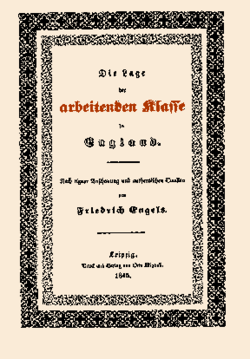
Drawing on his observations in Manchester, Engels documented the horrific living and working conditions of English factory workers. The book exposed the human costs of industrial capitalism and established Engels as a serious social critic.
Image source: The Condition of the Working Class in England
1846
% complete
Engels and Marx wrote 'The German Ideology' while in Brussels, articulating for the first time their theory of historical materialism—the idea that material economic conditions shape society, culture, and consciousness.
Image source: The German Ideology
Feb 21, 1848
% complete
Marx and Engels published 'The Communist Manifesto,' a revolutionary pamphlet calling for workers to unite against capitalist oppression. Its famous opening line, 'A spectre is haunting Europe,' announced a new era of organized socialist thought.
Image source: The Communist Manifesto
1878
% complete
Engels published 'Herr Eugen Dühring's Revolution in Science,' known as Anti-Dühring, a comprehensive defense and exposition of Marxist theory against philosopher Eugen Dühring. It became one of the most influential popularizations of Marxism.
Image source: Anti-Dühring
1880
% complete
Extracted from Anti-Dühring, this concise work distinguished scientific socialism from earlier utopian thinkers like Saint-Simon, Fourier, and Owen. It became one of the most widely read introductions to Marxism worldwide.
Image source: Socialism: Utopian and Scientific
1884
% complete
Engels applied historical materialism to anthropology, arguing that the family structure evolved alongside changes in property relations. Building on Lewis Morgan's research, it became foundational for Marxist feminism.
Image source: The Origin of the Family, Private Property and the State
1885 - 1894
% complete
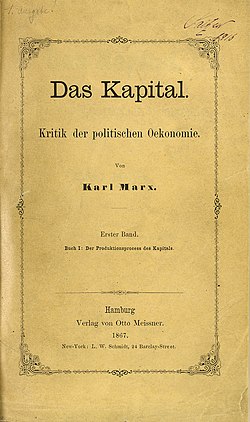
After Marx's death, Engels painstakingly edited Marx's unfinished manuscripts and published Volume II of Das Kapital in 1885 and Volume III in 1894, ensuring that Marx's economic analysis reached the world.
Image source: Das Kapital
Aug 28, 1844
% complete
Engels met Karl Marx in Paris at Café de la Régence, beginning one of the most consequential intellectual partnerships in history. They discovered they held nearly identical views on philosophy and politics, forging a friendship that would last until Marx's death.
Dec 1881
% complete
When Marx's beloved wife Jenny died after a long illness, Engels provided steadfast emotional and practical support to Marx during this profound personal loss.
Image source: Jenny von Westphalen
Mar 14, 1883
% complete
Karl Marx died peacefully in his armchair in London. Engels delivered a moving graveside eulogy at Highgate Cemetery, declaring that just as Darwin had discovered the law of organic nature, Marx had discovered the law of human history.
Image source: Karl Marx
1850 - 1870
% complete
Engels reluctantly returned to work at his family's firm in Manchester for two decades, enduring a job he despised in order to financially support Marx and his family, enabling Marx to dedicate himself to writing Das Kapital.
1864
% complete
Engels became a full partner in the Manchester cotton mill Ermen & Engels, increasing his income substantially. This wealth allowed him to provide even greater financial support to Marx during difficult years.
Image source: Baumwollspinnerei Ermen & Engels
Jul 1870
% complete
Having sold his share of the firm, Engels retired from business and moved to London, near Marx's home. Freed from commercial obligations, he devoted himself fully to revolutionary theory and political organizing.
Aug 5, 1895
% complete
Engels died of throat and stomach cancer at his home in London on August 5, 1895, aged 74. Following his wishes, his ashes were scattered off Beachy Head into the English Channel.
1925
% complete
Long after his death, Engels' unpublished manuscripts applying dialectical reasoning to natural science were compiled and published as 'Dialectics of Nature,' extending his influence into the philosophy of science.
Image source: Dialectics of Nature
Or browse the full history timeline directory, with more than 2,000 topics.
This Friedrich Engels timeline was generated with the help of AI, using information found on the internet.
We work hard to keep these timelines accurate, but mistakes do get through. If you spot one, email us at [email protected] and we'll fix it for future visitors.
Generate yours with AI or build it from scratch, for free.
Export your timeline, add your own events, edit or remove AI-generated events, and much more
No credit card required.
Cancel anytime.
Cancel anytime.
You can create an unlimited number of timelines with up to 10 events on each one, customize how they look, export them to PDF, PNG, PowerPoint, CSV, and Excel, and share them with a link. Paid plans raise the event limit and add features like spreadsheet imports and collaborators.
Yes. You can cancel your subscription from your account page at any time, and you will not be charged again. Your subscription stays active for the rest of the period you already paid for.
Yes. We will email you a reminder before the annual renewal, and we will also email you a receipt.
Yes. You can email us within 15 days of any payment, and we will issue you a full refund.
Check out our pricing docs or send us an email anytime: [email protected].