-
Use Cases
-
Resources
-
Pricing
Henry V of England (1386–1422) was King of England from 1413 until his death. Renowned for his military genius and leadership, he achieved lasting fame for his decisive victory over France at the Battle of Agincourt in 1415 during the Hundred Years' War. His conquests led to the Treaty of Troyes (1420), which named him heir to the French throne, though he died before ever assuming it. More Less
Sep 16, 1386
% complete
Henry was born on 16 September 1386 in the tower above the gatehouse of Monmouth Castle in Monmouthshire, hence his name Henry of Monmouth. Because he was not close to the line of succession, his birth was not formally recorded, and for many years it was disputed whether he was born in 1386 or 1387; modern scholarship finds 1386 most likely.
Image source: Henry V of England
Jan 1, 1387 - 1394
% complete
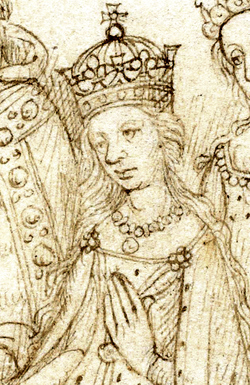
As an infant Henry was looked after by a nurse, Joan Waring. He spent his early childhood with his mother Mary until she died in 1394 aged only twenty-four, having already borne six children. Both his parents were young when he was born: Bolingbroke was nineteen and Mary sixteen or seventeen.
Image source: Mary de Bohun
1398
% complete
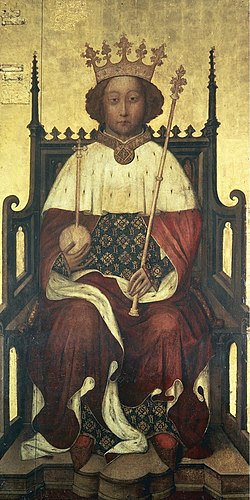
In 1398 a quarrel between Henry's father and the Duke of Norfolk led Richard II to order a trial by combat, only for the king to banish both men before the duel could be fought. With Bolingbroke in exile, Richard took the boy into his own household and treated him generously.
Image source: Richard II of England
Oct 1399
% complete
After John of Gaunt died in early 1399 Richard granted Henry an income from the royal revenues, but Richard was ultimately deposed by the newly styled Henry IV, who recalled his son from Ireland as heir apparent in October 1399. Henry thus became heir apparent and Prince of Wales.
Image source: Henry IV of England
1400 - 1404
% complete
From 1400 to 1404 Henry served as High Sheriff of Cornwall, gaining practical administrative experience during his years as heir apparent to the throne.
1403 - 1406
% complete
The Welsh revolt absorbed much of Henry's energy between 1403 and 1406; as his father's health declined, the prince began to take a wider part in politics.
Image source: Glyndŵr rebellion
Apr 1403
% complete
In April 1403 Henry was additionally made royal lieutenant for the whole of Wales, a military appointment during which he led his own forces against Owain Glyndŵr in the ongoing Welsh revolt.
Image source: Owain Glyndŵr
Jul 21, 1403
% complete
At the Battle of Shrewsbury on 21 July 1403, the sixteen-year-old Henry fought alongside his father against the rebel forces of Henry 'Hotspur' Percy, demonstrating his martial abilities at a young age.
Image source: Battle of Shrewsbury
1410 - Nov 1411
% complete
Through Henry IV's prolonged illness of 1410–11, backed by his uncles Henry and Thomas Beaufort, legitimised sons of John of Gaunt, he held practical control of the government. Father and son diverged on foreign and domestic policy, and in November 1411 the king removed Henry from the council.
1412 - 1420
% complete
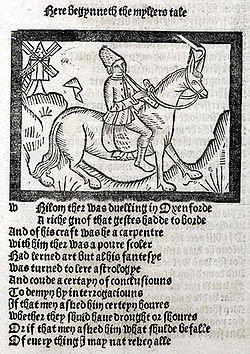
John Lydgate's Troy Book had been commissioned by Henry himself in 1412; Lydgate concluded the work in 1420 by placing the king 'in the highest place of the hous of fame'.
Image source: John Lydgate
Mar 20, 1413
% complete
Henry acceded to the throne after his father Henry IV's death on 20 March 1413; the new king was twenty-six years old and would reign for nine and a half years.
Apr 9, 1413
% complete
Comparatively little is known about Henry's coronation three weeks after his accession, held on Passion Sunday, 9 April 1413, in Westminster Abbey. A Frenchman who met him later thought he looked more like a priest than a soldier.
Image source: Coronation of the British monarch
Dec 1413
% complete
Late in 1413 the deposed Richard II was honourably re-interred at Westminster, and the heirs of the earldoms of Huntingdon, Northumberland and Salisbury were restored to their inheritances, signalling reconciliation.
Jan 1414 - 1417
% complete
The breach with the Lollards became open during the Oldcastle Revolt in January 1414, which was swiftly crushed; its leader John Oldcastle was executed in 1417 after three years in hiding.
Image source: Oldcastle Revolt
1414
% complete
Lawlessness at sea was tackled by the Safe Conducts Act of 1414, intended to protect merchants and uphold the crown's truces, though recurrent unrest in Lancashire and Cheshire continued between 1419 and 1421.
Image source: Safe Conducts Act 1414
1414 - 1415
% complete
Showing his piety through patronage, in 1414–1415 Henry established a Carthusian charterhouse beside the royal manor at Sheen (now Richmond) and Syon Abbey as a home for Bridgettine nuns.
Image source: Syon Abbey
1414 - 1418
% complete
Henry's reign coincided with the climax of the Great Western Schism, which he worked to help end. The conflict was resolved at the Council of Constance (1414–1418) with the election of Pope Martin V, while Henry guarded the crown's rights against concessions to papal authority.
Image source: Council of Constance
Apr 1414
% complete
Henry made restoration of order the principal theme of his second Parliament, which met at Leicester in April 1414. It passed the Statute of Lollards, making heresy a felony and a breach of the king's peace, drawing secular courts into punishing heterodoxy.
Image source: Lollardy
1415
% complete
Remembering the nurse who cared for him as an infant, Henry granted Joan Waring an annuity of £20 a year for life in 1415 after coming to the throne.
1417
% complete
From 1417 Henry promoted the use of English as a language of record in government, becoming the first English king since the Norman Conquest to use English in his personal correspondence.
Image source: Middle English
1417
% complete
John Oldcastle, leader of the crushed Lollard rising of 1414, was executed in 1417 after three years in hiding, marking the definitive end of the Lollard threat under Henry's rule.
1414 - 1415
% complete
Henry demanded less the bare claim to the French throne than enforcement of the Treaty of Brétigny of 1360: return of lands it granted England and unpaid remainder of John II's ransom. Successive embassies to Paris in 1414 and 1415 opened with sweeping territorial claims and returned empty-handed.
Image source: Treaty of Brétigny
Jul 1415
% complete
Preparations for war culminated in the summer of 1415, when a fleet of some 1,500 vessels assembled in the Solent to carry an army of 10,000–12,000 men, over 80% archers, across the English Channel.
Image source: Siege of Harfleur
Aug 14, 1415
% complete
On 11 and 12 August 1415 Henry sailed from Southampton and landed near Harfleur on the Norman coast by 14 August, opening the Lancastrian phase of the Hundred Years' War (1415–1453).
Oct 25, 1415
% complete
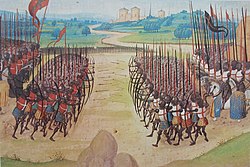
Henry's victory at Agincourt in 1415 ranked alongside Crécy and Poitiers as one of the most significant English victories of the Hundred Years' War, giving England the upper hand in the conflict. It was his greatest military success.
Image source: Battle of Agincourt
Mar 1416
% complete
In March 1416 a raiding force under Thomas Beaufort, Earl of Dorset, was attacked and narrowly escaped defeat at the Battle of Valmont after a counterattack by the garrison of Harfleur.
May 1416 - Aug 1416
% complete
King Sigismund of Hungary visited England hoping to mediate peace with France. Though mediation failed, by the Treaty of Canterbury of August 1416 Sigismund accepted the justice of Henry's claims to the French throne and bound himself in a perpetual alliance with England.
Image source: Treaty of Canterbury (1416)
Aug 1416
% complete
A Franco-Genoese fleet blockaded Harfleur while a French army besieged it by land. Henry's brother John, Duke of Bedford, relieved the town in August, defeating the Genoese and giving England mastery of the Channel for years to come.
Image source: Battle of the Seine
1417
% complete
The 1417 expedition aimed to conquer Normandy, lost to France since King John surrendered the duchy in 1204. Henry framed the campaign as recovery of a historic English possession, appealing to Norman separatism. His army numbered just over 10,000.
Image source: Siege of Caen (1417)
Aug 1417 - Feb 1418
% complete
Henry besieged Caen from August to September 1417, capturing it, then invested Falaise over the following winter, steadily advancing his conquest of Lower Normandy.
Jul 1418 - Jan 19, 1419
% complete
The conquest of Upper Normandy turned on the siege of Rouen, the ducal capital, which Henry began in the summer of 1418. The city finally surrendered on 19 January 1419. An eyewitness account attributed to 'John Page' described Henry above all as a conqueror.
Image source: Siege of Rouen (1418–1419)
Jun 1419
% complete
In June 1419 Henry negotiated with John the Fearless, Duke of Burgundy, and Queen Isabella at Meulan, coming close to terms more generous than Brétigny: Normandy in full sovereignty plus Aquitaine, sealed by marriage to Catherine of Valois, whom he first met there.
Image source: Catherine of Valois
Jul 31, 1419
% complete
Henry pushed up the Seine, and the fall of Pontoise at the end of July 1419 gave him the region of Vexin and the road to the capital; by August his army stood before the walls of Paris.
Image source: Pontoise
Sep 10, 1419
% complete
On 10 September 1419, at a parley on the bridge of Montereau, John the Fearless was assassinated by partisans of the Dauphin, shattering reconciliation between the French factions that had briefly united them against Henry and pushing Burgundy toward alliance with England.
Image source: Assassination of John the Fearless
May 21, 1420
% complete
The treaty was signed on 21 May 1420 and ratified by the Estates General in Paris in July 1420, recognizing Henry as heir and regent of France. It was never accepted in Dauphinist territories south of the Loire.
Image source: Treaty of Troyes
Jun 2, 1420
% complete
The wedding between Henry and Catherine took place at Troyes Cathedral on 2 June 1420, fulfilling the provision of the Treaty of Troyes and sealing the Anglo-French dynastic settlement.
Nov 1420
% complete
Henry besieged and captured Melun by November 1420, returning to England after three and a half years of fighting in France.
Image source: Melun
1421 - May 10, 1422
% complete
Henry redoubled his efforts to take Meaux; its garrison eventually surrendered on 10 May 1422, completing another major siege victory that relied heavily on his artillery.
Image source: Siege of Meaux
Mar 22, 1421
% complete
On 22 March 1421 Henry's brother Thomas, Duke of Clarence, suffered a disastrous defeat at the Battle of Baugé against a Franco-Scottish army, during which the duke himself was killed — a serious setback to the English war effort.
Image source: Battle of Baugé
Dec 1421
% complete
Henry and Catherine had one child: the future Henry VI of England, born in December 1421, who was less than a year old at the time of his father's death in 1422.
Image source: Henry VI of England
Jun 1422
% complete
Henry fell ill in June 1422, shortly after celebrating Whitsun in Paris, where his wife Catherine and infant son had joined him. In late June he appeared well enough to march toward Cosne-sur-Loire but suffered a relapse, possibly from heatstroke or dysentery, and was carried in a litter.
Aug 31, 1422
% complete
Henry died in the early hours of 31 August 1422, aged thirty-five, seven weeks before the ailing Charles VI, after reigning nine and a half years. He was succeeded by his only son, the infant Henry VI.
Oct 1422
% complete
When Charles VI died in October 1422 only weeks after Henry, the nine-month-old Henry VI became king of both England and France at least in name, though the settlement rested precariously on the Burgundian alliance.
Image source: Charles VI of France
Nov 7, 1422
% complete
After his death Henry's body was embalmed and transported to England, where a solemn funeral procession preceded his burial in Westminster Abbey on 7 November 1422. His tomb carries the Latin inscription 'Henry V, hammer of the Gauls, lies here.'
1435
% complete
The Treaty of Troyes settlement rested on the alliance with the Burgundians, and when they deserted the English at the Congress of Arras in 1435, the arrangement disintegrated, dooming the conquests Henry had won.
Image source: Congress of Arras
Or browse the full history timeline directory, with more than 2,000 topics.
This Henry V of England timeline was generated with the help of AI, using information found on the internet.
We work hard to keep these timelines accurate, but mistakes do get through. If you spot one, email us at [email protected] and we'll fix it for future visitors.
Generate yours with AI or build it from scratch, for free.
Export your timeline, add your own events, edit or remove AI-generated events, and much more
No credit card required.
Cancel anytime.
Cancel anytime.
You can create an unlimited number of timelines with up to 10 events on each one, customize how they look, export them to PDF, PNG, PowerPoint, CSV, and Excel, and share them with a link. Paid plans raise the event limit and add features like spreadsheet imports and collaborators.
Yes. You can cancel your subscription from your account page at any time, and you will not be charged again. Your subscription stays active for the rest of the period you already paid for.
Yes. We will email you a reminder before the annual renewal, and we will also email you a receipt.
Yes. You can email us within 15 days of any payment, and we will issue you a full refund.
Check out our pricing docs or send us an email anytime: [email protected].