-
Use Cases
-
Resources
-
Pricing
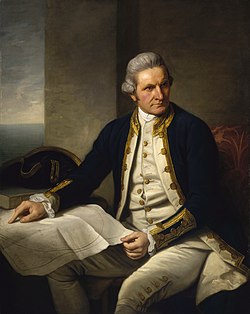
James Cook (1728–1779) was a British explorer, navigator, and cartographer who led three epic voyages of discovery across the Pacific Ocean. He mapped previously uncharted lands including New Zealand, the eastern coast of Australia, and numerous Pacific islands, greatly expanding European knowledge of the world through his skillful navigation and scientific observations. More Less
Nov 7, 1728
% complete
Captain James Cook was born on 7 November 1728 in the village of Marton in the North Riding of Yorkshire, approximately 8 miles (13 km) from the sea.
Image source: James Cook
1736
% complete
In 1736, Cook's family moved to Airey Holme farm at Great Ayton, where his father's employer Thomas Skottowe paid for Cook to attend a school run by a charitable foundation.
1741
% complete
In 1741, after five years of schooling, Cook began working for his father, who had been promoted to farm manager.
1745
% complete
In 1745, at age 16, Cook relocated to the fishing village of Staithes to be apprenticed as a shopboy to grocer and haberdasher William Sanderson. He later joined the British merchant navy as a teenager.
1752
% complete
After obtaining his mariner licence in 1752, Cook was promoted to the rank of mate and began serving on the collier brig Friendship.
Jun 17, 1755
% complete
At the age of 26, Cook declined an offer of promotion to captain of Friendship and instead enlisted in the Royal Navy at Wapping on 17 June 1755.
Oct 1755 - Nov 1755
% complete
In October and November 1755, Cook took part in Eagle's capture of one French warship and the sinking of another during the Seven Years' War.
Image source: HMS Eagle (1745)
Jan 1756
% complete
Following the death of Eagle's boatswain in January 1756, Cook was unofficially promoted to fill that role.
Mar 1756
% complete
Cook's first command came in March 1756 when he was briefly in charge of Cruizer, a small cutter attached to HMS Eagle.
Jun 1757
% complete
In June 1757, Cook passed his master's examinations at Trinity House, Deptford, qualifying him to navigate and handle a ship of the King's fleet.
Image source: Trinity House
1758
% complete
With others in Pembroke's crew, Cook took part in the major amphibious assault that captured the Fortress of Louisbourg in Nova Scotia from the French in 1758.
Image source: Siege of Louisbourg (1758)
1758 - 1759
% complete
Cook's first map to be engraved and printed was of Gaspé Bay, drawn in 1758 and published in 1759.
Image source: Gaspé Bay
1759
% complete
As Major-General James Wolfe's advance on Quebec progressed in 1759, Cook and other ships' masters took soundings, marked shoals, and updated charts, particularly around Quebec.
Image source: Battle of the Plains of Abraham
Dec 21, 1762
% complete
On 21 December 1762, Cook married Elizabeth Batts at St Margaret's Church, Barking, Essex. They had six children: James, Nathaniel, Elizabeth, Joseph, George, and Hugh.
Image source: Elizabeth Cook
1763 - 1767
% complete
Cook surveyed the north-west stretch of Newfoundland in 1763 and 1764, the south coast between the Burin Peninsula and Cape Ray in 1765 and 1766, and the west coast in 1767.
Image source: Newfoundland and Labrador
Aug 1764
% complete
Cook severely injured his right hand in August 1764 when a powder horn he was carrying exploded, leaving a scar that would later help confirm his remains after his death.
Jul 1765
% complete
In July 1765, Cook experienced the first of several ship groundings in his career: Grenville struck an uncharted rock, and cargo had to be unloaded before she could be refloated.
Aug 5, 1766 - 1767
% complete
While in Newfoundland, Cook precisely recorded the apparent (local) time of the start and end of the solar eclipse of 5 August 1766. The results were communicated to the Royal Society in 1767, and the longitude obtained was used in his printed sailing directions for Newfoundland.
May 5, 1768
% complete
On 5 May 1768, based on the recommendation of Hugh Palliser, Cook, aged 39, was selected by the Admiralty to lead a three-year scientific expedition to the south Pacific Ocean. Earlier that year, the shipwright Adam Hayes had chosen the merchant collier Earl of Pembroke, renamed Endeavour, as the expedition vessel.
Image source: First voyage of James Cook
Aug 25, 1768 - Jul 12, 1771
% complete
The expedition departed England on 25 August 1768 and headed south to round Cape Horn into the Pacific. The publicly stated goal was to observe the 1769 transit of Venus from Tahiti; the ship finally returned to England on 12 July 1771, anchoring in the Downs.
Apr 13, 1769
% complete
Endeavour arrived at Tahiti on 13 April 1769, where Cook's crew made the observations of the transit of Venus that were the publicly stated goal of the voyage.
Image source: Transit of Venus
Oct 1769
% complete
In October 1769, Cook sailed to New Zealand and landed at Poverty Bay near the Tūranganui River, beginning European contact with New Zealand.
Image source: Poverty Bay
Jan 1770
% complete
In January 1770, Cook arrived in Queen Charlotte Sound on the north coast of New Zealand's South Island.
Image source: Queen Charlotte Sound / Tōtaranui
Apr 19, 1770
% complete
On 19 April 1770, Point Hicks was sighted, and Cook's crew became the first Europeans to encounter Australia's eastern coastline.
Image source: Point Hicks
May 1770
% complete
The crew stopped at Bustard Bay in May 1770, then proceeded north through the shallow and extremely dangerous Great Barrier Reef.
Image source: Great Barrier Reef
Oct 1770 - Dec 1770
% complete
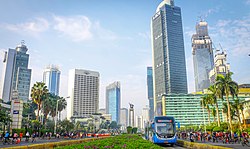
In October 1770, Cook stopped at Batavia (modern Jakarta, Indonesia), where Dutch dockyard facilities were used to inspect and repair damage from running aground on the Great Barrier Reef. He departed Batavia in late December 1770.
Image source: Jakarta
Apr 30, 1771 - Jul 12, 1771
% complete
After departing Batavia, the expedition sailed to the Cape of Good Hope, then to the island of Saint Helena, arriving on 30 April 1771. The ship returned to England on 12 July 1771.
Image source: Saint Helena
1773
% complete
A book about the first voyage, based on the journals of Cook and Banks, was published in 1773.
1772 - 1775
% complete
In 1772, Cook was commissioned to lead a second scientific expedition on behalf of the Royal Society with the objective of determining whether the hypothetical continent Terra Australis existed. He chose Resolution, a Whitby-built North Sea collier launched in 1770, of the same type as his previous ship.
Image source: Second voyage of James Cook
Nov 1772
% complete
In late November 1772, the ships sighted their first icebergs. Cook performed an experiment in which his crew retrieved blocks of ice and melted them on board, producing good quality fresh water and proving drinking water could be obtained from sea ice.
Image source: Sea ice
Nov 1772
% complete
After departing England, Resolution and Adventure travelled south to the Dutch Cape Colony and stopped at Cape Town in November 1772.
Image source: Cape Town
Jan 17, 1773
% complete
On 17 January 1773, the crews became the first recorded Europeans to cross the Antarctic Circle.
Image source: Antarctic Circle
Feb 1773
% complete
In February 1773, in dense Antarctic fog, Resolution and Adventure became separated during the second voyage.
Image source: Disney Adventure
Dec 1773
% complete
In December 1773, while ten members of Adventure's crew were ashore gathering provisions, a violent altercation occurred with a group of Māori, resulting in the deaths of all ten crewmen and two Māori.
Image source: Hochstetler massacre
Jan 1774
% complete
Continuing her search for Terra Australis, Resolution headed south-east and reached her most southern latitude of 71°10′S in January 1774.
Jan 1, 1774 - Mar 31, 1774
% complete
In early 1774, Cook experienced a severe gastrointestinal illness marked by prolonged abdominal pain and constipation.
Jun 1774
% complete
In June 1774, the ship stopped to resupply at the island of Nomuka in Tonga, where most of the crew engaged in intimate relations with women.
Image source: Nomuka
Sep 1774
% complete
Cook was the first European to set foot on New Caledonia in September 1774, and he claimed the land in the name of his king.
Image source: New Caledonia
Jan 1775
% complete
Leaving New Zealand, Resolution proceeded home sailing south of Tierra del Fuego, stopping at South Georgia Island in January 1775, where Cook charted the coast and claimed the island group in the name of his king.
Image source: South Georgia
1777
% complete
Two books about the expedition were published in 1777: one written by Cook himself, and another by the Forsters who had accompanied the voyage.
Dec 1776
% complete
Cook's third expedition began by sailing south from England around Southern Africa into the Indian Ocean, stopping in December 1776 at desolate Kerguelen Island. There the crew discovered a message in a bottle left in 1774 by the French explorer Yves-Joseph de Kerguelen-Trémarec.
Image source: Third voyage of James Cook
Jan 1777
% complete
At the end of January 1777, the expedition stopped for four days at Bruny Island, Tasmania, where they encountered Aboriginal Tasmanians.
Image source: Bruny Island
Feb 1777
% complete
Proceeding to New Zealand, the expedition anchored in February 1777 near the location where ten crew members of Adventure had been killed during the second voyage.
Oct 1777
% complete
In October 1777, on the Tahitian island of Mo'orea, a goat belonging to the expedition was stolen by a local inhabitant.
Image source: Moʼorea
Jan 18, 1778
% complete
Continuing northward, and after a brief stop at Kiritimati, the expedition became the first recorded Europeans to see the Hawaiian Islands on 18 January 1778.
Image source: Hawaiian Islands
Mar 29, 1778 - Apr 26, 1778
% complete
Cook's two ships remained in Nootka Sound from 29 March to 26 April 1778, in a cove at the south end of Bligh Island on the northwest coast of North America.
Image source: Nootka Sound
Aug 1778
% complete
By the second week of August 1778, Cook had sailed through the Bering Strait, crossed the Arctic Circle, and sailed into the Chukchi Sea in search of the Northwest Passage.
Image source: Bering Strait
Sep 1778 - Nov 1778
% complete
By early September 1778 Cook was back in the Bering Sea on his way to return to Hawaii. He arrived in late November 1778, stopping first in Maui. His arrival during this second visit contributed to his status there as an akua.
Image source: Bering Sea
Feb 13, 1779
% complete
On 13 February 1779, a group of Hawaiians stole one of Cook's cutters, escalating tensions during his second visit to Hawaii.
Image source: Death of James Cook
Feb 14, 1779
% complete
On 14 February 1779, during his second visit to Hawaii, Cook was killed when a dispute with Native Hawaiians turned violent. A large scar on the right hand from his 1764 powder horn injury later confirmed that the recovered remains belonged to Cook.
Feb 23, 1779
% complete
Following Cook's death, Clerke assumed leadership of the expedition, and the ships left the bay on 23 February 1779.
Image source: Charles Clerke
Aug 22, 1779
% complete
Clerke died of tuberculosis on 22 August 1779, and John Gore, a veteran of Cook's first voyage, took command of Resolution and the expedition.
Oct 4, 1780
% complete
The surviving ships of Cook's third voyage returned home, reaching England on 4 October 1780.
1780
% complete
One of the earliest monuments to Cook in the United Kingdom was erected in 1780 at The Vache by Hugh Palliser, a friend of Cook.
Image source: Hugh Palliser
1780
% complete
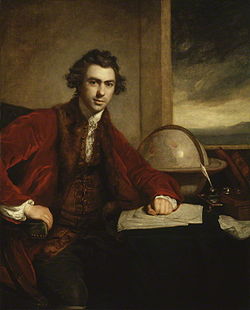
In 1780, Joseph Banks, now president of the Royal Society, publicised Cook's legacy and had the society mint a commemorative medal.
Image source: Joseph Banks
Sep 1785
% complete
Cook's coat of arms was granted in September 1785 and is the only known example of a posthumously granted coat of arms.
1788
% complete
Banks used the fame surrounding Cook's voyages to help promote a new colony in Australia, and in 1788 the First Fleet arrived in what is now Sydney.
Image source: First Fleet
1822
% complete
In 1822, the Philosophical Society of Australia placed a monument at Cook's supposed landing place in Botany Bay.
Image source: Botany Bay
1879
% complete
There were no notable commemorations in England to mark the centenary of Cook's death in 1879.
Or browse the full history timeline directory, with more than 2,000 topics.
This James Cook timeline was generated with the help of AI, using information found on the internet.
We work hard to keep these timelines accurate, but mistakes do get through. If you spot one, email us at [email protected] and we'll fix it for future visitors.
Generate yours with AI or build it from scratch, for free.
Export your timeline, add your own events, edit or remove AI-generated events, and much more
No credit card required.
Cancel anytime.
Cancel anytime.
You can create an unlimited number of timelines with up to 10 events on each one, customize how they look, export them to PDF, PNG, PowerPoint, CSV, and Excel, and share them with a link. Paid plans raise the event limit and add features like spreadsheet imports and collaborators.
Yes. You can cancel your subscription from your account page at any time, and you will not be charged again. Your subscription stays active for the rest of the period you already paid for.
Yes. We will email you a reminder before the annual renewal, and we will also email you a receipt.
Yes. You can email us within 15 days of any payment, and we will issue you a full refund.
Check out our pricing docs or send us an email anytime: [email protected].