
-
Use Cases
-
Resources
-
Pricing
James Clerk Maxwell (1831–1879) was a Scottish physicist and mathematician best known for formulating the classical theory of electromagnetism. His set of equations, known as Maxwell's equations, unified electricity, magnetism, and light as manifestations of the same phenomenon. He also made foundational contributions to statistical mechanics, color photography, and kinetic theory. More Less
Jun 13, 1831
% complete
James Clerk Maxwell was born on 13 June 1831 at 14 India Street, Edinburgh, to John Clerk Maxwell of Middlebie, an advocate, and Frances Cay, daughter of Robert Hodshon Cay and sister of John Cay.
Image source: James Clerk Maxwell
Dec 1839
% complete
Maxwell's mother was taken ill with abdominal cancer and, after an unsuccessful operation, died in December 1839 when he was eight years old.
1841
% complete
In 1841, at age ten, Maxwell was sent to the prestigious Edinburgh Academy.
Image source: Edinburgh Academy
Nov 1841
% complete
The tutor who had been engaged for Maxwell was dismissed in November 1841.
Feb 12, 1842
% complete
James' father took him to Robert Davidson's demonstration of electric propulsion and magnetic force on 12 February 1842, an experience with profound implications for the boy.
1846
% complete
The work 'On the description of oval curves and those having a plurality of foci' was presented to the Royal Society of Edinburgh by James Forbes because Maxwell was deemed too young to present it himself. Though Descartes had examined such multifocal ellipses earlier, Maxwell had simplified their construction.
1847
% complete
Maxwell left the Academy in 1847 at age 16 and began attending classes at the University of Edinburgh.
Image source: University of Edinburgh
Oct 1850
% complete
In October 1850, already an accomplished mathematician, Maxwell left Scotland for the University of Cambridge.
Image source: University of Cambridge
Nov 1851
% complete
In November 1851, Maxwell studied under William Hopkins, whose success in nurturing mathematical genius had earned him the nickname of 'senior wrangler-maker'.
Image source: William Hopkins
Apr 1853
% complete
Having attended both Church of Scotland (his father's denomination) and Episcopalian (his mother's denomination) services as a child, Maxwell underwent an evangelical conversion in April 1853.
1854
% complete
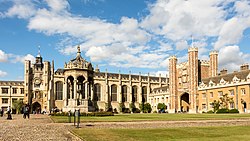
In 1854, Maxwell graduated from Trinity with a degree in mathematics, earning distinction in mathematics and the Smith's Prize.
Image source: Trinity College, Cambridge
1855
% complete
Maxwell had studied and commented on electricity and magnetism as early as 1855 when his paper 'On Faraday's lines of force' was read to the Cambridge Philosophical Society. This work was later developed into 'On Physical Lines of Force' published in March 1861.
Mar 1855
% complete
His paper 'Experiments on Colour' laid out the principles of colour combination and was presented to the Royal Society of Edinburgh in March 1855. In the course of this work, Maxwell proposed that three black-and-white photographs taken through red, green, and blue filters could be superimposed to reproduce all colours of a scene.
1857 - 1859
% complete
St John's College, Cambridge, had chosen Saturn's rings as the topic for the 1857 Adams Prize. Maxwell was awarded the £130 Adams Prize in 1859 for his essay 'On the stability of the motion of Saturn's rings', being the only entrant to make enough headway to submit an entry. He correctly proposed that the rings were composed of numerous small particles.
1859 - 1866
% complete
Between 1859 and 1866, Maxwell developed the theory of the distributions of velocities in particles of a gas, work later generalised by Ludwig Boltzmann. His seminal 1867 paper On the Dynamical Theory of Gases introduced the Maxwell model for viscoelastic materials and originated the Maxwell-Cattaneo equation for heat transport.
Image source: Maxwell–Boltzmann distribution
1860
% complete
Maxwell was awarded the Royal Society's Rumford Medal in 1860 for his work on colour and was later elected a Fellow of the Society in 1861. From 1855 to 1872, he published a series of investigations concerning colour perception, colour-blindness, and colour theory, receiving the medal for 'On the Theory of Colour Vision'.
Image source: Rumford Medal
1861
% complete
During an 1861 Royal Institution lecture on colour theory, Maxwell presented the world's first demonstration of colour photography by three-colour analysis and synthesis, showing that any colour can be produced with red, green, and blue primaries — the basis for colour television. Researchers in 1961 concluded the partial success of the red-filtered exposure was due to ultraviolet light reflected by some red dyes.
Image source: Color photography
Mar 1861 - 1862
% complete
Maxwell examined the nature of both electric and magnetic fields in his two-part paper 'On Physical Lines of Force', published in 1861. Two more parts were added and published in early 1862. Around 1862 he calculated that the speed of propagation of an electromagnetic field is approximately the speed of light, obtaining a velocity of 310,740,000 metres per second.
1865
% complete
His 1865 publication demonstrated that electric and magnetic fields travel through space as waves moving at the speed of light, proposing that light is an electromagnetic disturbance propagated through the field according to electromagnetic laws. He wrote that light and magnetism are affections of the same substance.
Image source: A Dynamical Theory of the Electromagnetic Field
1867
% complete
In 1867, Maxwell proposed the thought experiment known as Maxwell's demon, which challenges how information affects entropy in thermodynamics.
Image source: Maxwell's demon
1868
% complete
In his paper 'On governors' (1868), Maxwell mathematically described the behaviour of governors—devices that control the speed of steam engines—establishing the theoretical basis of control engineering and serving as an important foundation for control theory and cybernetics, and the earliest mathematical analysis of control systems.
Image source: Governors Island
1870
% complete
In his 1870 paper 'On reciprocal figures, frames and diagrams of forces', Maxwell discussed the rigidity of various designs of lattice.
1871
% complete
Maxwell wrote the textbook Theory of Heat (1871) and was also the first to make explicit use of dimensional analysis in 1871, helping to establish the CGS system of measurement. That year he also established Maxwell's thermodynamic relations, statements of equality among second derivatives of thermodynamic potentials.
Image source: History of thermodynamics
1873
% complete
Maxwell's famous twenty equations, in their modern form of partial differential equations, first appeared in fully developed form in his textbook A Treatise on Electricity and Magnetism in 1873.
Image source: A Treatise on Electricity and Magnetism
1874
% complete
In 1874, Maxwell constructed a plaster thermodynamic visualisation as a way of exploring phase transitions, based on Josiah Willard Gibbs's graphical thermodynamics papers.
1876
% complete
Maxwell wrote the treatise Matter and Motion (1876) and was elected as a member to the American Philosophical Society in 1876.
Image source: Matter
Oct 10, 1855
% complete
Maxwell was made a fellow of Trinity on 10 October 1855, sooner than was the norm, and was asked to prepare lectures on hydrostatics and optics and to set examination papers.
Nov 1856
% complete
He accepted the Chair of Natural Philosophy at Marischal College in Aberdeen, leaving Cambridge in November 1856.
Image source: Marischal College
1857
% complete
In 1857 Maxwell befriended the Reverend Daniel Dewar, who was then the Principal of Marischal.
Feb 1858
% complete
Maxwell and Katherine Dewar were engaged in February 1858 and married in Aberdeen on 2 June 1858.
Image source: Katherine Clerk Maxwell
1860 - 1865
% complete
From 1860 to 1865, Maxwell served as Professor of Natural Philosophy at King's College London, where he developed his theory of electromagnetic fields.
Image source: King's College London
1860
% complete
After recovering from a near-fatal bout of smallpox in 1860, Maxwell moved to London with his wife to take up his post at King's College London.
1860
% complete
In 1860 Marischal College merged with the neighbouring King's College to form the University of Aberdeen, ending Maxwell's post there.
Image source: University of Aberdeen
1865
% complete
In 1865 Maxwell resigned the chair at King's College, London, and returned to Glenlair with Katherine.
Image source: James Clerk Maxwell
1871
% complete
In 1871, Maxwell returned to Cambridge as the first Cavendish Professor of Physics, overseeing the construction of the Cavendish Laboratory.
Image source: Cavendish Laboratory
Apr 1879
% complete
In April 1879 Maxwell began to have difficulty in swallowing, the first symptom of his fatal illness.
Nov 5, 1879
% complete
Maxwell died in Cambridge of abdominal cancer on 5 November 1879 at the age of 48. Many physicists regard him as the 19th-century scientist having the greatest influence on 20th-century physics.
1881
% complete
In 1881 Heaviside replaced the electromagnetic potential field by force fields as the centerpiece of electromagnetic theory. Maxwell was proved correct, and his quantitative connection between light and electromagnetism is considered one of the great accomplishments of 19th-century mathematical physics.
Image source: Oliver Heaviside
1882
% complete
The extended biography The Life of James Clerk Maxwell, by his former schoolfellow and lifelong friend Professor Lewis Campbell, was published in 1882. Campbell also published a collection of Maxwell's poems that same year.
Image source: Lewis Campbell (classicist)
1884
% complete
Overburdened with work, Stokes passed Maxwell's papers to William Garnett, who had effective custody of the papers until about 1884.
1890
% complete
Maxwell's collected works were issued in two volumes by the Cambridge University Press in 1890.
Image source: Cambridge University Press
Or browse the full history timeline directory, with more than 2,000 topics.
This James Clerk Maxwell timeline was generated with the help of AI, using information found on the internet.
We work hard to keep these timelines accurate, but mistakes do get through. If you spot one, email us at [email protected] and we'll fix it for future visitors.
Generate yours with AI or build it from scratch, for free.
Export your timeline, add your own events, edit or remove AI-generated events, and much more
No credit card required.
Cancel anytime.
Cancel anytime.
You can create an unlimited number of timelines with up to 10 events on each one, customize how they look, export them to PDF, PNG, PowerPoint, CSV, and Excel, and share them with a link. Paid plans raise the event limit and add features like spreadsheet imports and collaborators.
Yes. You can cancel your subscription from your account page at any time, and you will not be charged again. Your subscription stays active for the rest of the period you already paid for.
Yes. We will email you a reminder before the annual renewal, and we will also email you a receipt.
Yes. You can email us within 15 days of any payment, and we will issue you a full refund.
Check out our pricing docs or send us an email anytime: [email protected].