
-
Resources
-
Pricing
Freedom Summer was a 1964 civil rights campaign in Mississippi that brought volunteers and activists together to challenge racial discrimination, expand Black voter registration, and establish alternative educational and political institutions. More Less
Build a timeline like this one in minutes, for free. Start Yours →
1890 - 1910
Southern states effectively disenfranchised most African Americans and many poor white people by adopting constitutions, amendments, and laws that imposed poll taxes, subjective literacy tests, difficult residency requirements, and extensive documentation rules.
Image source: Disfranchisement after the Reconstruction era
1890 - 1910
Poll taxes became one of the financial barriers used by Southern states to prevent African Americans and many poor white people from registering and voting.
Image source: Poll taxes in the United States
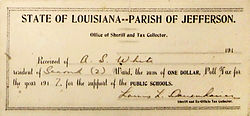
1890 - 1910
Subjective literacy tests administered by white registrars made voter registration difficult and discriminatory, helping suppress Black political participation in Mississippi and across the South.
Image source: Literacy test
1962
In 1962, only 6.7 percent of eligible Black voters in Mississippi were registered, illustrating the scale of the barriers that Freedom Summer organizers sought to overcome.
Image source: Freedom Summer
1963 - 1964
Organizers focused on strengthening networks of local leadership, a central goal alongside voter registration and the integration of public accommodations.
Image source: Student Nonviolent Coordinating Committee
1963 - 1964
Students and other activists began integrating public accommodations while building broader civil rights organizing networks in Mississippi.
Image source: Civil rights movement
1963
Registration efforts in Greenwood became part of the organizing experience that later informed planning for the Mississippi Summer Project.
Image source: Greenwood, Mississippi
1963
Volunteers set up unofficial polling places in Black churches and business establishments across Mississippi as part of the Freedom Vote effort.
1963
The Student Nonviolent Coordinating Committee organized a mock Freedom Vote to demonstrate that Black Mississippians wanted to vote despite terror, intimidation, and official barriers.
Image source: Freedom Vote
Dec 1963
SNCC's committee agreed to recruit only one hundred white students for the project, reflecting debate about the role and scale of outside volunteers.
Dec 1963 - 1964
Jewish civil rights leaders, including Allard Lowenstein, recruited a much larger number of white volunteers in order to bring greater public attention to Mississippi's civil rights struggle.
Image source: Allard K. Lowenstein
1964 - 1965
After the influx of summer workers in 1964, movement leaders decided that projects should continue the following summer under the direction of local leadership.
Feb 1964
Building on the Freedom Vote and earlier registration work, Bob Moses overcame doubts among SNCC and COFO workers, and formal planning for Freedom Summer began.
Jun 1964
Freedom Summer, also called Mississippi Freedom Summer or the Mississippi Summer Project, launched a campaign to register as many African American voters as possible in Mississippi.
1965
The Council of Federated Organizations collapsed in 1965, leaving local organizers to set movement priorities.
1900 - 1964
Lynchings were widespread around the turn of the century and continued for years, creating a climate of terror that reinforced racial segregation and political disenfranchisement.
Image source: Lynching in the United States
1964
In the fall of 1964, informants provided the FBI with information about the murders of Chaney, Goodman, and Schwerner.
Image source: Murders of Chaney, Goodman, and Schwerner
Apr 1964
Charles Eddie Moore was among approximately 600 students expelled from Alcorn A&M for participating in civil rights protests.
May 2, 1964
After returning home, Charles Eddie Moore was abducted and killed by Ku Klux Klan members in Franklin County, Mississippi, along with his friend Henry Hezekiah Dee.
Jun 1964 - Aug 1964
Federal law enforcement participated in weeks of searching for Chaney, Goodman, and Schwerner after their disappearance.
Jun 21, 1964
James Chaney, a Black CORE activist from Mississippi, and summer volunteers Andrew Goodman and Michael Schwerner, both Jewish New Yorkers, were arrested by Neshoba County deputy sheriff and KKK member Cecil Price.
Aug 4, 1964
On August 4, 1964, the bodies of James Chaney, Andrew Goodman, and Michael Schwerner were found buried in an earthen dam.
Nov 1964
Leading up to the November 1964 federal election, nuisance arrests, beatings, and church burnings continued in Mississippi.
Oct 1967
In October 1967, the men accused in the murders, including Klan Imperial Wizard Samuel Bowers, went on trial in the federal courthouse in Meridian.
Image source: Murders of Chaney, Goodman, and Schwerner
1964
After the MFDP was denied voting status at the convention, Bob Moses withdrew from both the MFDP and the Council of Federated Organizations.
Image source: Bob Moses (activist)
Jul 2, 1964
Before the Democratic National Convention, Democratic President Lyndon B. Johnson gained passage of the Civil Rights Act of 1964, a major federal civil rights measure.
Image source: Civil Rights Act of 1964
Aug 1964
The Mississippi Freedom Democratic Party was denied voting status at the 1964 Democratic National Convention, a decision that deeply disillusioned Bob Moses.
Image source: Mississippi Freedom Democratic Party
Oct 1964
Mario Savio returned to the University of California, Berkeley, where he became a leader of the Free Speech Movement, which arose in response to restrictions on student civil rights activism.
Image source: Mario Savio
1965
Congress passed the federal Voting Rights Act in 1965, providing federal oversight and enforcement to facilitate registration and voting in areas with historically low turnout.
2003
Since redistricting in 2003, Mississippi has had four congressional districts.
Image source: Mississippi's congressional districts
2005
A renewed investigation into the 1964 murders of Chaney, Goodman, and Schwerner led to a state trial in 2005.
Jun 21, 2005
The verdict against Edgar Ray Killen was announced on June 21, 2005, exactly forty-one years after the crime.
Image source: Edgar Ray Killen
Jan 12, 2007
The Supreme Court of Mississippi upheld Killen's sentence of three consecutive twenty-year prison terms on January 12, 2007.
2008
In 2008, Bob Moses played a crucial role in organizing Barack Obama's field staff for the presidential campaign.
2009
In a 2009 article, Stanford historian James T. Campbell highlighted Freedom Summer as an example in which structured efforts to reconcile conflicting white and Black Mississippian historical views might have lessened the event's lasting effects.
Image source: James T. Campbell
2009
Campbell argued that the violent outcomes stemmed from opposing interpretations of history and suggested that truth and reconciliation efforts could have addressed the conflict, without directly calling for a truth and reconciliation commission.
Build a timeline like this one in minutes, for free. Start Yours →
Or browse the full history timeline directory, with more than 2,500 topics.
This Freedom Summer timeline was generated with the help of AI, using information found on the internet.
We work hard to keep these timelines accurate, but mistakes do get through. If you spot one, email us at [email protected] and we'll fix it for future visitors.
Generate yours with AI or build it from scratch, for free.
Export your timeline, add your own events, edit or remove AI-generated events, and much more
No credit card required.
15-day money-back guarantee.
You can create an unlimited number of timelines with up to 10 events on each one, customize how they look, export them to PDF, PNG, PowerPoint, CSV, and Excel, and share them with a link. Timelines made with Timeline Maker AI keep every event the generator created, and you can add up to 5 events of your own. Paid plans remove the event limit, add spreadsheet imports and hide Preceden's branding, and the higher-priced plan also adds collaborators, a custom logo and a custom domain.
Yes. You can cancel your subscription from your account page at any time, and you will not be charged again. Your subscription stays active for the rest of the period you already paid for.
Yes. We email you a reminder 15 days before your annual renewal, and we email you a receipt after every payment.
Yes. You can email us within 15 days of any payment, and we will issue you a full refund.
Check out our pricing docs or send us an email anytime: [email protected].