-
Resources
-
Pricing
The history of archery spans thousands of years, evolving from a vital hunting and military technology into a global competitive sport and cultural tradition. More Less
Build a timeline like this one in minutes, for free. Start Yours →
6000 BC - 500 AD
Archery seems to have arrived in the Americas through Alaska as early as 6000 BC with the Arctic small tool tradition. It spread south into temperate regions by about 2500–2000 BC and was widely known among Indigenous peoples of North America by about 500 AD.
3700 BC - 3400 BC
At the Neolithic settlement of Carn Brea, excavations found burned timber structures and a concentration of arrowheads near a probable entrance. The evidence suggests an organized assault involving a large group of archers.
2700 BC - 2601 BC
One of the oldest representations of the Nine bows, a symbolic designation for Egypt’s traditional enemies, appears on the seated statue of Pharaoh Djoser of the Third Dynasty.
Image source: Djoser
2100 BC - 1700 BC
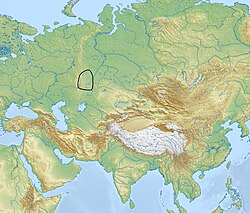
Arrowheads were found among the earliest chariot burials at Krivoye Lake, associated with the Sintashta culture. The finds date to approximately 2100–1700 BC.
Image source: Sintashta culture
1146 BC - 256 BC
In Zhou dynasty China, archery was one of the Six Noble Arts. Skill with the bow was regarded as a virtue expected of Chinese emperors and members of the educated elite.
301 - 400
By the fourth century, archers using powerful composite bows had become a regular component of the imperial Roman armies.
400 - 500
The Byzantine Empire was already using mounted archers extensively by the fifth century, integrating mobility and missile fire into its military system.
Image source: Byzantine army
582 - 602
Emperor Mavrikios, or Maurice, laid down principles for the use of mounted archers in the Strategikon, a major Byzantine military work traditionally associated with his reign.
900 - 999
The Sasanian general Bahram Chobin was credited in Ibn al-Nadim’s Kitab al-Fihrist with writing a manual of archery, preserving evidence of a Persian technical tradition.
900 - 999
The crossbow was introduced in Europe around the tenth century. Its mechanical draw system enabled powerful shooting with less specialized physical training than a hand bow.
Image source: Crossbow
1097
Turkish tribes, including the Seljuk Turks, used mounted archers against the First Crusade. Their tactics were prominent at the Battle of Dorylaeum in 1097.
1139
Crossbow use attracted controversy and stigma, and the Second Lateran Council of 1139 outlawed its use against Christians, reflecting concerns about its destructive power.
1200 - 1299
The longbow first appeared in Europe in the thirteenth century, although similar weapons had been described in antiquity.
Image source: Longbow
1200 - 1299
Thirteenth-century bows were said to be capable of accurately shooting distances of 700–800 meters, although such claims reflect historical descriptions rather than modern standardized testing.
1283
A complete 75-centimeter arrow, together with fragments and arrowheads, was discovered in a cave in Lebanon’s Qadisha Valley and dated to 1283.
1300 - 1541
From the fourteenth century onward, England reinforced longbow use as a civic duty through statute law and local enforcement, helping maintain a trained pool of archers.
1300 - 1399
Hussain bin Abd al-Rahman wrote the fourteenth-century Arab archery treatise Kitāb fī maʿrifat ʿilm ramy al-sihām.
1300 - 1399
A treatise on Arab archery by Muḥammad ibn Abī Bakr, known as Ibn Qayyim al-Jawziyya, dates from the fourteenth century and records regional knowledge of archery.
Image source: Ibn Qayyim al-Jawziyya
1368
A treatise on Saracen archery was written in 1368, contributing to the surviving medieval literature on bow construction, shooting, and training.
Image source: Archery
1541
The Unlawful Games Act 1541 prohibited several newly devised games that might distract people from archery practice. Comparable legislation in England and Scotland sought to preserve trained longbowmen.
1500 - 1599
Malian formations in the sixteenth century generally used a ratio of three archers to one spearman, demonstrating the continuing importance of archery in West African warfare.
1500 - 1899
Early firearms could be slower to reload than bows, but they offered greater penetration, greater effective range in many tactical situations, and superior performance when soldiers fired from behind obstructions. Repeating firearms eventually made bows functionally obsolete in warfare.
Image source: History of the firearm
1503
The Battle of Cerignola was won by Spain mainly through the use of matchlock firearms and is often identified as the first major European battle won through firearms.
1600 - 1868
The Tokugawa shogunate severely limited the import and manufacture of guns and encouraged traditional martial skills among the samurai, preserving a role for archery in Japan.
Image source: Tokugawa shogunate
Oct 1642
At Bridgnorth in October 1642, an impromptu militia armed with bows was reportedly effective against unarmoured musketeers, marking the last recorded use of bows in battle in England.
Image source: English Civil War
Sep 1, 1644
The last reputed use of the bow in battle in Britain occurred at Tippermuir, where James Graham, 1st Marquess of Montrose, led Royalist Highlanders to victory over Scottish Covenanters.
1658
François Bernier reported that well-trained mounted archers at the Battle of Samugarh in 1658 could shoot six times before a musketeer fired twice, illustrating the bow’s continuing rate-of-fire advantage.
Image source: Battle of Samugarh
1688
Bows were last used in large numbers in the final clan battle between the MacDonalds and the Mackintoshes in 1688.
1689
In the Scottish Highlands, archers continued to be used in battle until 1689 at Killiecrankie, where a documented fatal shot was made by an archer serving in the Hanoverian government army.
Image source: Battle of Killiecrankie
1800
After about 1800, most Comanches began discarding muskets and pistols and relying more on older weapons. Repeating firearms later proved superior, and the Comanches adopted them when possible.
Image source: Comanche
1826
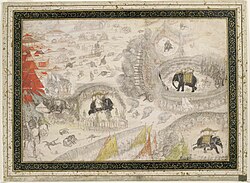
Mounted archers remained part of the Ottoman order of battle until the post-1826 reforms to the Ottoman Army. The practice had already declined after Russia absorbed the Crimean Khanate.
Image source: Auspicious Incident
1877
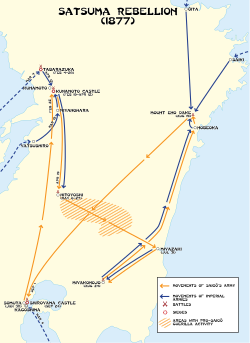
Toward the end of the Satsuma Rebellion, some rebels fell back on bows and arrows, showing the persistence of traditional weapons even in an era dominated by firearms.
Image source: Satsuma Rebellion
1878
The last Comanche hunt took place in 1878. It failed because of the lack of buffalo rather than because of inadequate weapons.
1894 - 1904
Archery remained an important part of military examinations in Korea until 1894 and in China until 1904, even as firearms transformed warfare.
2000 - 2099
The Sentinelese continue to use bows as part of a lifestyle that has been scarcely touched by outside contact.
Image source: Sentinelese
2007 - 2008
Bows and arrows saw considerable use during the 2007–2008 Kenyan crisis. Traditional archery has also been reported in some African conflicts in the twenty-first century.
Image source: 2007–2008 Kenyan crisis
1676
The Company of Scottish Archers was formed in 1676 and became one of the oldest sporting bodies in the world.
1688
Early recreational archery societies included the Finsbury Archers and the Kilwinning Papingo, both established in 1688.
1780 - 1840
The British initiated a major revival of archery as an upper-class pursuit from about 1780 to 1840. The pastime remained small and scattered before its fashionable aristocratic resurgence.
1781
Antiquarian and collector Sir Ashton Lever formed the Toxophilite Society in London in 1781 with the patronage of George, Prince of Wales.
Image source: Royal Toxophilite Society
1789
From 1789, general meetings brought local archery lodges together to standardize rules and ceremonies.
1819
Sir Walter Scott’s 1819 novel Ivanhoe helped popularize archery by depicting the heroic archer Locksley winning an archery tournament.
Image source: Ivanhoe
1844
The first Grand National Archery Society meeting was held in York in 1844. Over the following decade, older festive practices were reduced and rules were standardized as the York Round.
1850
The standardized York Round consisted of shoots at 60, 80, and 100 yards and became a defining format for organized British target archery.
1856
A leading champion who won the Grand National eleven consecutive times published a highly influential guide to archery in 1856, helping codify sporting technique.
1875 - 1889
Toward the end of the nineteenth century, archery participation declined as croquet, tennis, and other sports became more popular among the middle class. By 1889, only about 50 British archery clubs remained.
1900 - 1925
Primitive archery experienced a revival in the United States during the early twentieth century, encouraging renewed interest in traditional equipment and techniques.
1900
Archery was included as a sport at the 1900 Paris Olympics despite declining participation in Britain.
1911
Ishi, the last known member of the Yahi, emerged from hiding in California in 1911. His knowledge helped draw attention to Indigenous technologies, including traditional archery.
Image source: Ishi
1961
Founded in 1961 and named for Saxton Pope and Arthur Young, the Pope and Young Club became one of North America’s leading bowhunting and conservation organizations.
Image source: Saxton Pope
2000 - 2099
At the beginning of the twenty-first century, interest in traditional Chinese archery revived among craftspeople constructing bows and arrows and practitioners studying historical Chinese techniques.
Build a timeline like this one in minutes, for free. Start Yours →
Or browse the full history timeline directory, with more than 2,500 topics.
This History of Archery timeline was generated with the help of AI, using information found on the internet.
We work hard to keep these timelines accurate, but mistakes do get through. If you spot one, email us at [email protected] and we'll fix it for future visitors.
Generate yours with AI or build it from scratch, for free.
Export your timeline, add your own events, edit or remove AI-generated events, and much more
No credit card required.
15-day money-back guarantee.
You can create an unlimited number of timelines with up to 10 events on each one, customize how they look, export them to PDF, PNG, PowerPoint, CSV, and Excel, and share them with a link. Timelines made with Timeline Maker AI keep every event the generator created, and you can add up to 5 events of your own. Paid plans remove the event limit, add spreadsheet imports and hide Preceden's branding, and the higher-priced plan also adds collaborators, a custom logo and a custom domain.
Yes. You can cancel your subscription from your account page at any time, and you will not be charged again. Your subscription stays active for the rest of the period you already paid for.
Yes. We email you a reminder 15 days before your annual renewal, and we email you a receipt after every payment.
Yes. You can email us within 15 days of any payment, and we will issue you a full refund.
Check out our pricing docs or send us an email anytime: [email protected].