-
Resources
-
Pricing
The history of skiing spans thousands of years, evolving from practical snow transportation into a popular recreational activity and competitive international sport. More Less
Build a timeline like this one in minutes, for free. Start Yours →
4500 BCE - 2500 BCE
A primitive Scandinavian ski found in a peat bog at Hoting in Jämtland County, Sweden, was dated to approximately 4500–2500 BCE.
Image source: History of skiing
4000 BCE - 3000 BCE
Primitive Scandinavian carvings dating to about 4000–3000 BCE provide some of the earliest evidence of skiing in Scandinavia.
4000 BCE
Rock drawings in Norway dated to about 4000 BCE depict a man on skis holding a stick.
3300 BCE - 3200 BCE
The Kalvträskskidan ski from Sweden, dated to 3300 BCE, and the Vefsn Nordland ski from Norway, dated to 3200 BCE, are notable ancient ski finds.
3245 BCE
A ski found at Salla, Finland, in 1938 was dated to 3245 BCE.
2000 BCE
Stone Age cliff paintings from the Altai Mountains in northwest China, at least 4,000 years old, depict hunters using primitive skis and are often cited as evidence that skiing may have independently developed in Central Asia.
1000 BCE - 500 BCE
A Norwegian rock carving from about 1000–500 BCE depicts a skier apparently preparing to shoot a bow and arrow, with the skis angled for support.
1010
A ski excavated in Greenland was dated to the year 1010, showing the long-distance spread of ski technology across northern regions.
1926
Rock carvings discovered near the White Sea in Russia in 1926 were dated to approximately 2000–2500 BCE and added to the archaeological record of early skiing.
2014
A ski complete with leather bindings emerged from a glacier in the Reinheimen mountains of Norway in 2014. The ski was estimated to be about 1,300 years old.
2021
In 2021, a well-preserved 187-centimeter-long ski, up to 17 centimeters wide, was found near a shrinking glacier at about 1,000 meters in Reinheimen. Estimated to date from around 700, it was found roughly five meters from the ski discovered in 2014; together they are believed to form the world’s oldest complete set.
550
The Byzantine scholar Procopius wrote in the sixth century CE about a skiing people he called the “scrithiphinnoi,” interpreted as “sliding Sami.”
1200
The saga of King Sverre of Norway reports that around 1200 he sent troops on skis to patrol the Aker area near Oslo.
1200 - 1299
The Danish historian Saxo Grammaticus provided the first recorded reference to ski warfare, describing the use of ski-equipped troops in the 13th century.
Image source: Ski warfare
1206
According to a saga, soldiers transported the infant Haakon IV of Norway on skis through the hills between the Gudbrandsdalen and Østerdalen valleys. The episode later inspired the Birkebeinerrennet ski marathon.
1555
Olaus Magnus’s 1555 work A Description of the Northern Peoples described skiers and their climbing skins in Scricfinnia, in what is now Norway.
Image source: Olaus Magnus
1593
A 1593 inventory of curiosities at Leiden University described a pair of stilts or skates used by Norwegians, Laplanders, and Finnlanders to travel rapidly down snowy mountains.
1675
The garrison at Trondheim was using skis by at least 1675, demonstrating the institutional role of skiing in Scandinavian military life.
1741
The first known depiction of a skier using two ski poles dates to 1741.
1747
The Danish-Norwegian army included specialized skiing battalions from 1747 and used skis in military exercises.
1767
Details retained from 1767 describe downhill travel over rough terrain, target practice while skiing downhill, and a three-kilometer cross-country race carrying a full military backpack.
1836
Norwegian immigrants began using skis, called “Norwegian snowshoes,” in the American Midwest from around 1836.
1856
Norwegian immigrant Snowshoe Thompson transported mail by skiing across the Sierra Nevada between California and Nevada beginning in 1856.
1872
Norwegian immigrants in Berlin, New Hampshire, founded the club now known as the Nansen Ski Club in 1872, making it the oldest surviving ski club in North America.
1878
The Norwegian pavilion at the Exposition Universelle in Paris presented a display of skis in 1878.
1888
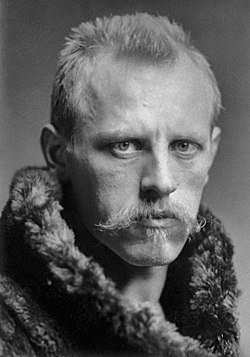
Norwegian explorer Fridtjof Nansen and his team crossed the Greenland ice cap on skis in 1888.
Image source: Fridtjof Nansen
1890
Norwegian workers on the Buenos Aires–Valparaiso railway line introduced skiing to South America around 1890.
1893
Henrik Angell introduced skiing in Montenegro in 1893.
Image source: Skiing
1893
William Adolf Baillie Grohman began skiing in the Tyrol with his family in 1893 using four pairs of skis sent from Norway.
1902
The Norwegian consul in Kobe imported ski equipment in 1902 and introduced skiing to Japanese people, motivated partly by the deaths of Japanese soldiers in snowstorms.
1908
The Kiandra Snow Shoe Club held an international contest of “ski running” in Australia in 1908.
1910
Roald Amundsen used skis during his South Pole Expedition in 1910.
Image source: Amundsen's South Pole expedition
1929
Norwegian instructors arrived in Sapporo in 1929 and trained Japanese athletes in ski jumping.
1942
In 1942, German armed forces published a manual for ski troops, while the Russian war documentary Moscow Strikes Back showed a winter attack by ski infantry supported by tanks.
1800 - 1899
Nineteenth-century races in Telemark followed difficult routes from steep mountains along timber slides and ended with sharp turns, helping establish the Telemark turn.
1809
Olaf Rye made the first recorded ski jump in 1809.
Mar 19, 1843
The first public skiing competition, described as a betting race, was held in Tromsø, Norway, on March 19, 1843.
1849
The first public ski tour was organized in Trondheim, Norway, in 1849.
1861 - 1862
The Trysil Skytte- og Skiløberforning was founded on May 20, 1861, while Inderøens Skiløberforening in Trøndelag was founded in 1861 or possibly 1862. The Onion Valley Snow Shoe Club formed in California in January 1861.
Jan 22, 1862
The first public ski jumping competition was held in Trysil Municipality, Norway, on January 22, 1862.
1863
A woman became the first recorded female ski jumper at the Trysil competition in 1863.
1864
From January 1864, Trondheim Weapons Training Club organized regular training and competitions in cross-country skiing and ski jumping.
1879
The word “slalom” was first recorded in 1879, reflecting the development of organized ski racing terminology.
1884
Trondheim held its first pure cross-country competition in 1884 after ski jumping was removed from the annual event.
1904
Italy held its first ski race at Bardonecchia in 1904.
1905
The United States national ski association was founded in 1905.
1905 - 1906
The Norwegian term slalåm was used at a race in Sonnenberg in 1905 or 1906, and a slalom race was held in Oslo in 1906.
1907
The first International Ski Competition was held between Montgenevre in France and Claviere in Italy in 1907.
1922
Arnold Lunn created modern competitive slalom skiing in 1922.
1922
The Vasaloppet cross-country ski race began in 1922.
1922
The first team ski race took place during a Varsity Trip between Oxford and Cambridge Universities in 1922.
1924
The International Ski Federation was formed in 1924, the same year as the first Winter Olympics.
1931
The FIS held an international slalom contest in 1931.
1936
The downhill race was included in the Winter Olympics in 1936, strengthening the separation between alpine and Nordic disciplines.
1976
Cross-country skiing was included in the Winter Paralympics in 1976.
1992
Mogul skiing and freestyle skiing were added to the 1992 Winter Olympics.
2002
The 2002 Winter Olympics in Salt Lake City introduced sprint and mass-start cross-country events.
2009 - 2014
A campaign for the inclusion of women’s ski jumping began in 2009 and led to the event’s inclusion in the 2014 Winter Olympics.
Image source: Ski jumping at the 2014 Winter Olympics
1850
Around 1850, artisans in Telemark, Norway, invented the cambered ski, improving its performance and shaping later ski design.
1868
Mountain resorts became commercially viable in 1868 as city dwellers gained winter access by train.
Image source: Ski resort
1908
The introduction of ski lifts in 1908 helped transform alpine skiing into a distinct sport by enabling repeated ascents and descents.
1910
The first rope tow was introduced in 1910, providing a simple mechanical means of transporting skiers uphill.
1913
Peter Østbye invented and patented klister in 1913. The sticky grip material is effective on coarse, transformed snow produced by freeze-thaw cycles or wind packing.
1928
Steel edges were invented in Austria in 1928, improving ski control and durability on hard snow.
1934
Limited production of solid aluminum skis began in France in 1934.
1936
The introduction of the chairlift in 1936 made ski resorts more accessible and helped divide the sport into cross-country and downhill traditions.
1937
After breaking his leg skiing in 1937, Hjalmar Hvam invented the Saf-Ski toe binding while recovering from surgery.
1939
The Sno-Surf was patented in the United States in 1939, representing an early precursor to the snowboard.
1950
Howard Head introduced the Head Standard in 1950. Its sandwich construction placed aluminum alloy around a plywood core, with steel edges and phenol formaldehyde resin surfaces.
1952
The first major commercial snow-making machinery was installed at Grossinger’s Catskill Resort Hotel in New York State in 1952.
1959
Ed Scott introduced a large-diameter, tapered-shaft, lightweight aluminum ski pole in 1959.
Image source: Ski pole
1960 - 1969
The modern ski goggle emerged in the 1960s with the creation of double-lens goggles, which improved vision and reduced fogging.
1962
Kneissl’s White Star fiberglass ski was used by Karl Schranz to win two gold medals at the FIS Alpine World Ski Championships in 1962.
1962
Torsion box construction became common with the introduction of Dynamic VR7 and VR17 racing skis in 1962, despite a related patent being granted in 1975.
1965
The snurfer, the first commercially successful precursor to the snowboard, was introduced in 1965.
1970
Waxless Nordic skis with fish-scale bases were produced in 1970, giving cross-country skiers grip without conventional kick wax.
1974 - 1986
Surfactants were introduced by Hertel Wax in 1974, and fluorocarbons followed in 1986 to improve ski-wax water and dirt repellency and increase glide.
1993
Elan introduced the Elan SCX in 1993. Other companies quickly followed, and the shaped design overturned assumptions about ski construction and performance.
1995
Line introduced the modern twin-tip ski in 1995, allowing skiers to travel and land more effectively in both directions.
Build a timeline like this one in minutes, for free. Start Yours →
Or browse the full history timeline directory, with more than 2,500 topics.
This History of Skiing timeline was generated with the help of AI, using information found on the internet.
We work hard to keep these timelines accurate, but mistakes do get through. If you spot one, email us at [email protected] and we'll fix it for future visitors.
Generate yours with AI or build it from scratch, for free.
Export your timeline, add your own events, edit or remove AI-generated events, and much more
No credit card required.
15-day money-back guarantee.
You can create an unlimited number of timelines with up to 10 events on each one, customize how they look, export them to PDF, PNG, PowerPoint, CSV, and Excel, and share them with a link. Timelines made with Timeline Maker AI keep every event the generator created, and you can add up to 5 events of your own. Paid plans remove the event limit, add spreadsheet imports and hide Preceden's branding, and the higher-priced plan also adds collaborators, a custom logo and a custom domain.
Yes. You can cancel your subscription from your account page at any time, and you will not be charged again. Your subscription stays active for the rest of the period you already paid for.
Yes. We email you a reminder 15 days before your annual renewal, and we email you a receipt after every payment.
Yes. You can email us within 15 days of any payment, and we will issue you a full refund.
Check out our pricing docs or send us an email anytime: [email protected].