-
Use Cases
-
Resources
-
Pricing
Cricket is a bat-and-ball sport that originated in England in the late 16th century and evolved from a rural pastime into an international game governed by the Marylebone Cricket Club (MCC) and the International Cricket Council (ICC). The timeline of cricket covers the first recorded matches, the codification of its laws, the birth of Test cricket in 1877, the introduction of One Day Internationals in 1971, and the revolutionary rise of Twenty20 cricket and franchise leagues in the 21st century. More Less
1550
% complete
John Derrick's account proves beyond reasonable doubt that the game was being played in Surrey circa 1550, making it the earliest universally accepted reference to the game.
1598
% complete
In 1598, a court case in England concerning an ownership dispute over a plot of common land in Guildford, Surrey, mentions the game of creckett. This is the first definite written reference to the sport, which had a known history beginning in late 16th century England.
Image source: History of cricket
1611
% complete
The first reference to cricket being played as an adult sport was in 1611, when two men in Sussex were prosecuted for playing cricket on Sunday instead of going to church. It is generally believed that cricket survived as a children's game for many generations before adults increasingly took it up around the beginning of the 17th century.
1640
% complete
In an account of a case brought before the King's Bench in 1640, it was recorded that a cricket match 'between the Weald & Upland' took place 'about 30 yeares' previously, providing further evidence of the game's growth in south-east England.
1648
% complete
After the Civil War ended in 1648, the new Puritan government clamped down on 'unlawful assemblies', particularly targeting raucous sports such as football, which affected sporting life in England during the Interregnum.
1660
% complete
Cricket thrived after the Restoration in 1660 and is believed to have first attracted gamblers making large bets at this time. It is also believed that the first 'county teams' were formed in the aftermath of the Restoration, with members of the nobility employing 'local experts' from village cricket as the earliest professionals.
1664
% complete
In 1664, the 'Cavalier' Parliament passed the Gaming Act 1664 which limited stakes to £100, although that was still a fortune at the time, equivalent to about £18,000 in present-day terms.
Image source: Gaming Act 1845
1696
% complete
With freedom of the press having been granted in 1696, cricket for the first time could be reported in the newspapers. During the first half of the 18th century, press reports tended to focus on the betting rather than the play.
1697
% complete
By the end of the 17th century, cricket had become a significant gambling sport. In 1697, a newspaper report described a 'great match' played in Sussex which was 11-a-side and played for high stakes of 50 guineas a side. The match was probably Sussex versus another county.
1709
% complete
The first known game in which the teams use county names is in 1709, but these types of fixtures were being arranged long before then. The first famous clubs were London and Dartford in the early 18th century.
1725
% complete
The most notable of the early patrons were a group of aristocrats and businessmen who were active from about 1725, which is also the time that press coverage became more regular, perhaps as a result of the patrons' influence.
1728
% complete
In 1728, the Duke of Richmond and Alan Brodick drew up Articles of Agreement to determine the code of practice in a particular game. This became a common feature, especially around payment of stake money and distributing winnings given the importance of gambling.
1751
% complete
The game continued to spread throughout England, and, in 1751, Yorkshire is first mentioned as a venue, showing the sport's expansion beyond its southern strongholds.
1756
% complete
The Hambledon Club started as a parish organisation that first achieved prominence in 1756. The club itself was founded in the 1760s and was well patronised to the extent that it was the focal point of the game for about thirty years until the formation of MCC and the opening of Lord's Cricket Ground in 1787.
Image source: Hambledon Club
1760
% complete
The original form of bowling (i.e., rolling the ball along the ground as in bowls) was superseded sometime after 1760 when bowlers began to pitch the ball and study variations in line, length and pace — a major technical revolution in the game.
1772
% complete
Scorecards began to be kept on a regular basis from 1772; since then, an increasingly clear picture has emerged of the sport's development. Three surviving scorecards exist of 1772 matches organised by the Hambledon Club which commence a continuous statistical record, and first-class cricket is considered to have begun in this year.
1772 - 1781
% complete
Broadhalfpenny Down continued in regular use by Hambledon/Hampshire teams until 1781, serving as the home ground of the club that dominated English cricket in the latter half of the 18th century.
Image source: Broadhalfpenny Down
1744 - 1774
% complete
In 1744, the Laws of Cricket were codified for the first time and then amended in 1774, when innovations such as lbw, middle stump and maximum bat width were added, formalising how the game was played.
Image source: Laws of Cricket
1787
% complete
The codes of cricket were drawn up by the so-called 'Star and Garter Club', whose members ultimately founded the Marylebone Cricket Club at Lord's in 1787. The opening of Lord's Cricket Ground marked the beginning of a new era with MCC at the centre of the game.
Image source: Marylebone Cricket Club
1839
% complete
All the modern county clubs, starting with Sussex in 1839, were founded during the 19th century, establishing the structure of domestic cricket in England.
Image source: Sussex County Cricket Club
1846
% complete
No sooner had the first county clubs established themselves than they faced what amounted to 'player action' as William Clarke created the travelling All-England Eleven in 1846, taking professional cricketers around the country.
Image source: All England Eleven
1850
% complete
The growth of cricket in the mid and late 19th century was assisted by the development of the railway network, which allowed teams and spectators to travel much more easily across the country.
1864
% complete
In 1864, another bowling revolution resulted in the legalisation of overarm bowling, and in the same year Wisden Cricketers' Almanack was first published, becoming the bible of the sport.
Image source: Wisden Cricketers' Almanack
1890 - 1914
% complete
The period from 1890 to the outbreak of the First World War has become one of nostalgia, ostensibly because the teams played cricket according to 'the spirit of the game', but more realistically because it was a peacetime period shattered by the First World War.
1890
% complete
A significant development in domestic cricket occurred in 1890 when the official County Championship was constituted in England, formalising the competition between county clubs.
Image source: County Championship
1892
% complete
Australia established the Sheffield Shield in 1892–93, creating the premier domestic first-class competition in Australian cricket.
Image source: Sheffield Shield
May 1894
% complete
Soon afterwards, in May 1894, the sport's first-class standard was officially defined, establishing criteria for what constitutes first-class cricket.
Image source: First-class cricket
1900
% complete
During most of the 19th century standard overs were made up of four deliveries. In 1889 five-ball overs were introduced in first-class cricket, with a move to generally use six-ball overs in 1900.
Image source: Over (cricket)
1918 - 1979
% complete
In the 20th century, eight-ball overs were used at times in a number of countries, primarily Australia, where eight-balls were the standard over length between 1918/19 and 1978/79, as well as South Africa and New Zealand. Since the 1979/80 seasons, six balls per over have been used worldwide.
1947
% complete
The ICC re-defined first-class status in 1947 as a global concept, extending the definition of first-class cricket beyond England's traditional boundaries.
1788
% complete
Cricket arrived in Australia almost as soon as colonisation began in 1788. It had earlier been introduced to North America via the English colonies in the 17th century, to the West Indies by colonists, and to the Indian subcontinent by East India Company mariners in the first half of the 18th century.
1800
% complete
New Zealand and South Africa followed Australia in adopting cricket in the early years of the 19th century, continuing the global spread of the game throughout the British Empire.
1844
% complete
The first international cricket game took place between what were essentially club teams from the United States and Canada in 1844, predating even the first Test matches by more than three decades.
Image source: Canadian cricket team in the United States in 1844
1859
% complete
In 1859, a team of leading English professionals set off to North America on the first-ever overseas tour, and in 1862 the first English team toured Australia, expanding international competition.
Image source: English cricket team in North America in 1859
1860 - 1960
% complete
Canada, unlike Australia and the West Indies, witnessed a continual decline in the popularity of the game during 1860 to 1960, despite having hosted the first international cricket match in 1844.
May 1868 - Oct 1868
% complete
Between May and October 1868, a team of Aboriginal Australians toured England in what was the first Australian cricket team to travel overseas, a landmark moment in cricket history.
Image source: Australian Aboriginal cricket team in England in 1868
1877
% complete
In 1877, an England touring team in Australia played two matches against full Australian XIs that are now regarded as the inaugural Test matches, marking the formal beginning of Test cricket.
Image source: Test cricket
1882
% complete
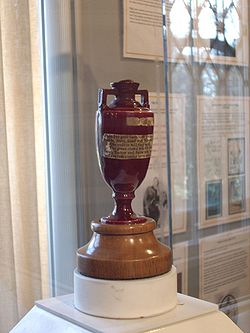
No Tests were played in 1878 but more soon followed and, at The Oval in 1882, the Australian victory in a tense finish gave rise to The Ashes, one of cricket's most celebrated rivalries.
Image source: The Ashes
1889
% complete
South Africa became the third Test nation in 1889, joining England and Australia in international Test cricket.
Image source: South Africa national cricket team
1900
% complete
Cricket came to Latin America in the 19th century as part of a broader British presence in the region. By the 20th century, the growing influence of America meant baseball became the more popular bat-and-ball sport in the Caribbean, while World War I dried up support for the game in Mexico as British expatriates returned home.
1909
% complete
The Imperial Cricket Conference (ICC) was founded in 1909 with England, Australia and South Africa as the founding members, creating the governing body for international cricket.
Image source: International Cricket Council
1926
% complete
In 1926, both New Zealand and the West Indies were admitted as members of the Imperial Cricket Conference, allowing them to play Test cricket against the other teams.
1930
% complete
New Zealand and India both became Test playing nations before World War II, expanding the ranks of Test cricket beyond its original three members.
1952
% complete
Pakistan joined the ranks of Test playing nations soon afterwards in 1952, following India and New Zealand's admission before World War II.
Image source: Pakistan national cricket team
1965
% complete
At the initial suggestion of Pakistan, the ICC was expanded to include non-Test playing countries from 1965, with Associate members being admitted, broadening the global governance of the sport.
1982
% complete
The first limited-overs World Cups were played during the 1970s and Sri Lanka became the first Associate member to be raised to Test playing status in 1982.
Image source: Sri Lanka national cricket team
1984
% complete
The international game continued to grow with the introduction of Affiliate Member status in 1984, a level of membership designed for teams with less history of playing cricket.
1989
% complete
In 1989 the ICC renamed itself the International Cricket Council, reflecting its evolution into the truly global governing body of the sport.
1992 - 2000
% complete
Zimbabwe became Full Members in 1992 and Bangladesh in 2000, expanding Test cricket to new nations in the 1990s and beyond.
2004
% complete
In 2004, the ICC Intercontinental Cup brought first-class cricket to 12 nations, mostly for the first time, helping develop the game in emerging cricketing countries.
Image source: ICC Intercontinental Cup
2017 - 2018
% complete
In 2017, the number of countries with full ICC membership was increased to twelve by the addition of Afghanistan and Ireland, and both were admitted as Test teams in 2018, bringing the number of full members of the ICC to 12.
1961
% complete
The situation began to crystallise after 1961 when South Africa left the Commonwealth of Nations and so, under the rules of the day, its cricket board had to leave the International Cricket Conference (ICC).
1963
% complete
Starting in 1963 as a knockout competition only, limited-overs cricket grew in popularity and, in 1969, a national league was created which consequently caused a reduction in the number of matches in the County Championship.
1968
% complete
Cricket's opposition to apartheid intensified in 1968 with the cancellation of England's tour to South Africa by the South African authorities, due to the inclusion in the England team of Basil D'Oliveira, a Cape Coloured player.
Image source: D'Oliveira affair
1970 - 1991
% complete
In 1970, the ICC members voted to suspend South Africa indefinitely from international cricket competition over apartheid. South Africa, now a 'Rainbow Nation' under Nelson Mandela, was welcomed back into international sport in 1991.
1971
% complete
The first limited-overs international match took place at Melbourne Cricket Ground in 1971 as a time-filler after a Test match had been abandoned because of heavy rain on the opening days, giving birth to One Day International cricket.
Image source: One Day International
1975
% complete
The International Cricket Council reacted to the rise of limited-overs cricket by organising the first Cricket World Cup in England in 1975, with all the Test-playing nations taking part.
Image source: 1975 Cricket World Cup
1977 - 1979
% complete
The money problems of top cricketers were the root cause of a cricketing crisis that arose in 1977 when Australian media magnate Kerry Packer fell out with the Australian Cricket Board over TV rights. The schism lasted only until 1979 and the 'rebel' players were allowed back into established international cricket.
1992
% complete
In 1992, the use of a third umpire to adjudicate run-out appeals with television replays was introduced in the Test series between South Africa and India, bringing technology into officiating.
Image source: Third umpire
Jun 2001 - Oct 2002
% complete
In June 2001, the ICC introduced a 'Test Championship Table' and, in October 2002, a 'One-day International Championship Table', adding formal rankings to international cricket.
2003
% complete
Cricket's newest innovation is Twenty20 (T20), essentially an evening entertainment started in 2003, which revolutionised the sport with its fast-paced, short format.
Image source: Twenty20
2007
% complete
The inaugural ICC Twenty20 World Cup tournament was held in 2007, establishing T20 as a major international format of the game.
Image source: 2007 World Twenty20
2007 - 2008
% complete
The formation of Twenty20 leagues in India – the unofficial Indian Cricket League, which started in 2007, and the official Indian Premier League, starting in 2008 – raised much speculation in the cricketing press about their effect on the future of cricket.
Image source: Indian Premier League
2011
% complete
From 2011, the third umpire was called upon to moderate review of umpires' decisions, including lbw, with the aid of virtual-reality tracking technologies such as Hawk-Eye and Hot Spot, though such measures still could not free some disputed decisions from heated controversy.
Image source: Decision Review System
Or browse the full history timeline directory, with more than 2,000 topics.
This History of Cricket timeline was generated with the help of AI, using information found on the internet.
We work hard to keep these timelines accurate, but mistakes do get through. If you spot one, email us at [email protected] and we'll fix it for future visitors.
Generate yours with AI or build it from scratch, for free.
Export your timeline, add your own events, edit or remove AI-generated events, and much more
No credit card required.
Cancel anytime.
Cancel anytime.
You can create an unlimited number of timelines with up to 10 events on each one, customize how they look, export them to PDF, PNG, PowerPoint, CSV, and Excel, and share them with a link. Paid plans raise the event limit and add features like spreadsheet imports and collaborators.
Yes. You can cancel your subscription from your account page at any time, and you will not be charged again. Your subscription stays active for the rest of the period you already paid for.
Yes. We will email you a reminder before the annual renewal, and we will also email you a receipt.
Yes. You can email us within 15 days of any payment, and we will issue you a full refund.
Check out our pricing docs or send us an email anytime: [email protected].